
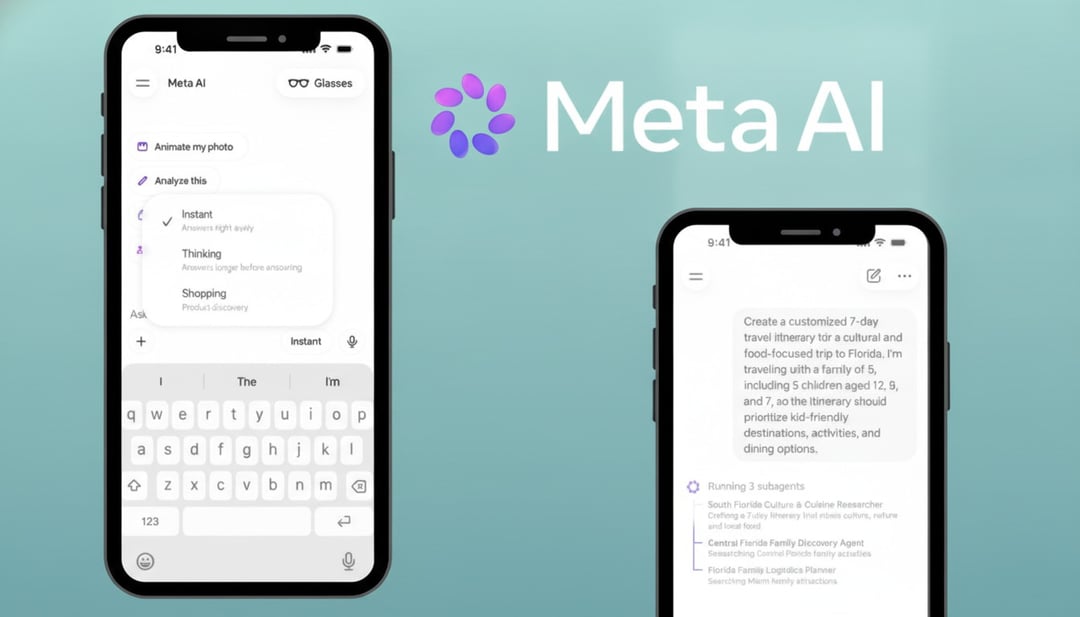
AI Mode Turns Facebook's Public Content Into a Searchable Knowledge Base
Meta Platforms has rolled out a fresh lineup of AI-powered tools for Facebook, and the headline addition is AI Mode — a feature that lets people search the platform in plain, conversational language and receive synthesized answers instead of a raw list of links. Rather than typing rigid keywords, users can pose questions the way they'd ask a friend, and the system responds with answers assembled from content that has been shared publicly across the platform.
This marks Meta's most pointed attempt yet to rethink how search works inside Facebook. The feature draws on publicly shared posts, Groups, and Reels, effectively converting Facebook's enormous library of user-generated content into a knowledge base that can be queried in real time. Instead of scrolling and guessing where relevant discussion might live, people can ask a direct question and let Meta AI surface the most pertinent material.
How Muse Spark Powers the Experience
The intelligence behind AI Mode comes from Muse Spark, the same model that drives Meta's AI assistant. The capability isn't entirely new ground — it expands on functionality Meta first showed off in April, when Muse Spark debuted with the ability to pull rich, relevant context out of communities and public posts and fold it directly into AI-driven conversations. At launch, Meta framed the appeal in simple terms: users could ask what people were talking about and get a fuller picture stitched together from posts and community discussion. AI Mode is the search-focused expression of that idea, putting Muse Spark's contextual reach at the center of how people find information on Facebook.
Wall Street Sees a Multibillion-Dollar Revenue Opportunity
The search overhaul has caught the attention of analysts watching Meta's heavy investment in artificial intelligence. Morgan Stanley analyst Brian Nowak laid out the financial case in a June research note, arguing that if AI Mode captures a meaningful slice of the searches people run every day, it could bring in more than $10 billion in annual revenue. That kind of return would go a long way toward justifying the scale of Meta's AI outlays. Nowak kept Meta on his list as a top pick and held to a $775 price target, signaling confidence that the company's search ambitions can translate into durable revenue.
Creative Editing Tools and World Cup 2026 Tie-Ins
Search isn't the only area getting an AI upgrade. Meta also introduced AI photo presets and a set of creative editing tools for Facebook, continuing a steady buildout of content-creation features. Recent additions in this vein include collage tools that scan a user's camera roll and propose edits, along with restyling options and themed content designed to make posting more visual and less effortful.
The timing aligns with World Cup 2026, and Meta has leaned into the moment with tournament-themed features. Its "wear it" AI Edit tool lets fans virtually try on jerseys from national teams and share the resulting selfies, turning fandom into shareable content. Facebook users can also flip the app into a dedicated World Cup experience by double-tapping the Facebook logo to switch on "football mode," giving the platform a tournament-specific look and feel during the event.
Embedding AI Across Meta's Family of Apps
AI Mode and the new creative tools fit into a wider strategy to weave artificial intelligence through Meta's entire family of apps. Since Muse Spark arrived in April, the company has steadily layered on new capabilities, including a shopping mode, voice-based conversations, and multimodal perception features that let its AI work across more than just text.
That expansion reaches into Meta's creator ecosystem as well. The company has introduced a creator assistant on Facebook and built additional AI features into its Edits video app. The commercial logic is becoming clearer with each release: Meta expects total revenues between $53.5 billion and $56.5 billion for the first quarter of 2026, growth it attributes in large part to AI-enhanced advertising and engagement tools. Search, creation, and discovery are all being reshaped by the same underlying push, and AI Mode is among the most visible signs of where Facebook is headed.