
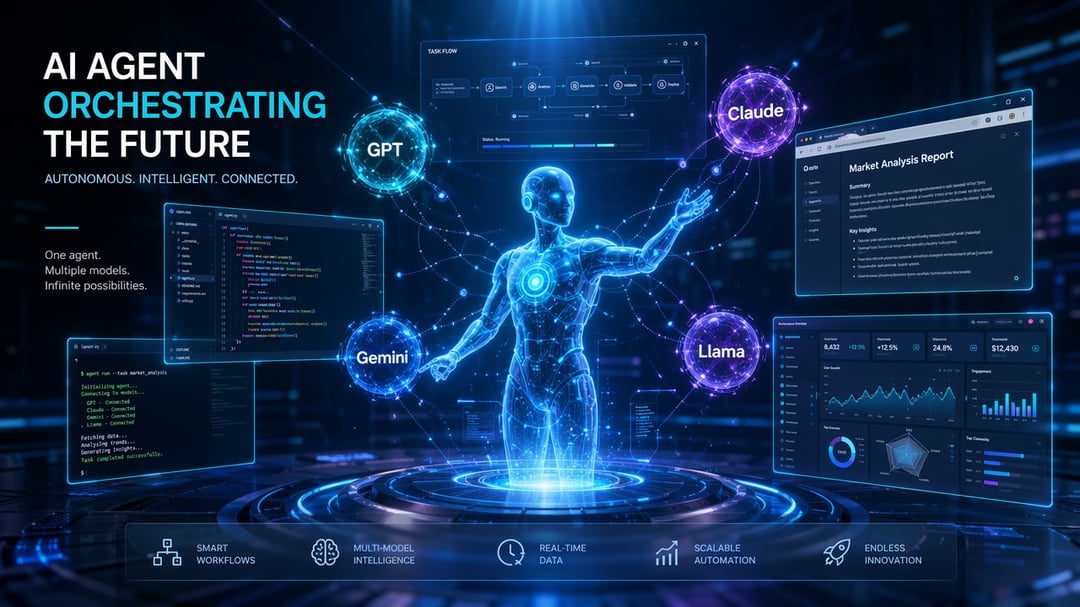
You can feel the shift the first time an AI model does more than answer a question.
It doesn’t just explain how to fix a bug. It reads the repo, calls a tool, edits a file, runs a test, notices the failure, tries again, and leaves you with something closer to working software than a nice paragraph.
That is the real difference between a chatbot and an agentic AI system. The best LLM models for agentic reasoning and tool use are not simply fluent. They can plan, act, check results, recover from mistakes, and keep moving through a task without losing the plot.
For anyone comparing today’s leading models, the question is no longer “Which LLM sounds smartest?” A better question is: which model can reliably use tools to complete real work?
What Agentic Reasoning Means in an LLM Tool Use Comparison
Agentic reasoning describes a model’s ability to break a goal into steps, choose the right action, use external tools, interpret the result, and adjust its plan.
Think about a travel-planning agent. A basic chatbot can suggest hotels. An agentic model can check flights, compare prices, inspect calendar constraints, call a booking API, flag visa rules, and summarize tradeoffs. It behaves less like a search box and more like a careful assistant with access to instruments.
Tool use is the practical side of that intelligence. The model may call functions, query databases, browse the web, run code, use a calculator, operate a browser, or interact with enterprise systems. Strong agentic reasoning without reliable tool use is like a brilliant mechanic without a wrench. Interesting, but limited.
The hardest part is not the first tool call. Many modern models can do that well. The challenge comes in long workflows where the model must remember instructions, handle failed calls, avoid hallucinated tool outputs, and know when to stop.
How to Compare the Top LLM Models for Agentic Reasoning and Tool Use
A useful LLM tool use comparison should look beyond brand names. Model selection depends on the job.
The strongest evaluation criteria include:
- Planning quality: Can the model divide messy goals into sensible steps?
- Function calling accuracy: Can it choose the right tool and pass valid arguments?
- Schema discipline: Can it return clean JSON or structured output every time?
- Recovery behavior: Can it correct course after an API error or bad result?
- Context handling: Can it work across long documents, codebases, or chat histories?
- Coding ability: Can it edit, test, and debug rather than merely suggest?
- Cost and latency: Can the agent run often enough to be useful?
- Enterprise fit: Can the model support governance, privacy, and observability?
Benchmarks help, although they never tell the whole story. The Berkeley Function Calling Leaderboard evaluates tool-calling accuracy across realistic functions. SWE-bench tests whether models can resolve real GitHub issues. AgentBench looks at broader agent behavior. OSWorld focuses on computer-use tasks across operating-system environments.
Still, your own workflow matters more than any leaderboard. A customer-support agent, a coding agent, and a research agent fail in different ways.
OpenAI GPT Models: Strong General Agents With Mature Tooling
OpenAI’s GPT family remains one of the safest starting points for production agent systems. Its biggest advantage is not only reasoning quality. It is the maturity of the surrounding platform.
GPT models generally perform well with structured outputs, function calling, code assistance, retrieval workflows, and multi-step instructions. That makes them useful for internal copilots, customer-service agents, analytics assistants, and developer tools.
The ecosystem matters here. Teams can build faster when the API design, documentation, SDKs, and community patterns are already well established. For many companies, that reduces implementation risk more than a small benchmark lead ever could.
The tradeoff is cost and dependency. High-volume agent workflows can become expensive quickly. Vendor lock-in also deserves attention. If your agent sits at the center of support, finance, or engineering operations, portability becomes a strategic concern rather than a technical footnote.
Anthropic Claude Models: Careful Reasoning for Complex Workflows
Claude models are widely respected for long-context reasoning, careful instruction following, and strong synthesis. They often feel especially useful when the task involves dense documents, nuanced constraints, or multi-step analysis.
That makes Claude a strong option for legal research support, technical writing workflows, code review, policy analysis, and enterprise knowledge agents. In these settings, the model must not only retrieve information. It must preserve subtle distinctions.
Claude also tends to shine when users need a model to reason through ambiguity before acting. That matters for agentic workflows because premature action can create expensive mistakes. A model that pauses to interpret constraints correctly can outperform a faster model that charges into the wrong tool call.
The tradeoffs are familiar. Advanced reasoning can raise cost and latency. Teams should also test tool-call performance inside their own stack instead of assuming that strong writing or reasoning automatically means flawless automation.
Google Gemini Models: Multimodal Strength and Large-Context Agent Design
Gemini is particularly compelling when agentic reasoning must span text, images, code, documents, audio, video, and search-grounded information. That matters because real work rarely arrives as clean text in a prompt box.
A Gemini-based agent might inspect a PDF, interpret a chart, compare source material, draft a response, and connect the result to a Google Workspace flow. For organizations already invested in Google’s ecosystem, this can create a smoother path from model capability to practical automation.
Gemini’s large-context strengths also make it useful for research-heavy tasks. Long context does not magically solve reasoning, but it gives the model more room to inspect source material before making decisions.
The main caution is consistency. Multimodal agents need rigorous testing because each modality adds another failure surface. A model may summarize text well yet miss a visual detail in a chart. In production, those small misses matter.
Open-Weight Models: Llama, Qwen, DeepSeek, and Mistral
Open-weight models deserve serious attention in any comparison of the top LLM models for agentic reasoning and tool use. They are not always the strongest out of the box, but they offer control that closed models cannot.
Meta’s Llama ecosystem gives teams broad deployment flexibility and strong community support. Qwen models have become attractive for coding, multilingual use, and tool-oriented applications. DeepSeek models are known for strong reasoning relative to cost. Mistral models often appeal to teams that want efficient deployment and enterprise-friendly architecture.
Open-weight models make sense when privacy, customization, latency control, or inference cost matters more than frontier performance. A healthcare company may prefer self-hosted inference for sensitive documents. A developer-tools startup may fine-tune a model around its own APIs. A high-volume automation product may need predictable unit economics.
But open models come with hidden labor. You must manage hosting, evaluation, monitoring, security, routing, fine-tuning, and upgrades. The sticker price can look low while the engineering bill quietly grows teeth.
Best LLM Models by Agentic Use Case
For coding agents, GPT and Claude remain strong default choices because they combine reasoning, code understanding, and tool integration. Gemini is also competitive when workflows involve large repositories or multimodal context. DeepSeek and Qwen can be excellent cost-conscious options for teams with engineering depth.
For business process automation, prioritize structured outputs, function calling, permissions, and auditability. The best model is the one that updates the CRM correctly every time rather than the one that writes the most elegant explanation.
For research agents, choose models that handle long context, source grounding, contradiction detection, and citation discipline. Claude and Gemini often fit this profile well while GPT remains a strong general-purpose choice.
For private or self-hosted agents, start with Llama, Qwen, DeepSeek, or Mistral. The right pick depends on your infrastructure, data sensitivity, and willingness to tune.
Final Verdict
There is no universal winner in the top LLM models for agentic reasoning and tool use comparison.
Closed frontier models usually lead in raw reliability, reasoning depth, and platform maturity. Open-weight models often win when privacy, customization, and cost control matter most. Gemini stands out for multimodal and Google-native workflows. GPT and Claude remain strong choices for general production agents.
Here is the practical next step: build a 25-task evaluation set from your real work. Include messy inputs, failed API calls, edge cases, and tasks that require multiple tools. Run each candidate model through the same workflow. The winner is not the model with the loudest reputation. It is the one that finishes the job.