
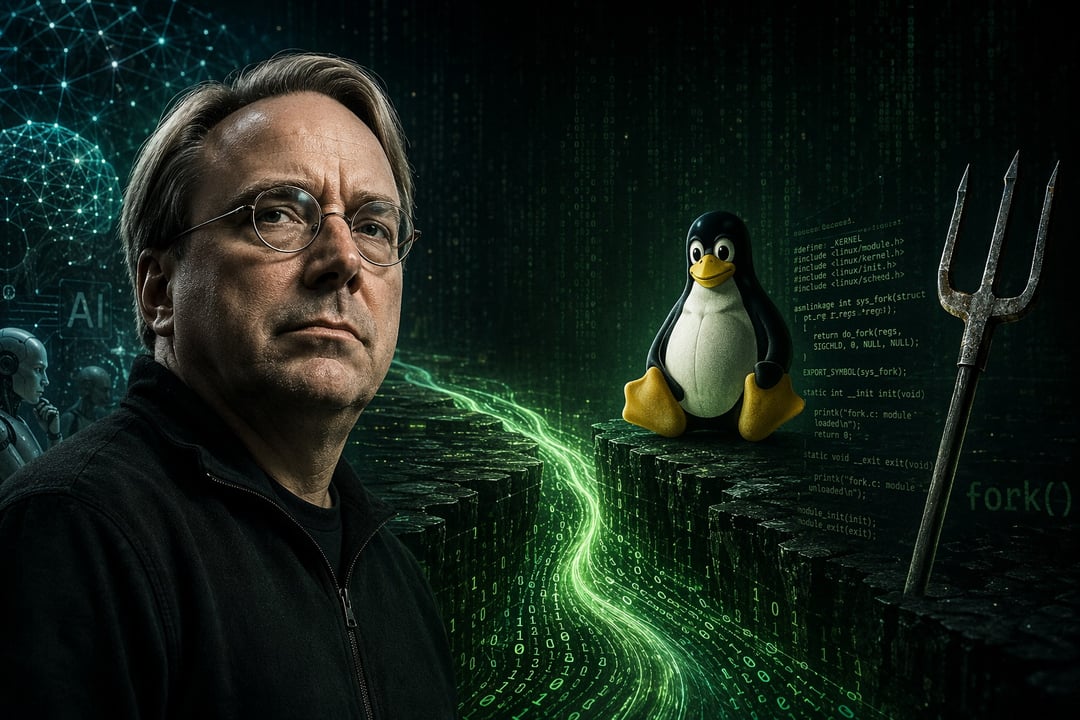
Torvalds Draws a Hard Line on AI Inside the Kernel Community
Linus Torvalds has made his position on artificial intelligence unmistakably clear to the Linux community: the kernel he oversees is not, and will not become, an anti-AI project. The remark surfaced during a discussion about anti-LLM sentiment on lore.kernel.org, the official public archive that hosts Linux kernel development mailing lists. Torvalds acknowledged that a segment of contributors genuinely dislikes AI tooling, but he framed this as one of the rare issues where he's prepared to exercise his authority as the kernel's top-level maintainer without compromise.
His message to anyone unhappy with that stance was blunt: dissatisfied contributors are free to exercise their open-source rights by forking the project, or simply "walk away." It's a characteristically direct response from a maintainer known for speaking plainly, and it signals that AI tooling isn't going anywhere in kernel development, regardless of internal objections.
AI as a Tool, Not a Debate
Torvalds went further, describing AI as nothing more than a tool — comparable to any other utility developers rely on — and one he considers genuinely useful. He noted that plenty of legitimate questions remain about AI, particularly around its long-term economic impact, but insisted that whether the technology is useful in the first place is no longer an open question in his mind.
From Cautious Skeptic to Reluctant Convert
The 2024 "90% Marketing" Assessment
Torvalds' current position marks a notable evolution. Back in 2024, he was openly skeptical, estimating that AI technology amounted to roughly 90% marketing spin and only 10% substantive reality. At that point, he predicted it would take around five years before the genuine use cases for AI became clear.
A Faster Turnaround Than Expected
That timeline appears to have compressed considerably. Torvalds now suggests the practical usefulness of AI has become evident far sooner than his original five-year estimate, even as his tone toward the technology remains far from uncritical.
The Real Costs AI Is Creating for Maintainers
Despite his more accepting stance, Torvalds doesn't pretend AI is friction-free for the people maintaining Linux. He described it as a tool that can be "somewhat painful," both in terms of the extra workload it generates for maintainers and because of its habit of surfacing embarrassing bugs. His view, though, is that avoiding the technology outright isn't a real solution — he compared that approach to covering your ears and refusing to acknowledge what's happening around you.
He was equally clear that he isn't mandating AI use across the project. Instead, his stated position is one of non-interference paired with active pushback against anyone trying to stop others from using it. Torvalds also pushed back on the idea that AI's imperfections make it uniquely suspect, arguing that critics ought to hold human judgment to the same standard, since natural intelligence isn't always reliable either.
The RC5 Bug Report Controversy
Torvalds' patience has been tested in practice, not just in theory. Earlier this year, he criticized Linux developers for submitting poorly timed bug reports just ahead of an RC5 release, with some of those reports relying on AI to flag issues that turned out to be trivial. Compounding the problem, many of the fixes proposed alongside those reports were themselves AI-generated — and rather than resolving the underlying issues, they frequently added unnecessary bloat to the kernel.
Torvalds' Own Experiment with AI Coding
Torvalds isn't asking others to do something he hasn't tried himself. In January, he revealed that he had started using AI to help write code, though he limited that experimentation to a small personal project rather than applying it to Linux kernel work directly.
What Torvalds' Comments Signal for Linux's Future
Taken together, Torvalds' recent statements suggest that AI has already moved well past the experimental phase for the Linux project, even as the community continues wrestling with its downsides. Maintainers are absorbing added workload, sorting through questionable AI-assisted fixes, and occasionally cleaning up the kernel bloat those fixes introduce. Yet none of that has pushed Torvalds toward rejecting the technology — if anything, his comments make clear that AI's presence in kernel development is now treated as a settled, if imperfect, reality rather than a debate still up for grabs.


