
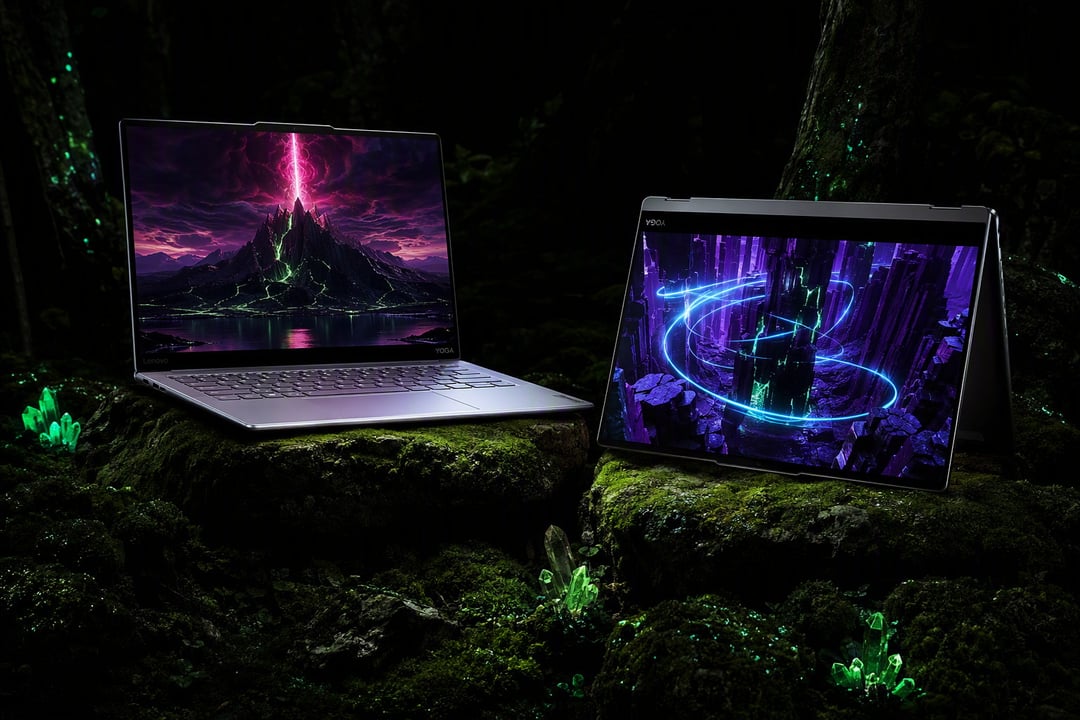
Lenovo has announced the Yoga Pro 9n and Yoga 9n 2-in-1, two creator-focused laptops built around Nvidia’s RTX Spark platform. The company says the systems are intended for people who need substantial local computing power for AI development, content creation, software development, and 3D rendering rather than sending every workload to the cloud.
Lenovo positions the new Yoga models as systems that can run increasingly sophisticated AI models locally. The company is also introducing Lenovo Qira, a personal ambient intelligence system, and the Smart Canvas Concept, which is meant to let users capture ideas across devices and input methods and continue the same work elsewhere.
Lenovo Yoga Pro 9n: RTX Spark Performance in a 15-Inch Laptop
The 15-inch Lenovo Yoga Pro 9n is the performance-focused model in the new lineup. It uses Nvidia RTX Spark and can be configured with up to 128GB of unified memory.
According to Lenovo, the RTX platform and CUDA software stack are designed to run advanced AI models locally. Beyond AI-focused work, the laptop is aimed at video editing, 3D rendering, software development, and RTX gaming.
Despite its performance focus, the Yoga Pro 9n starts at 3.64 pounds and measures as little as 16.7mm thick.
Yoga Pro 9n Display Specifications
The Yoga Pro 9n includes a 15.3-inch PureSight Pro OLED display with:
- 2.5K resolution
- Variable refresh rate from 48Hz to 165Hz
- 100% sRGB coverage
- 100% P3 coverage
- Up to 1,100 nits of HDR brightness
Lenovo also uses its X Power thermal architecture to help sustain performance inside the slim chassis. The system supports up to 80W TDP, has two SSD slots, and offers up to 4TB of storage.
Lenovo Yoga 9n 2-in-1 Combines RTX Spark With a Convertible Design
The Lenovo Yoga 9n 2-in-1 takes a more flexible approach. This 16-inch model pairs Nvidia RTX Spark with a 360-degree convertible design and supports up to 64GB of unified memory.
Its dual-surface pen system allows users to draw or write on either the OLED display or the haptic Force Pad. That gives the system two distinct surfaces for pen-based interaction within the same convertible format.
Lenovo Qira and Smart Canvas Expand the AI PC Approach
The new laptops are part of Lenovo’s wider AI-focused direction. Lenovo Qira is described as the company’s personal ambient intelligence system, while the Smart Canvas Concept is designed to connect compatible devices.
The stated goal is to support work that moves across different devices and input methods. Lenovo says users can capture ideas and continue the same work elsewhere rather than treating each device as a separate workspace.
The new Yoga tablets support several interaction methods:
- Pen
- Voice
- Vision
- Touch
Lenovo says its AI tools can assist with note-taking, transcription, creation, and productivity. Together, Qira and Smart Canvas point toward a workflow where local AI has both computing power and more context from the work taking place across compatible devices.
Local AI Workflows on Lenovo Yoga Pro Laptops
Lenovo’s announcement frames local AI as something broader than asking a chatbot a question. The company is focusing on computers with enough local processing capability and context to take part in an entire workflow.
For the Yoga Pro 9n, that includes configurations with up to 128GB of unified memory, alongside support for workloads such as AI development, content creation, software development, 3D rendering, video editing, and RTX gaming.
The Yoga 9n 2-in-1 offers up to 64GB of unified memory in a 16-inch convertible design. Its pen support across both the OLED screen and haptic Force Pad adds another layer to Lenovo’s emphasis on different ways to capture and develop ideas.
Lenovo Yoga Pro 9n and Yoga 9n 2-in-1 Pricing and Availability
Lenovo has not announced pricing or availability for the Yoga Pro 9n or Yoga 9n 2-in-1. The company says those details will be shared at a later date.