
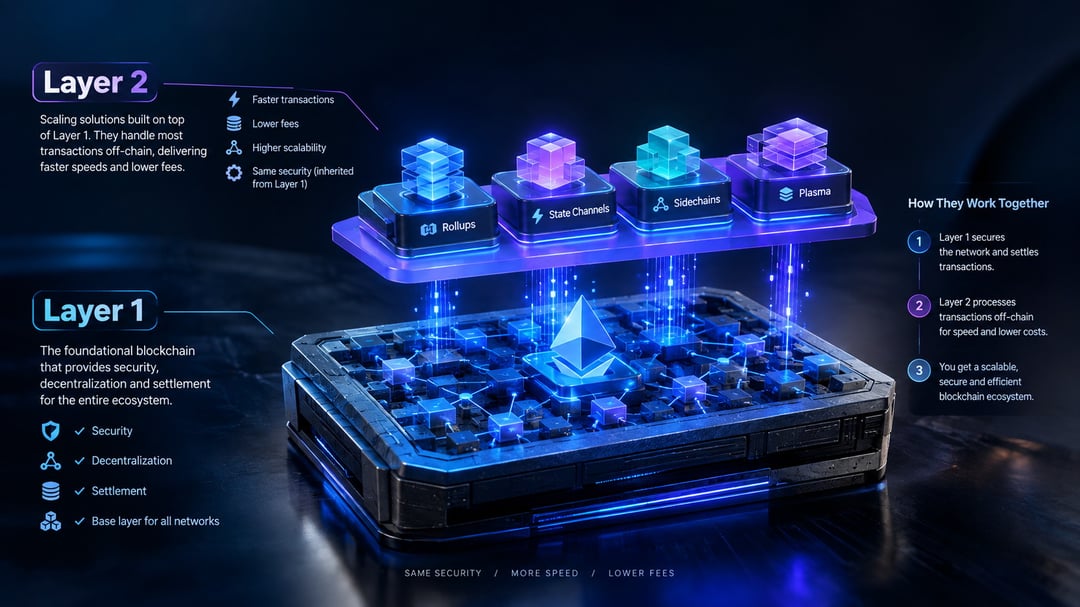
When Bitcoin launched, the base protocol handled everything: recording transactions, securing the network, and maintaining consensus. That worked at small scale, but as usage grew, the tradeoffs between speed, cost, and decentralization became harder to ignore. Layer 1 vs layer 2 blockchain architecture splits these responsibilities differently. Layer 1 is the main chain where security and finality happen. Layer 2 moves the transaction processing off-chain, then anchors the results back to the base layer.
Understanding how each one works explains why Ethereum can't just increase its block size, why rollups bundle thousands of transactions into one, and when a sidechain makes more sense than staying on the main chain. You'll see what each layer actually does, how the two main L2 approaches differ, and which tradeoffs matter for the applications you care about.
What layer 1 blockchains do
Layer 1 blockchains are base networks that finalize transactions and maintain consensus on their own. They don't depend on another blockchain to validate data or enforce security. When you send Bitcoin or execute a smart contract on Ethereum mainnet, the transaction is processed, validated, and permanently recorded by that network's validator nodes. Examples include Bitcoin, Ethereum, Solana, Cardano, and Avalanche. Each runs its own independent validator set.
These base layers handle three critical functions: security (validators stake value or compute power to prevent attacks), data availability (the network stores transaction history so anyone can verify it), and settlement (transactions are irreversibly finalized according to the chain's consensus rules).
The constraint is that processing every transaction on the base layer creates a bottleneck. Validators must download, verify, and store each transaction. When demand spikes, throughput hits a ceiling and fees rise. Bitcoin processes around seven transactions per second. Ethereum manages roughly fifteen. Higher throughput requires either centralizing validation or making compromises that layer 2 solutions are designed to handle differently.
What layer 2 blockchains do
Layer 2 blockchains execute transactions off the main chain, then post the results back to Layer 1 for final settlement. Instead of recording every transaction directly on Ethereum or Bitcoin, an L2 processes hundreds or thousands of transactions in its own environment, bundles the results into a compact proof or summary, and submits that single package to the base layer.
This architecture separates execution from settlement. The L2 handles the computational work—validating signatures, updating balances, running smart contracts—while the L1 provides security and data availability. Because the L2 inherits the base layer's security model, users get the same cryptographic guarantees without requiring the main chain to process every individual transaction.
The efficiency gain comes from batching. A single Layer 1 transaction might contain the compressed state of 500 L2 transactions, splitting the cost across all participants. What would cost $50 on Ethereum mainnet might cost a few cents on an L2, because the expensive part—writing to the base layer—is shared.
Rollups vs sidechains: the two main L2 approaches
Rollups
Rollups execute transactions off-chain but post all transaction data back to the Layer 1 blockchain. This means they inherit the full security of the base layer because anyone can reconstruct the rollup's state from L1 data and challenge invalid transitions.
Two types exist. Optimistic rollups, like Arbitrum and Optimism, assume transactions are valid by default. If someone suspects fraud, they can submit a challenge during a dispute window, typically seven days. ZK rollups use zero-knowledge cryptographic proofs to demonstrate validity upfront, eliminating the dispute period but requiring more computational overhead to generate the proofs.
Sidechains
Sidechains run their own consensus mechanisms independent of Layer 1. They only checkpoint state snapshots to the main chain periodically rather than posting every transaction. This architecture allows higher throughput because the sidechain isn't constrained by L1's block times or gas costs. The tradeoff is weaker security guarantees since you're trusting the sidechain's validator set rather than inheriting Ethereum or Bitcoin's security directly.
Polygon PoS launched as a sidechain before evolving toward rollup technology.
Why scaling is important and when to use each layer
When demand spikes on a layer 1 network, block space becomes scarce and transaction fees climb. Ethereum gas fees hit hundreds of dollars per transaction during periods of heavy use, making small transfers uneconomical. Layer 2 solutions absorb that traffic and process it at a fraction of the cost, typically under a dollar per transaction even during congestion.
Layer 1 remains the appropriate choice for high-value settlements, protocol upgrades, and scenarios where maximum security justifies higher fees. Moving large amounts between exchanges or participating in governance votes makes sense on the base layer because the security guarantee matters more than the cost.
Layer 2 handles everything else. Everyday transfers, DeFi swaps, NFT mints, and application interactions run faster and cheaper on rollups and sidechains. Speed and low cost matter more than direct validation by the full network.
The long-term architecture treats layer 1 as the settlement and security foundation while layer 2 networks handle transaction execution at scale. This separation lets blockchains serve millions of users without requiring every participant to validate every transaction.
How to choose between layer 1 and layer 2 blockchain networks
Layer 1 blockchains finalize transactions and secure the network independently, while layer 2s handle execution and post results back to L1 for settlement. If you're building or using applications where cost and speed matter more than absolute security guarantees, start with L2 solutions like rollups. For high-value transfers, protocol changes, or situations where you need the strongest possible security, stay on layer 1. The practical middle ground for most users: keep larger holdings on L1, move working capital to L2 for everyday transactions, and understand that rollups inherit L1 security while sidechains make their own tradeoffs. Watch which L2 approach a platform uses before committing funds or infrastructure to it.