
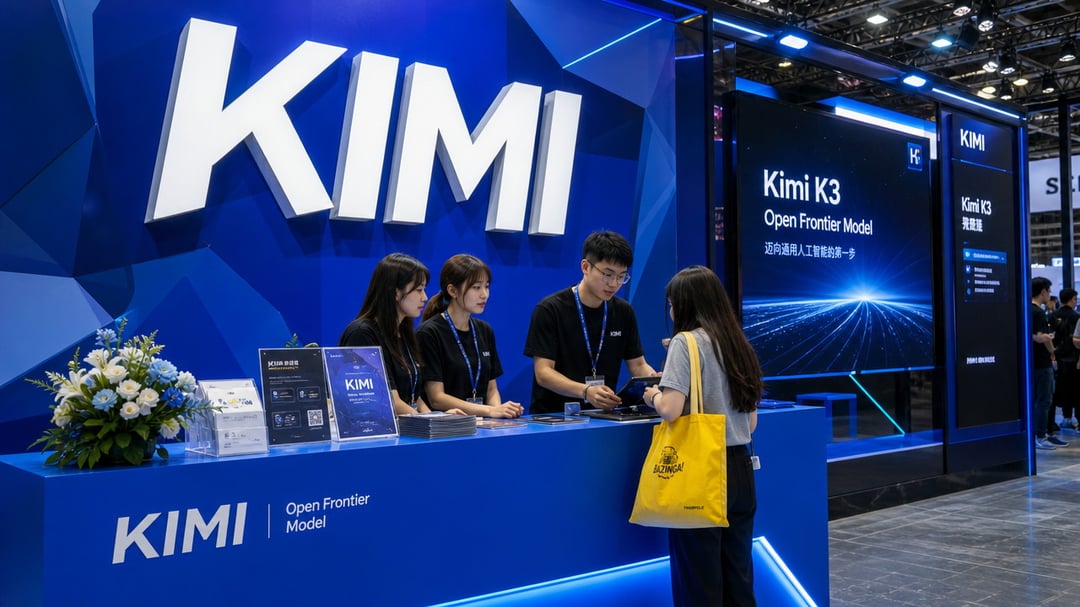
A single model release doesn't usually get blamed for a $314 billion swing in how much two of America's biggest AI labs are worth. Kimi K3 managed exactly that. Chinese startup Moonshot AI pulled the covers off the 2.8-trillion-parameter open-weight model on July 16, and within days investors were rethinking what OpenAI and Anthropic are actually worth — while chip stocks around the world took a beating.
The number everyone latched onto came from IG market analyst Tony Sycamore, whose estimate Bloomberg reported on July 20. He put the combined hit to implied valuation estimates for OpenAI and Anthropic at $314 billion. That figure deserves a close read before anyone treats it as gospel, and we'll get to why. But the market reaction underneath it was real, fast, and hard to ignore.
What Moonshot AI Actually Released
Kimi K3 isn't just another big model quietly posted to a leaderboard. At 2.8 trillion parameters, it's the first freely downloadable model in the three-trillion-parameter class — a size range that had, until now, stayed locked behind proprietary walls. Moonshot plans to release the full weights on July 27 under a Modified MIT license, which means developers won't just be renting access through an API. They'll be able to pull the whole thing down and run it themselves.
That's the part that changes the math for everyone else. A closed model can be priced and gated. Weights in the wild can't be un-released.
The Benchmark Claims, and Where K3 Lands
Moonshot's pitch is aggressive. The company says K3 beats Claude Opus 4.8 and GPT 5.5 on coding and agentic benchmarks — the tasks where models plan, use tools, and chain steps together rather than just answering a prompt. Overall, Moonshot positions K3 as trailing only two models: Anthropic's Claude Fable 5 and OpenAI's GPT-5.6 Sol.
Worth keeping in mind: these are the developer's own benchmark claims, not independent results. They set the tone for how the model was received, but they're Moonshot's framing of Moonshot's model.
The $314 Billion Estimate, and Why It Comes With Caveats
Here's the thing about that headline figure. OpenAI and Anthropic are both privately held. There's no ticker to watch, no share price ticking down in real time, no trades you can point to. So the $314 billion isn't a record of money that changed hands or a markdown any investor formally booked.
It's one analyst's read on where implied valuation estimates for two unlisted companies might be heading in light of K3. That distinction matters. It's a directional judgment about pressure on those valuations, not a confirmed loss. Treating an estimate about private companies as a settled fact is how a reasonable data point turns into a misleading one.
How Global Markets Reacted
The stuff you can measure moved sharply. The announcement set off immediate sell-offs across global technology stocks on Saturday, July 18:
- Taiwan's stock market fell more than 6%.
- Japan's market closed down 4%.
- The Nasdaq Composite dropped 1.5%, its worst session of the week.
- The Philadelphia Semiconductor Index slid into a formal bear market, falling more than 20% below the record it set in late June.
That last one is the tell. When a semiconductor benchmark drops into bear-market territory on the back of a software release, the market is making a bet about hardware demand — specifically, whether cheaper and freely available models change how much expensive compute the industry actually needs.
Pricing That Undercuts the Incumbents
Even for developers who'd rather use an API than host the weights themselves, Moonshot came in cheap. K3's API access runs $3 per million input tokens and $15 per million output tokens. That's roughly 60% of what Claude Opus 4.8 charges and about half the price of GPT-5.6 Sol.
Cheaper pricing on a comparable model raises an uncomfortable question for the proprietary labs: how much pricing power do you really have when a capable open-weight alternative exists at a fraction of the cost? That's the anxiety the stock moves were pricing in.
The Policy Fight Over Chinese Open Weights
K3 landed in the middle of an already-heated argument about how the United States should handle Chinese open-weight models. According to The Washington Post, the Trump administration has been weighing a framework that would cap U.S. open-source AI releases at the current capability level of the leading Chinese open models — a way of keeping American releases from racing ahead of what's already out there.
Not everyone in government is reading from the same script, though. A Pentagon spokesperson pushed back on comments from an OpenAI executive who'd urged restrictions on Chinese open-weight systems, pointing to existing 2026 legislation that already limits certain uses of DeepSeek and High Flyer models. In other words: the rules some are calling for may partly exist already.
Who's Behind Moonshot AI
Moonshot isn't a scrappy unknown. Yang Zhilin, a former Google Brain researcher, founded the company in 2023. This past May it raised $2 billion at a $20 billion valuation, and Bloomberg reports it's now lining up a Hong Kong IPO within six months that could push its value past $30 billion. Its annual recurring revenue hit $300 million in June.
Put the pieces together and K3 starts to look less like a one-off stunt and more like the technical centerpiece of a company heading for the public markets — one confident enough to give away its flagship weights and still expect to be worth north of $30 billion.


