
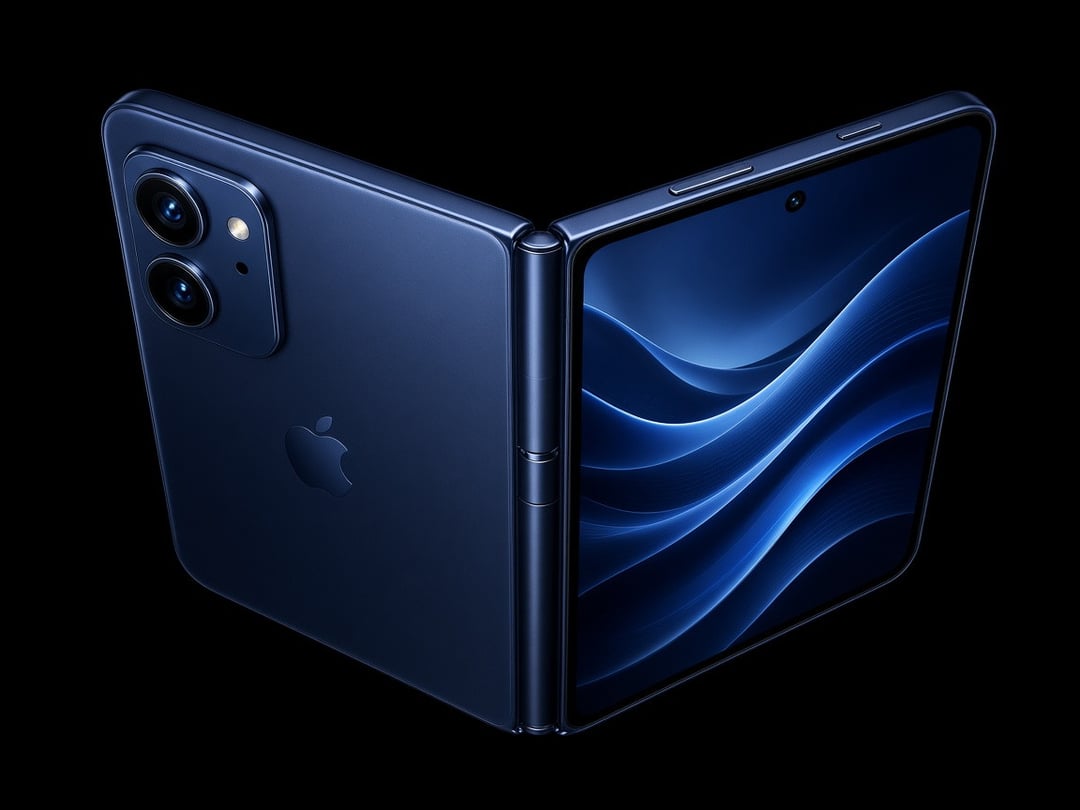
Apple’s first foldable phone, currently referred to as the iPhone Duo after earlier reports of iPhone Fold or iPhone Ultra, is expected to appear at the company’s September 9, 2026 event. The event carries the tagline “Surprise and shine.” Invitations went out on August 26. Bloomberg’s Mark Gurman has reported that the name could settle on iPhone Duo, with a starting price near $2,000 for the base model carrying 256GB of storage.
The device is projected to go on sale as early as October 2026, with wider availability possibly stretching into December. Some supply-chain reports suggest an initial U.S.-only launch, leaving other markets to wait additional months. Production targets have reportedly risen to around 10 million units for the year, up from earlier estimates of 7–8 million. IDC places the average selling price near $2,500.
Release Timeline and Availability
Mark Gurman has maintained that the foldable remains on track for the September 2026 fall hardware event alongside the iPhone 18 Pro models. Apple has confirmed the September 9 date. The announcement and retail availability may be separated by several weeks, with the earliest sales window in October.
Earlier reports floated a possible December start to shipping. More recent supply-chain chatter points to a staggered international rollout rather than an outright delay. A full global launch in 2027 now looks unlikely given the raised production target.
Pricing Details
Pricing estimates cluster between $2,000 and $2,500 for the entry configuration. Some sources have suggested a figure just under $2,000. Higher storage tiers could reach $3,000. One set of figures from Instant Digital places 256GB around $2,320, 512GB near $2,610, and 1TB near $2,900.
Samsung’s Galaxy Z Fold 8 Ultra launched at $2,099.99 on August 7, 2026, giving the expected iPhone Duo range a direct competitive reference point. Apple has raised its production goal to roughly 10 million units, signaling confidence in demand at these price levels.
Design and Displays
The phone follows a book-style fold, similar to current Galaxy Z Fold and Pixel Fold models, but with a wider aspect ratio. When open it is expected to resemble an iPad mini in proportions rather than the taller, narrower silhouette of most existing foldables.
Reported display sizes are approximately 5.3–5.5 inches for the outer screen and 7.76–7.8 inches for the inner panel, both OLED. One detailed leak lists a 5.49-inch cover display at 2,088 × 1,422 and a 7.76-inch inner display at 2,713 × 1,920. The inner screen is expected to use a roughly 4:3 aspect ratio, better suited to side-by-side multitasking and video without large black bars. The outer screen may remain limited to 60 Hz while the inner panel could receive ProMotion up to 120 Hz.
A near-invisible crease has been a priority. Reports describe a dual-layer ultra-thin glass structure and a liquid-metal hinge. Leaks in May claimed Apple had locked in a crease solution comparable to the approach used on the Oppo Find N6. Prototype testing earlier that month had noted a hinge-rattle issue that later reports indicated had been addressed.
Thickness estimates run about 4.5–4.8 mm unfolded and 9–9.5 mm folded. One set of renders pointed to a folded thickness of 9.23 mm. The frame is expected to combine titanium and aluminum. Colors have narrowed to dark blue and white.
Other design elements include a side-mounted Touch ID sensor integrated into the power button, a Camera Control button, and volume keys repositioned for horizontal use. Apple Pencil support has been reported. MagSafe remains unresolved: some dummy units show no magnet ring, while certain third-party case designs include circular cutouts consistent with MagSafe.
Performance Specs
The device is expected to use an A20 or A20 Pro chip built on TSMC’s 2 nm process. Early estimates suggest up to 15 percent higher performance and 30 percent better efficiency compared with the A19 series at similar power levels. Packaging may employ TSMC’s Wafer-Level Multi-Chip Module technology, stacking RAM directly with the CPU, GPU, and Neural Engine.
RAM is projected at 12 GB of LPDDR5X, matching the amount reported for the iPhone 17 Pro and expected for the iPhone 18 Pro. Storage options include 256 GB, 512 GB, 1 TB, and possibly a 2 TB tier. Connectivity is expected to include Apple’s second-generation C2 modem with mmWave 5G support. An eSIM-only design is considered likely because of internal space limits.
Biometrics shift to side-mounted Touch ID; Face ID is reported to have been dropped to free space. The phone is expected to ship with iOS 27, a version adapted for the dual-display form factor. Software is said to recognize whether the device is open, closed, or held at intermediate hinge angles. Split-screen multitasking is expected to be a headline feature, allowing two apps side by side in layouts closer to those on iPadOS.
Cameras and Battery
The rear camera system is described as dual 48 MP sensors—one main and one ultrawide—without a dedicated telephoto lens. Space constraints inside the folding chassis are cited as the reason. A 12 MP front-facing camera is expected on both the outer and inner displays rather than an under-display sensor. Some earlier forecasts suggested the possible omission of LiDAR and optical image stabilization, with computational photography and the A20 Neural Engine expected to compensate.
Battery capacity has been reported in two ranges. Earlier leaks pointed to 5,000–5,500 mAh, which would be the largest on any iPhone. A regulatory filing later described a dual-cell design totaling roughly 4,883 mAh (1,921 mAh + 2,962 mAh). That figure sits below some of the higher estimates and is also lower than the rumored capacity for the standard iPhone 18 Pro Max. Hardware-software optimization and chip efficiency are expected to help real-world endurance.