
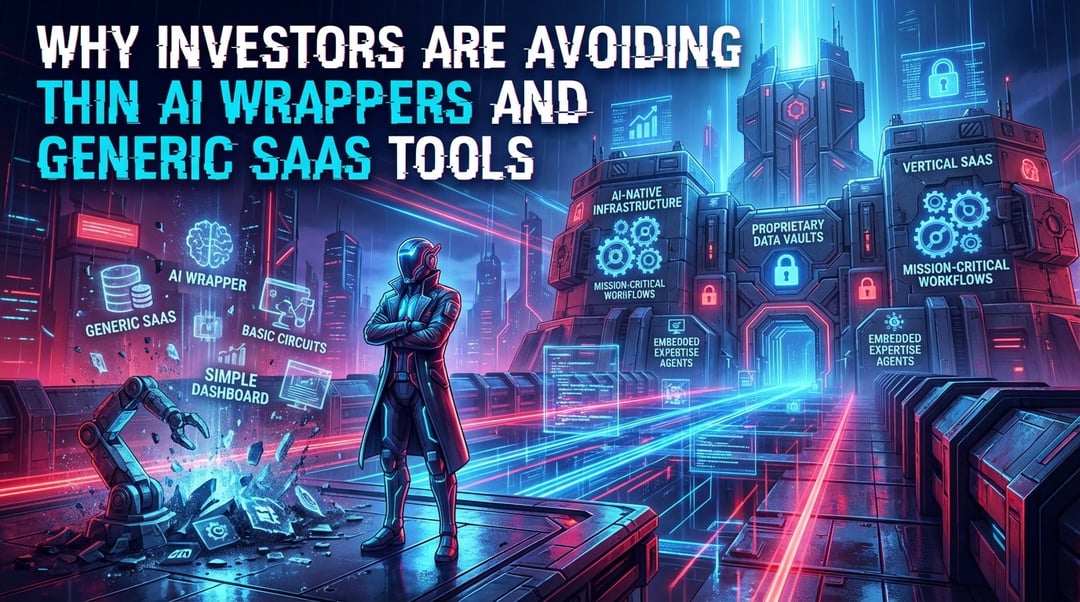
AI-Native Infrastructure and Vertical SaaS With Proprietary Data Are Winning
There’s a shift happening. And you can feel it.
Investors are still pouring billions into AI, yes. But they’re not throwing money at just anything with “AI” slapped onto the homepage anymore. The bar’s higher now.
What’s getting attention? AI-native infrastructure. Vertical SaaS companies with proprietary data. Systems of action — tools that don’t just analyze, but actually help users complete tasks. Platforms embedded deep inside mission-critical workflows.
That phrase matters: mission-critical workflows. If your product sits at the center of how a company operates — not just on the sidelines — you’re in a different category. Investors are looking for businesses that own workflows, data, and domain expertise. Not surface-level add-ons.
And here’s the part founders sometimes underestimate: proprietary data moats. Generic vertical software without exclusive, hard-to-replicate data? It’s losing its shine. If anyone can access the same models and datasets, where’s the defensibility?
Thin AI Wrappers and Generic Tools Are Losing Appeal
Let’s talk about what’s falling out of favor.
Startups building thin workflow layers. Generic horizontal tools. Light product management platforms. Surface-level analytics dashboards.
Basically, anything an AI agent can now handle.
If your differentiation mostly lives in UI and basic automation, that’s no longer enough. The barrier to entry has dropped. AI-native teams can rebuild simple interface layers on top of existing APIs — quickly. Cheaply.
That’s why generic productivity tools, basic CRM clones, and project management software without deep integration are struggling to raise capital. Thin AI wrappers built on existing APIs? Investors see through that now.
Here’s the uncomfortable truth: if your product can be replicated without much effort, it’s not defensible. And investors know it.
Workflow Ownership Matters More Than Workflow Stickiness
There’s an important distinction happening in AI SaaS: workflow ownership versus workflow stickiness.
Before advanced AI agents, getting humans to do their work inside your software was a moat. If teams relied on your tool daily, that stickiness created defensibility.
But now?
If agents are executing tasks, who cares about human workflow?
That’s the question investors are asking.
Products designed around attracting as many human users as possible to manually operate inside the software may face an uphill battle. The value shifts when AI agents start doing the actual work.
The difference between owning the workflow and just executing a task is becoming stark. Developers, for example, are increasingly choosing execution over process. A product that truly owns the workflow controls the environment where work happens. A product that just executes tasks may become interchangeable.
And interchangeable is dangerous.
Integrations Are Becoming a Utility, Not a Moat
There was a time when being “the connector” was powerful.
If your SaaS product integrated with everything else, you had leverage. You were the hub.
But emerging standards like model context protocols (MCP) are changing that. These make it easier than ever to connect AI models to external data and systems — without needing dozens of custom integrations.
In other words, users won’t have to download multiple integrations or build custom connectors anymore. They’ll use the protocol.
That shift turns integrations from a moat into a utility.
And when something becomes a utility, it stops commanding premium valuation multiples.
Workflow Automation and Task Management Tools Face Pressure
Workflow automation and task coordination tools — especially those built around managing human work — are under pressure.
If AI agents increasingly execute tasks autonomously, tools designed to coordinate human effort may become less necessary.
We’re already seeing public SaaS companies in this category face stock declines as AI-native startups introduce more efficient, deeply embedded solutions.
Investors are watching that closely.
They’re reallocating capital away from tools that sit on top of processes and toward platforms that reshape the processes themselves.
Depth, Embedded Expertise, and Real Moats Define Attractive AI SaaS
What remains attractive in SaaS isn’t hype. It’s depth.
Investors want:
- Deep integration into critical workflows
- Proprietary data advantages
- Embedded domain expertise
- Flexible pricing models, especially consumption-based approaches
- Speed and adaptability over massive legacy codebases
Rigid per-seat pricing models are becoming harder to defend. Consumption-based pricing aligns better with AI-native products, especially as usage fluctuates with agent-driven automation.
Massive codebases? Not necessarily an advantage anymore. Speed, focus, and the ability to adapt quickly matter more.
The common thread across all of this: defensibility.
If a strong AI-native team can rebuild your product quickly, you don’t have a moat. But if you own workflow, data, and expertise — that’s different. That’s harder to replicate.
And that’s where capital is flowing.


