
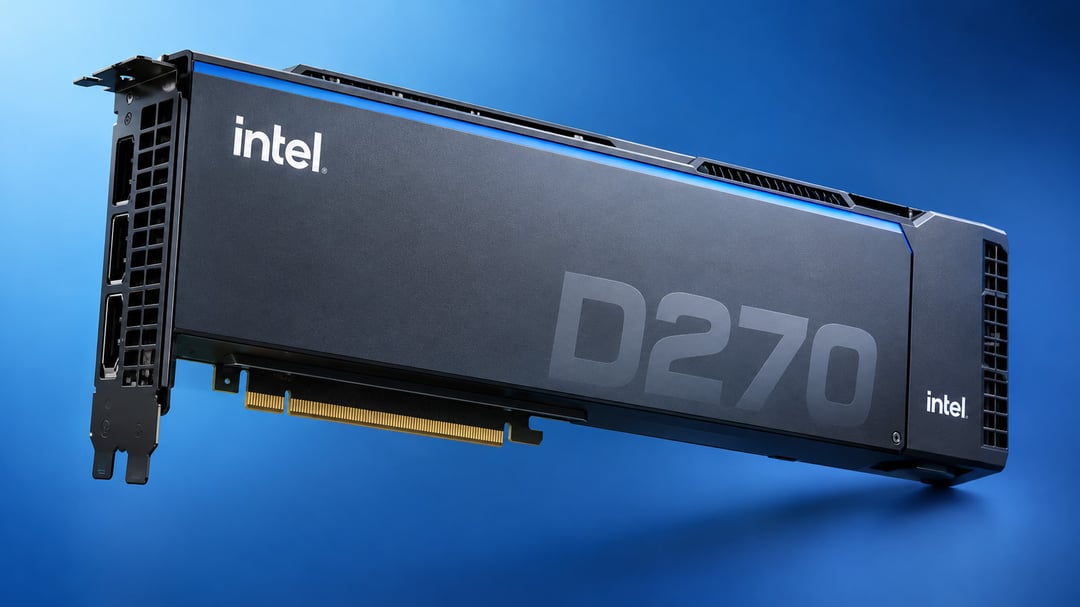
Intel has given its Crescent Island data center AI accelerator an official product name: the Intel GPU D-series. Announced at the Open Compute Project Global Summit in San Jose, the air-cooled PCIe card is aimed at AI inference workloads and is now sampling with customers.
Intel is positioning the D-series around cost and deployment practicality rather than top-end raw performance. The company is entering an AI accelerator market led by Nvidia, with support from partners including Dell, HPE, Supermicro, and ASUS.
Intel GPU D-Series Performance and Memory Specifications
Intel says the GPU D-series delivers up to 1.3 petaflops of FP8 compute within a 350-watt power envelope. It offers up to 1.5 TB/s of memory bandwidth and can support as much as 480 GB of LPDDR5X memory on partner-built cards.
Intel’s own branded card includes 160 GB of memory. The higher 480 GB configuration applies to hardware built by partners.
Reported hardware details include:
- 32 Xe3P cores
- 256 XMX matrix engines
- 32 MB of L2 cache
- No graphics output hardware
- Air-cooled PCIe card design
- Up to 480 GB of LPDDR5X memory on partner cards
- 1.5 TB/s of memory bandwidth
- Up to 1.3 petaflops of FP8 compute
- 350-watt power envelope
AI Inference Capacity for Large Models
The Intel GPU D-series is designed for AI inference. Intel says a single card can run models with up to 300 billion parameters, while an eight-GPU system can support models with more than one trillion parameters.
The company identifies multi-tenant AI services and robotics as target uses for the accelerator. Its approach focuses on infrastructure that can deliver performance at an appropriate cost, according to Anil Nanduri, Intel’s vice president of AI products and go-to-market.
Customer sampling is already underway. However, Intel has not announced pricing, a general availability date, or independent benchmark results.
How Intel D-Series Compares With Nvidia Hardware
The D-series sits in a different performance range from Nvidia’s highest-end hardware. Tom’s Hardware compared the accelerator with Nvidia’s Vera Rubin NVL72 rack, where each Rubin GPU is rated for a theoretical 17.5 petaflops of FP8 compute and requires liquid cooling.
Intel’s card is air-cooled and rated at up to 1.3 petaflops of FP8 compute. That difference reflects Intel’s stated focus on lower cost and easier deployment instead of competing directly at the top end of accelerator performance.
Intel Xeon Rack Designs and AI Software Updates
Alongside the GPU D-series announcement, Intel presented new Xeon-based rack designs using the Open Compute Project’s Open Rack v3 standard. Some Xeon 6+ configurations exceed 46,000 cores per rack at 133.45 kW.
Intel also announced Day 0 support for Meta’s Muse Glimmer model. Its AI for Enterprise Agent Toolkit now runs on Xeon processors and is designed to extend to Intel GPUs.
Intel says agentic AI is changing data center requirements, a point the company tied to its hardware, rack, and software announcements.
Crescent Island’s Path to the Intel GPU D-Series
Intel first previewed Crescent Island at OCP 2025 and said at the time that sampling would start by the end of that year. In August, Intel did not disclose the chip’s memory bandwidth at Hot Chips, while Chips and Cheese suggested the schedule could move into 2027.
The D-series also arrives after Intel’s Ponte Vecchio data center GPU failed and follow-on products were later shelved. Whether the new accelerator can succeed remains unresolved.
Intel shares have risen about 183% this year, according to Yahoo Finance. Much of that increase has been tied to demand for Intel CPUs, while AMD continues to compete for the same data center customers.