
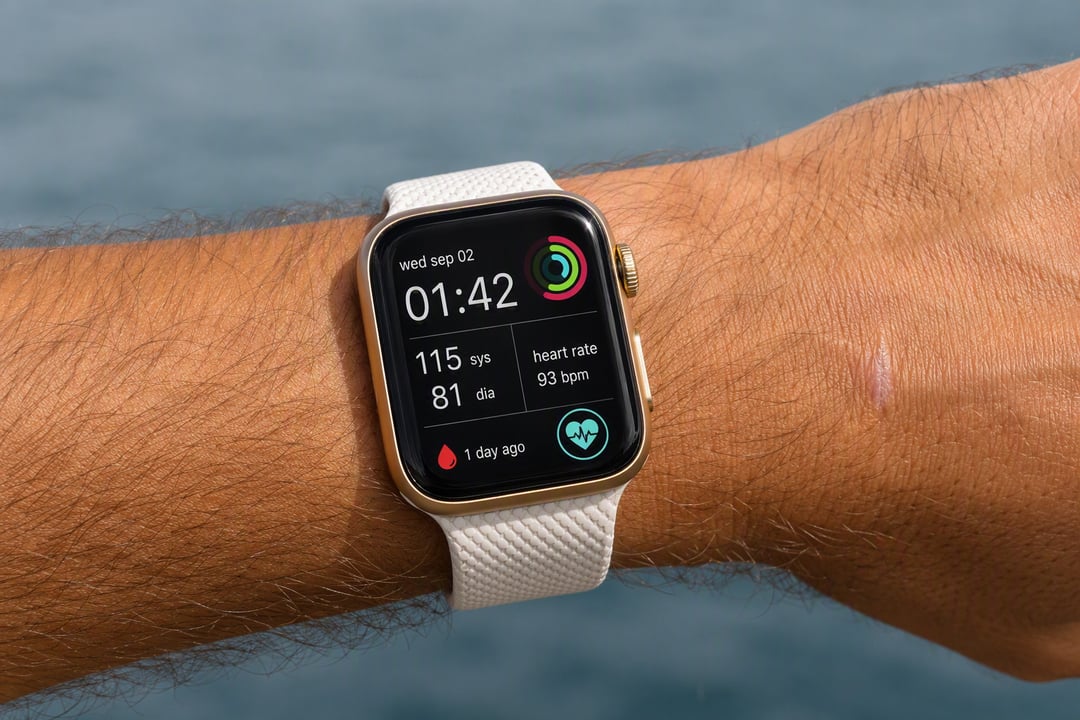
The Huawei Watch D3 stands apart from most smartwatches that track steps, sleep, and heart rate. It centers on cardiovascular health, with blood pressure as the core focus.
I’ve worn the Watch D3 for a handful of days. It quickly stood out not because it outperforms every rival feature by feature, but because it prioritizes a different problem. This is a smartwatch built around cardiovascular monitoring first, with everyday smartwatch functions coming second.
A Noticeably Slimmer Design
The Watch D3 looks less bulky than its predecessor. Thickness drops to 11.4mm from 13.3mm. That change makes a clear difference on the wrist.
Overnight wear feels more practical. Continuous health tracking works best when the watch can stay on without drawing attention, and the reduced bulk helps. The 1.92-inch display also improves readability for blood-pressure numbers and other metrics at a glance.
An Inflatable Cuff Built Into the Strap
The standout hardware sits in the strap. A miniature pump inside the watch inflates a cuff around the wrist. This delivers a pressure-based blood-pressure reading instead of an optical estimate.
The process is straightforward. Raise your wrist near heart level, start the measurement, and a reading appears in roughly 30 seconds. Some pressure builds as the cuff inflates, yet it stays manageable. After a few uses it becomes routine.
That design brings trade-offs. The Watch D3 carries an IP68 rating, but it is not built for prolonged water exposure, diving, hot showers, or swimming. Those limits come with the inflatable cuff.
Expanded Blood-Pressure Features
Pressure-based readings give the D3 a different view of health data. Most smartwatches rely on heart rate, heart-rate variability, and sleep for stress and wellness insights. The D3 adds actual blood-pressure measurements to the mix.
Compared with the previous D2, the D3 expands what it can do. It records blood pressure before and after exercise and maintains accuracy at elevated heart rates. Contextual reminders appear during sudden temperature changes or stays at high altitude, prompting a check when it may be useful.
These prompts move the watch beyond simply logging numbers. It recognizes moments when a reading could matter and nudges the wearer to take one.
Built for a Specific Audience
The Watch D3 is not aiming to match an Apple Watch, Galaxy Watch, or Garmin feature list. It offers fewer sports modes and tighter water limits. Its design exists to support the cuff hardware that most smartwatches skip.
Its audience is narrower: people focused on cardiovascular health, those managing hypertension, adults 40 and older, or anyone who prioritizes regular blood-pressure checks over the broadest sports tracking.
Huawei previewed the D3 at the European Society of Cardiology Congress in Munich. Cardiology professionals showed positive interest. The watch holds CE-MDR certification in the European Union for single blood-pressure measurements, ambulatory blood-pressure monitoring, and readings before and after exercise. It is also certified by TÜV Rheinland for MDR compliance.
Early Impressions After Several Days
Long-term value still needs more time to assess—accuracy across different conditions, battery life, and whether regular measurements settle into a lasting habit. Early use leaves a positive mark. Huawei has fitted complicated health hardware into a form that feels closer to a conventional smartwatch than expected.
The CE-MDR coverage across several blood-pressure scenarios strengthens the offering beyond another estimated metric. The Watch D3 will not replace broader smartwatches, and it does not appear designed to. It targets a more focused group. For someone who needs to track blood pressure regularly, having the capability on the wrist instead of a separate cuff in a drawer can make a real difference.


