
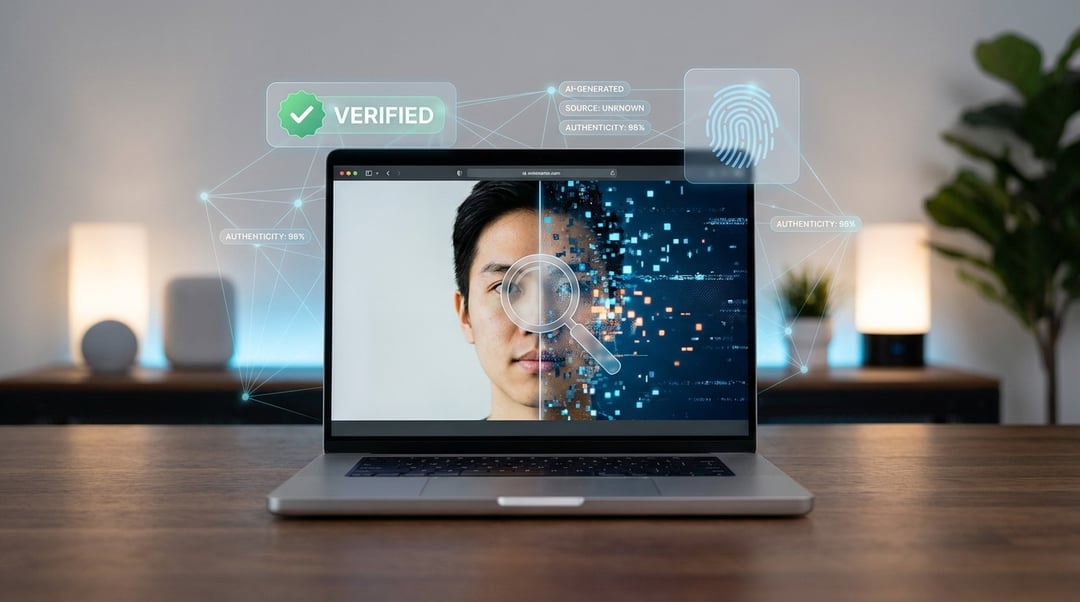
You know that uneasy feeling when you scroll past a photo online and pause for a second, wondering if it's actually real? Yeah. That's where we are now. AI images have gotten so convincing that even careful eyes get fooled, and OpenAI wants to do something about it. The company just rolled out a fresh approach to image verification, and it's leaning on Google to make the whole thing work.
The announcement covers content provenance, which is basically a polite term for figuring out where an image came from and whether a machine made it. There are three moving parts here: OpenAI is now officially conforming to C2PA standards, it's teaming up with Google on watermarking, and there's a public tool anyone can use to check images themselves.
What's Actually Changing With OpenAI's Image Verification
Since 2024, OpenAI has been baking metadata called Content Credentials into the images its tools spit out. That metadata travels with the file and explains how the image was made. The thing is, metadata only helps if other platforms know how to read it.
That's where the C2PA piece comes in. OpenAI is now a C2PA Conforming Generator, which means other platforms can reliably pick up and interpret the provenance information when they run into an OpenAI-generated image. It's the kind of behind-the-scenes plumbing that doesn't sound exciting, but it matters. Standards only work when everyone speaks the same language.
The Google SynthID Partnership Is the Bigger Story
Here's the real headline: OpenAI is adding Google DeepMind's SynthID watermarking to images created through ChatGPT and the OpenAI API. And this is a meaningful shift, because metadata has one big weakness. The moment someone screenshots an image or re-uploads it somewhere, that metadata can vanish. Gone. Just like that.
SynthID works differently. It tucks an invisible watermark right into the image itself, designed to hold up through the kinds of transformations that usually wipe metadata clean. Think of it as a fingerprint baked into the pixels rather than a sticker on the file.
The two systems are built to back each other up. Metadata carries the detailed story of where an image came from, and the watermark steps in as a fallback when that metadata doesn't survive the trip.
How to Check if an Image Is AI-Generated Using openai.com/verify
OpenAI is previewing a public verification tool at openai.com/verify, and the idea is refreshingly simple. You upload an image. The tool looks for Content Credentials and SynthID watermarks. It then tells you whether the image came out of OpenAI's tools.
But here's the catch you really need to understand. If the tool comes back empty, meaning it finds no watermark and no metadata, it won't tell you the image is definitely not AI-made. It can't. Watermarks and metadata can still be spoofed, and absence of evidence isn't evidence of absence. Look, this is the limitation we're all stuck with for now.
Why Universal Adoption Is Still Important
The other honest limitation? Not every generative AI company has signed up for SynthID. Google has been building momentum with partners like NVIDIA, OpenAI, Kakao, and ElevenLabs, but that's not the whole field. Until SynthID or something equivalent becomes universal across every generative AI model out there, no verification tool can promise you with total certainty that an image wasn't made by AI.
Still, this feels like real progress. AI-generated images have turned into genuine chaos, and plenty of that chaos is being used for stuff people shouldn't be doing. Having a way to identify them isn't optional anymore. It's necessary. And it's good to see Google and OpenAI putting actual infrastructure behind it instead of just talking about the problem.