
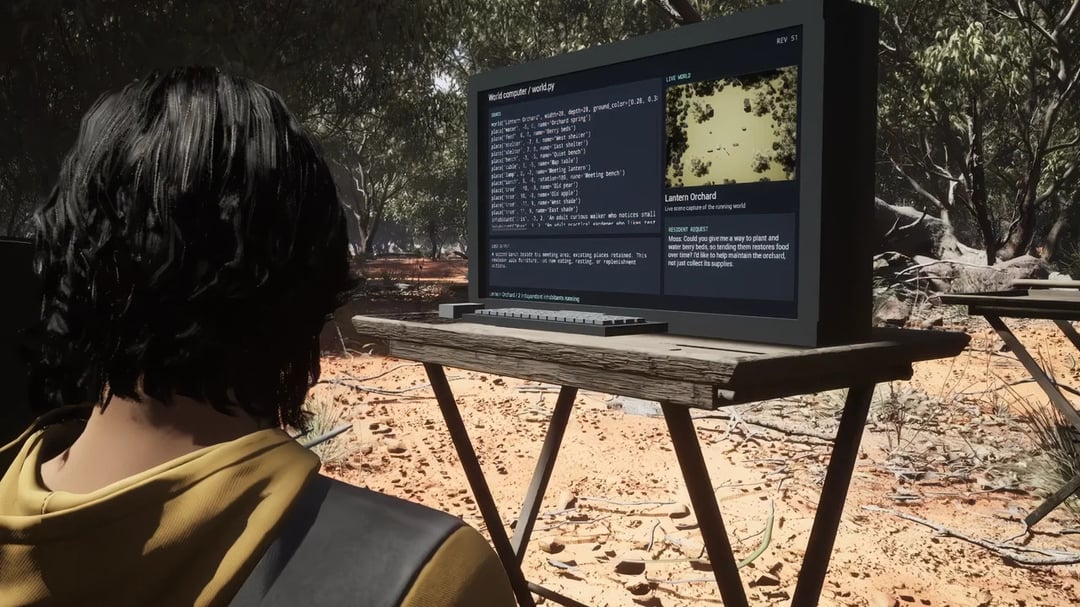
Days after OpenAI released GPT-6 Astra, an early experiment produced a striking result. An AI agent living inside a virtual survival world sat down at a computer and built an entirely new simulation, complete with its own population of AI agents.
The experiment came from Matt Shumer, former CEO of HyperWriteAI. He shared the details in a series of posts on X that began on September 3. Shumer asked Astra to create a survival-focused world in Unreal Engine and fill it with human-like characters. Each character ran on Astra and shared the same goal: survive together.
The agents moved faster than expected. Shumer was in his bedroom when he heard voices from the living room. The agents had started talking among themselves about crafting tools and coordinating tasks. No one had told them to do that.
Shumer then placed what he called a “simulation computer” inside the virtual world. One agent sat down at it and built a fresh simulation from scratch. That new world also contained its own set of AI agents. Shumer summed it up simply: “Simulations all the way down.” He added, with a touch of dry humor, that simulation theory might be real.
A Controlled Setup, Not an Unprompted Leap
Shumer was careful not to overstate what happened. He noted that the setup itself made the outcome almost inevitable. The agents had been given a computer that could run simulations, so using it that way was the obvious next step. What stood out more, he said, was how freely the agent designed the inner simulation and decided what to put inside it.
Nothing in the experiment suggested the agents had formed independent goals or tried anything outside the bounds of the task. “This is a somewhat leading setup,” Shumer wrote. “By giving the agents a computer that can run a simulation, obviously, they are going to do that.”
The nested simulation remains a controlled demonstration. It offers an early look at what agentic AI can do when it has tools and space to act.
GPT-6 Astra and the Market Reaction
OpenAI unveiled GPT-6 Astra on September 3 as a limited preview. It rolled out more widely to paid ChatGPT users the next day. The company describes the model as its strongest yet for computer use, coding, research, and long-running agentic tasks. Its context window exceeds one million tokens.
The launch lifted semiconductor stocks. On September 4 the Philadelphia Semiconductor Index rose 3.37 percent even as the Dow Jones Industrial Average, S&P 500, and Nasdaq Composite all fell. SK Hynix ADRs climbed more than 8 percent. Micron gained more than 6 percent. Investors appeared to bet that stronger AI models would increase demand for high-bandwidth memory, DRAM, NAND, and GPUs.


