
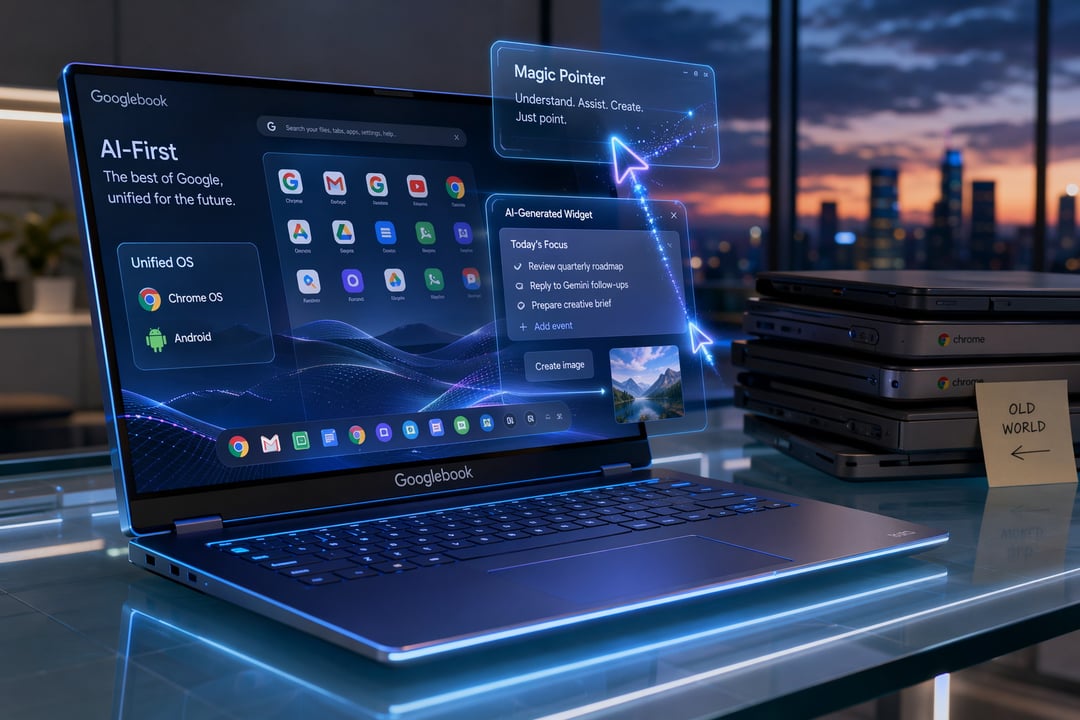
Googlebook Introduces a Gemini-Powered Laptop Category
Google announced the Googlebook, a new category of AI-first laptops powered by Gemini, at The Android Show: I/O Edition. The event streamed ahead of Google I/O 2026, where more details about Google’s broader AI and platform plans are expected.
The company described Googlebook as its most significant change in laptop strategy since Chromebooks were introduced more than 15 years ago. Rather than presenting it as a standard Chromebook refresh, Google positioned the device category around Gemini and a new Android-based operating system built for AI-driven assistance.
The Googlebook platform combines the Chrome browser with Android apps from the Google Play Store. Underneath that setup is what Google calls “contextual and proactive assistance” through Gemini, making AI a central part of the laptop experience instead of an added feature layered on top.
Hardware partners confirmed for Googlebook devices include Acer, ASUS, Dell, HP, and Lenovo. Devices from those partners are expected to launch by this fall.
New Android-Based Operating System Combines Chrome and Android Apps
The Googlebook runs on a new Android-based operating system that brings together core pieces of Google’s laptop and mobile ecosystems. Chrome remains part of the experience, while Android apps from the Google Play Store become available as part of the platform.
That combination points to a laptop environment designed around both web use and app access. Instead of separating browser-based work from Android app usage, the Googlebook operating system brings them into one unified system.
Gemini is built into that platform through contextual and proactive assistance. In practice, that means the AI layer is meant to understand what users are doing and surface help that fits the moment.
Magic Pointer Adds Gemini Intelligence to the Cursor
A Cursor Built With Context Awareness
One of the headline Googlebook features is Magic Pointer, a Gemini-powered cursor developed in collaboration with Google DeepMind. It adds intelligent context awareness to the traditional mouse pointer, turning a familiar laptop control into something more responsive to what appears on screen.
The idea is not just a redesigned cursor. Magic Pointer is presented as a smarter input tool, shaped around Gemini’s ability to understand context and assist while users navigate the laptop interface.
Google DeepMind Collaboration
Magic Pointer was developed with Google DeepMind, connecting the feature directly to Google’s wider AI work. Within the Googlebook platform, the cursor becomes part of the broader Gemini-powered experience, alongside proactive assistance and natural-language tools.
Create Your Widget Uses Natural Language Prompts
Google also introduced “Create your Widget,” a tool that lets users build custom widgets through natural language prompts. Instead of manually configuring dashboards piece by piece, users can describe what they want and have Gemini help assemble it.
Gemini can pull from services such as Gmail and Google Calendar to create personalized dashboards with relevant information. That makes the widget system more flexible and more closely tied to the user’s existing Google services.
The feature fits the broader Googlebook direction: using Gemini to reduce setup friction, organize information, and make the laptop feel more personal to the user’s day-to-day needs.
Android Phone Connectivity Extends Apps to the Laptop
The Googlebook platform also promises deep connectivity with Android smartphones. Users will be able to run phone apps directly on their laptops without installing those apps locally.
That creates a tighter bridge between Android phones and Googlebook laptops. Instead of treating phone apps and laptop apps as fully separate worlds, the platform allows phone-based experiences to appear directly on the larger laptop screen.
This connectivity is another part of Google’s larger push to merge the strengths of Android and laptop computing into one more unified experience.
Project Aluminium and the Future of ChromeOS
Googlebook as the Consumer-Facing Result
The Googlebook represents the consumer-facing culmination of Project Aluminium, Google’s long-running effort to merge ChromeOS and Android into a unified platform. The project has been tied to a broader shift in how Google approaches laptop software, especially as Android and AI become more central to its computing strategy.
The result is a platform that moves beyond the traditional Chromebook model while still keeping Chrome and app access at the center.
Unified OS Plans for 2026
Sameer Samat, president of Google’s Android Ecosystem, confirmed at MWC 2026 in March that the unified operating system remained on track for a 2026 debut. He said he was “super excited about later this year,” pointing to continued progress toward the platform’s launch.
Googlebook now gives that unified strategy a clearer consumer-facing shape. Rather than existing only as a platform effort, it becomes a new laptop category with confirmed hardware partners and AI-first features.
ChromeOS Support Will Continue for Existing Users
Although Googlebook marks a major shift, ChromeOS is not disappearing immediately for current users. Court documents from Google’s search antitrust case have suggested that a full public rollout may not arrive until 2028, with the initial 2026 launch limited to “commercial trusted testers.”
Google has also committed to supporting ChromeOS through at least 2033. That commitment is meant to honor the company’s 10-year update pledge to existing users.
So while Googlebook points toward a different future for Google laptops, ChromeOS support remains in place for people already using Chromebooks.
Google I/O 2026 Is Expected to Bring More Details
The Android Show acted as a lead-in for Google I/O 2026, which runs May 19–20 at the Shoreline Amphitheatre in Mountain View, California.
Further technical details about the Googlebook platform and its underlying operating system are expected during the developer conference. Gemini upgrades, Android 17, and Android XR hardware are also anticipated at the event.
For now, Googlebook stands as one of the clearest signs of Google’s next laptop direction: Android-based, Gemini-powered, and designed around a more proactive AI experience.