
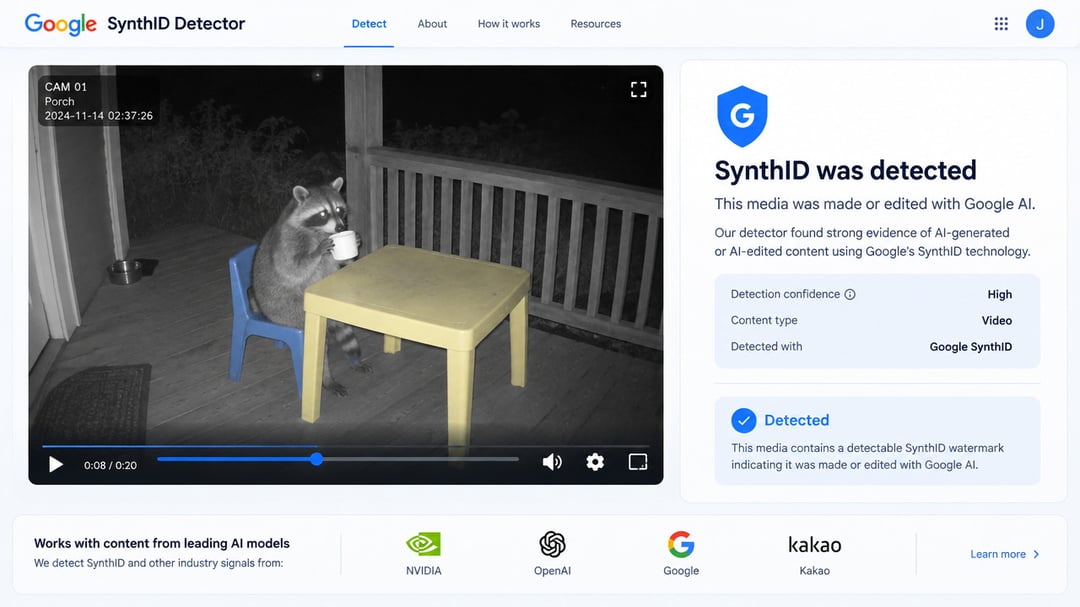
Google has opened its SynthID Detector to the public. The free site at synthid.com works worldwide in English. Anyone can upload an image, video, or audio file and check it for the invisible watermarks that Google and several partner companies place in AI-generated media.
Until now the tool stayed limited to journalists, researchers, and other media professionals. Pushmeet Kohli, a vice president at Google DeepMind, said the company is expanding access so the tool is available globally in English starting today.
How SynthID Watermarking Works
SynthID embeds a signal at the moment content is created. In images and video the mark sits in the pixels. In audio it sits in the waveform. That placement keeps the mark from disappearing the way ordinary metadata often does.
Since SynthID launched in 2023, Google has watermarked more than 180 billion images and videos plus 240,000 years of audio. Verification features already running inside Search, the Gemini app, and Chrome handle more than one million requests each day.
Supported Models and Current Partners
The detector reads SynthID marks from Google’s own models and from OpenAI, NVIDIA, and Kakao. Support for Apple is expected soon. ElevenLabs has already committed to using the watermarks as well. Google states it continues working to extend partnerships so more generated media can be detected.
The public site corrects a shortcoming in Google’s earlier detector. That version looked only for Google’s own watermark, so ChatGPT images that carried SynthID were never flagged.
Access Requirements and What Users See
Users must sign in with a Google, OpenAI, or Apple account. No other login methods are available. Once signed in, the public version returns a simple result that states whether a watermark was found. Unlike the earlier internal tool, it does not show which parts of an image carry the mark.
Limits of the Detector
The site’s FAQ states clearly that this is not a general AI detector. It only finds content from companies that have adopted SynthID. A “not detected” result does not prove the file is free of AI generation. The content may come from a model that never added the watermark, or heavy editing may have weakened the signal. Rare false positives can also occur when the detector flags content that carries no watermark.
The tool cannot separate material made entirely by AI from material that was only edited with AI tools. Watermarks can sometimes be stripped out. Detection still rests on a patchwork of standards. Meta, for example, runs its own detector that identifies images from its latest Muse models but not those from other companies. Google has not announced when languages beyond English will be added.