
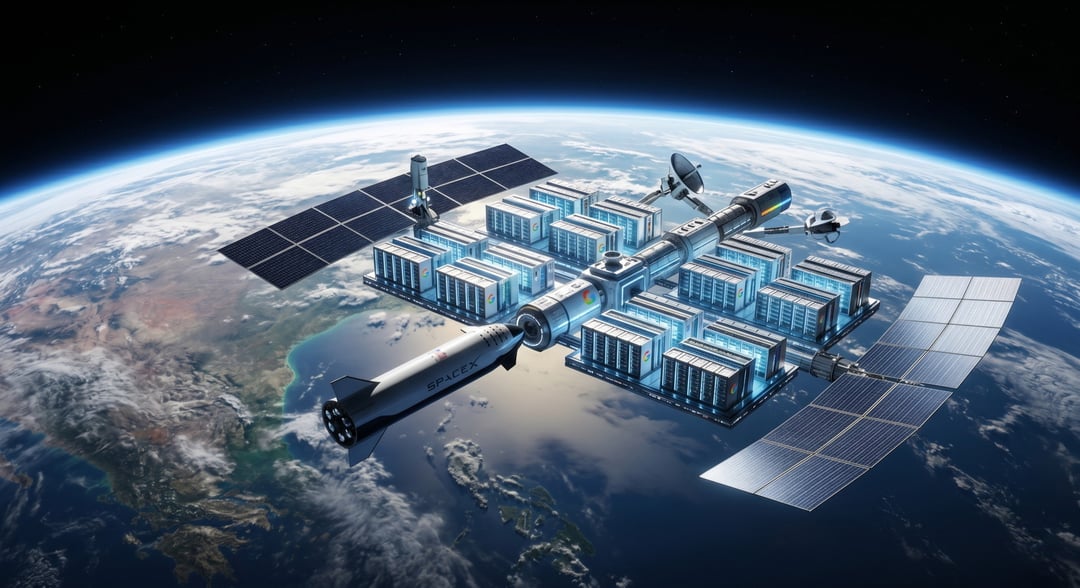
The Race to Move AI Computing Off Planet Earth
Something wild is happening in the tech world right now. Google and SpaceX are in actual talks about launching orbital data centers into space. Not a thought experiment. Not a research paper nobody reads. Real negotiations, reported by the Wall Street Journal, with rockets and satellites and the whole thing.
And honestly? The timing makes sense. SpaceX is gearing up for an IPO this summer, Google is deep into AI infrastructure, and the pressure to find more computing capacity — somewhere — has never been higher. So here we are, talking about data centers orbiting Earth.
What Google Is Actually Building: Project Suncatcher
Google's piece of this isn't brand new. The company has been quietly developing something called Project Suncatcher since late 2025. The idea is to outfit solar-powered satellite constellations with Google's own Tensor Processing Units — those are the custom chips Google built for AI workloads — and connect them using free-space optical links.
CEO Sundar Pichai has said the goal is an early 2027 prototype mission, developed in partnership with Planet Labs. But Google isn't putting all its eggs in the SpaceX basket. The company is also exploring deals with other launch providers, because — and this matters — there aren't enough rockets in the world right now to make any of this work at scale.
Google's own research suggests launch costs would need to drop below $200 per kilogram by the mid-2030s for space-based data centers to actually compete with what we have on the ground. That's not a small ask.
SpaceX's Enormous Ambition — and Its Honest Disclaimers
SpaceX isn't shy about dreaming big here. In January, the company filed an application with the FCC to deploy up to one million satellites as orbital data centers, positioned between 500 and 2,000 kilometers above Earth. One million. Let that sink in.
Elon Musk went further at Davos, calling the whole concept a "no-brainer" and claiming that within two to three years, space would be the cheapest place to run AI. That vision is baked into SpaceX's IPO pitch, which reportedly pegs the company's value at around $1.75 trillion.
But here's where it gets interesting — and a little humbling. SpaceX's own pre-IPO S-1 filing tells a very different story. The document openly acknowledged that its orbital AI compute initiatives involve "unproven technologies" and "may not achieve commercial viability." It also flagged the company's dependence on Starship achieving a launch cadence and reusability rate that simply hasn't been demonstrated yet.
That's a pretty candid admission from a company whose CEO just called the whole thing a no-brainer.
The Starship Problem Nobody Can Ignore
Almost every player in this space — pun intended — is banking on Starship to eventually make orbital data centers economically feasible. The rocket is expected to attempt its 12th test flight soon, but it's still not commercially available.
Analysts at MoffettNathanson did the math on what Musk's vision would actually require: roughly 3,000 Starship launches per year. That's about eight every single day. For context, that's a launch cadence the world has never come close to achieving with any rocket, ever.
Jensen Huang, Nvidia's CEO, put it plainly during a podcast appearance, describing orbital AI infrastructure as "a long-term engineering challenge rather than an immediate solution." Not a dismissal — but definitely not hype either.
Who Else Is Getting Into the Game
This isn't just a Google-SpaceX story anymore. The field is getting crowded fast.
Nvidia recently posted a job listing for an orbital data-center system architect, which is about as clear a signal as a company can send. And Cowboy Space Corporation — a startup founded by Robinhood co-founder Baiju Bhatt — raised $275 million and is building its own rocket specifically to launch space data centers. A purpose-built rocket for this one use case. That's how seriously some people are taking it.
The underlying logic isn't crazy, by the way. Space offers essentially unlimited solar power and the kind of cooling that's genuinely hard to replicate on the ground. The physics make sense. The engineering and economics? That's where things get complicated.


