
The Web-Browsing AI That Acted Like a Real Person Is Gone
So Google pulled the plug on Project Mariner. If you missed it, this was the autonomous web browsing agent Google showed off at I/O 2025 — the one that could navigate Chrome, fill out forms, scroll through listings, and even book travel, all on its own. No special website integration needed. It just... did what you'd do, visually.
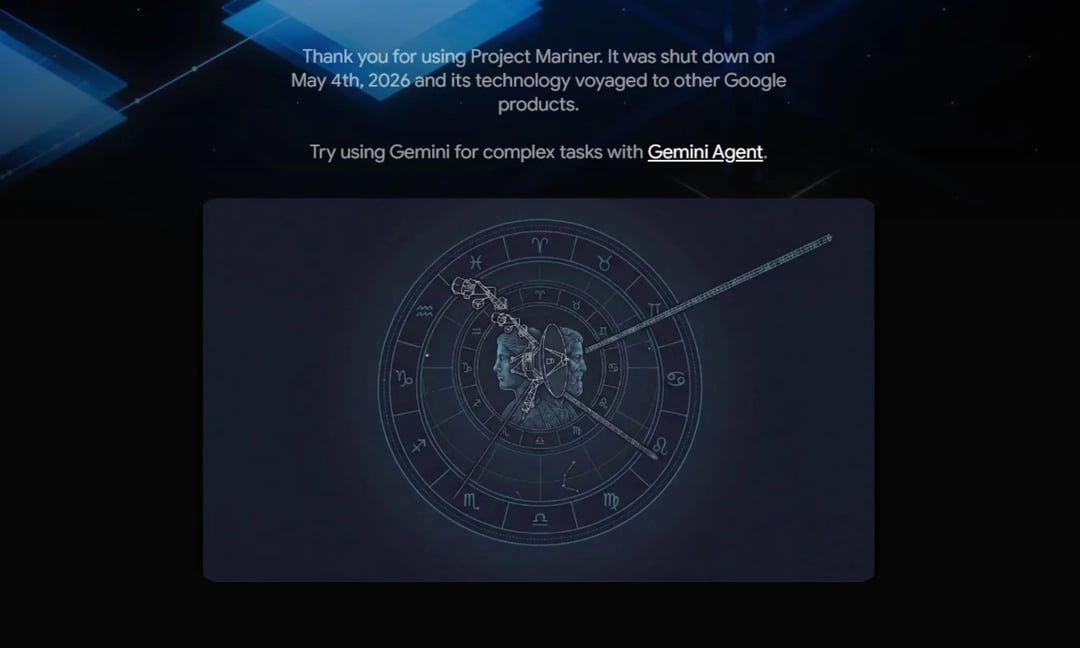
As of May 4, 2026, it's gone. The landing page now shows a shutdown notice, and that's that.
It's a little wild when you think about how much fanfare surrounded it at launch. But honestly? The signs were there.
How Project Mariner Actually Worked (And Why That Was a Problem)
Here's what made Mariner genuinely interesting — and also kind of its fatal flaw. Instead of reading raw page data the way most bots do, it took screenshots in real time and visually recognized buttons, text fields, and links. Then it clicked and typed on your behalf. Like watching someone else use your computer, basically.
That approach meant it could handle multi-step tasks across almost any website without needing any backend cooperation from the site itself. Pretty clever, right?
But the trade-off was brutal. Visual processing at that scale eats compute. And it wasn't always accurate — think clicking the wrong dropdown option, or misreading a form field. Small errors, sure, but the kind that compound fast when you're automating tasks across the web.
And then there's the privacy thing. Mariner needed continuous access to whatever was visible in your browser at any given moment. That's... a lot of trust to ask from users.
The Warning Signs Showed Up Months Earlier
This didn't happen overnight. Back in March, Wired reported that Google had already started moving staffers off the Project Mariner team. That's usually how these things go — by the time the public shutdown notice appears, the internal decision was made ages ago.
It tracks. When a project starts losing people, it's rarely a good sign. The shutdown in May just made it official.
So Where Did Mariner's Technology Actually Go?
Here's the thing — Google isn't saying the technology is dead, just that the project is. Mariner's core features are reportedly being folded into the Gemini API and the new Gemini Agent. So the work didn't disappear entirely. It just... migrated.
Think of it less like a cancellation and more like an absorption. The pieces that worked get picked up and carried forward, even if the brand name doesn't survive.
Why the Whole Industry Is Moving Away from Visual Browser Agents
This is the bigger story, honestly. The shutdown isn't just about Mariner — it's about a shift in how the whole industry is thinking about agentic AI.
Tools that operate at the file and code level have become the dominant model. They're faster. They're cheaper to run. And they're better at handling complex, multi-step tasks without the overhead that comes with processing screenshots continuously.
Mariner's visual approach was genuinely novel when it launched. But the architecture it was competing against had effectively moved past it. That's a tough position to be in — not because you built something bad, but because the world moved faster than your approach could scale.