
Beijing's Bet on Open AI Development
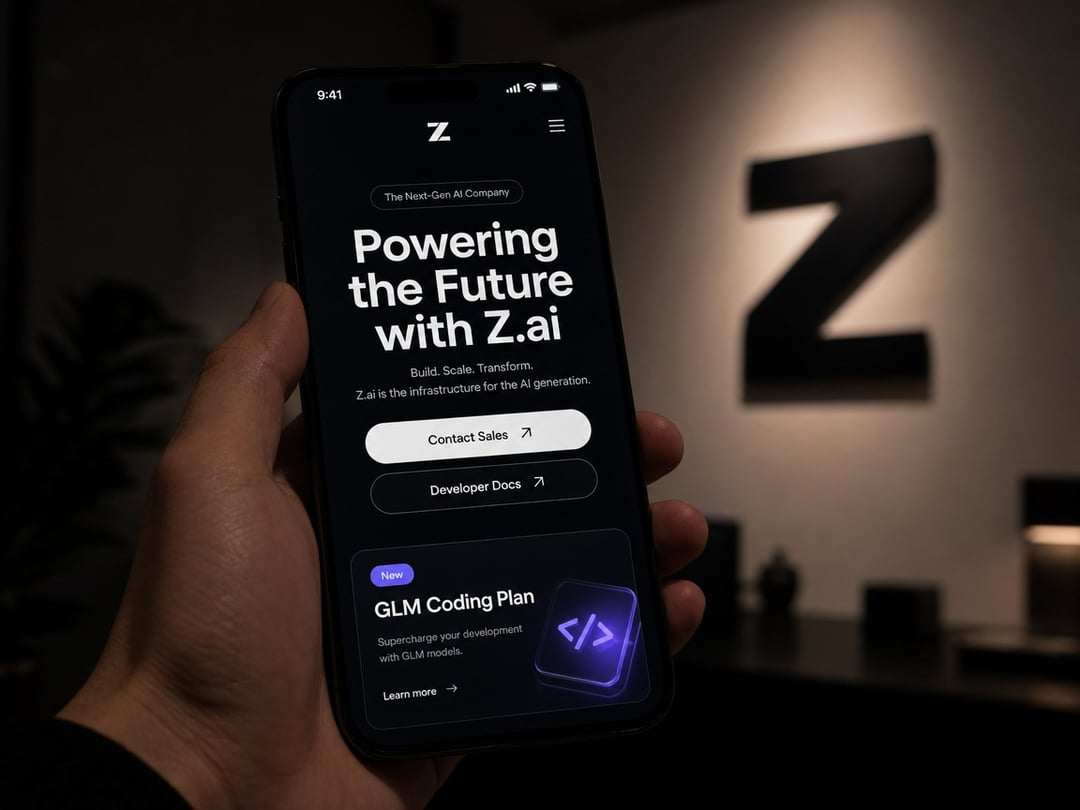
Z.ai, the Beijing-based artificial intelligence company behind the GLM model family, launched GLM-5.2 on June 13 — positioning it as a direct competitor to closed proprietary systems from OpenAI and Anthropic. The release arrived hours after U.S. authorities ordered Anthropic to disable two of its most advanced models, creating an opening that Z.ai's founder moved quickly to exploit.
Jie Tang, Z.ai's founder, framed the launch in explicitly ideological terms. Writing on X, he argued that restricting frontier AI access for non-technical reasons "strengthens our conviction that science should be global," adding that "the path to AGI should not be surrounded by high walls." The message landed at precisely the moment when global developers and enterprise customers were scrambling to find alternatives to Anthropic's now-suspended offerings.
What GLM-5.2 Brings to the Table
Technical Specifications and Capabilities
GLM-5.2 ships with a one-million-token context window and supports a maximum output of 128,000 tokens — specifications that place it in direct competition with the most capable closed models currently available. The model includes two thinking-effort presets, both optimized for coding tasks, giving developers a degree of control over the trade-off between speed and reasoning depth.
At launch, Z.ai made GLM-5.2 immediately available to subscribers of its GLM Coding Plan, with full API access and an open-source release under the MIT license scheduled for later in the week. The MIT license designation is significant: it permits unrestricted commercial use, modification, and distribution, a meaningful contrast to the access controls that have come to define competing systems.
Performance Without Published Benchmarks
Z.ai made an unusual choice at launch: no formal benchmark scores were published. The company acknowledged this decision, though it offered no detailed explanation. Despite the absence of official metrics, early community testing drew comparisons to Claude Opus 4.7 on coding tasks — an assessment cited by Ellie Jiang, head of internet and media research at Macquarie Capital.
The deliberate omission of benchmarks may reflect a broader positioning strategy. By sidestepping numerical comparisons, Z.ai kept attention on its pricing model and open availability rather than inviting granular head-to-head scrutiny.
Anthropic's Shutdown Creates an Unexpected Opening
The Fable 5 and Mythos 5 Suspension
On the evening of June 12, U.S. Commerce Secretary Howard Lutnick issued a directive ordering Anthropic to suspend all foreign national access to its Fable 5 and Mythos 5 models, citing national security concerns tied to a reported jailbreaking vulnerability. Because Anthropic had no mechanism in place to verify user nationality, the company was forced to disable both models for all customers worldwide — including domestic ones.
The timing was particularly damaging for customer trust. Fable 5 had only launched on June 9, three days before the shutdown order. Users who had upgraded their subscriptions specifically to access the new model began seeking refunds within hours of the suspension taking effect.
Zhipu's Strategic Positioning
The disruption handed Z.ai an unplanned but highly visible marketing moment. Jie Tang's public statement directly connected GLM-5.2's release to the Anthropic situation, reinforcing the argument that open-source models provide a form of resilience that proprietary systems structurally cannot. When access depends on a single company's compliance with shifting government directives, that access can disappear overnight. A model released under the MIT license does not carry the same risk.
How GLM-5.2 Stacks Up on Price
The cost differential between GLM-5.2 and its closed competitors is substantial. GLM-5 runs at approximately $1 per million input tokens and $3.20 per million output tokens. OpenAI's GPT-5.2 is priced at $1.75 per million input tokens and $14 per million output tokens. On output-heavy workloads — the type common in coding agents and long-form generation — the gap widens to a cost reduction of approximately five to seven times in Z.ai's favor.
For enterprise buyers running high-volume pipelines, that difference is not marginal. It makes GLM-5.2 a credible default for cost-sensitive deployments, particularly when performance on coding tasks tracks closely with significantly more expensive alternatives.
How the Market Responded and What the Competition Looks Like
Zhipu Shares Surge 33%
Investors responded decisively. Shares of Zhipu AI rose 33% on Monday following the announcement, as Wall Street banks raised their outlook on the company's ability to absorb global AI demand displaced by Anthropic's restrictions. Analysts cited the launch as a factor likely to strengthen Zhipu's pricing power in its upcoming subscription offerings.
On June 16, GLM-5.2 was added to the Arena AI Agent leaderboard, placing it alongside a growing roster of Chinese open-source models including offerings from DeepSeek and Minimax. JPMorgan separately identified Zhipu as its preferred position over MiniMax, applying a framework that weighs consistent state-of-the-art performance, pricing power, and sustainable adoption. MiniMax shares initially fell nearly 9% on the same news before recovering to close up 6.7%, reflecting the broader enthusiasm lifting Hong Kong-listed AI stocks — the Hang Seng Tech Index rose 1.28% on the day.