
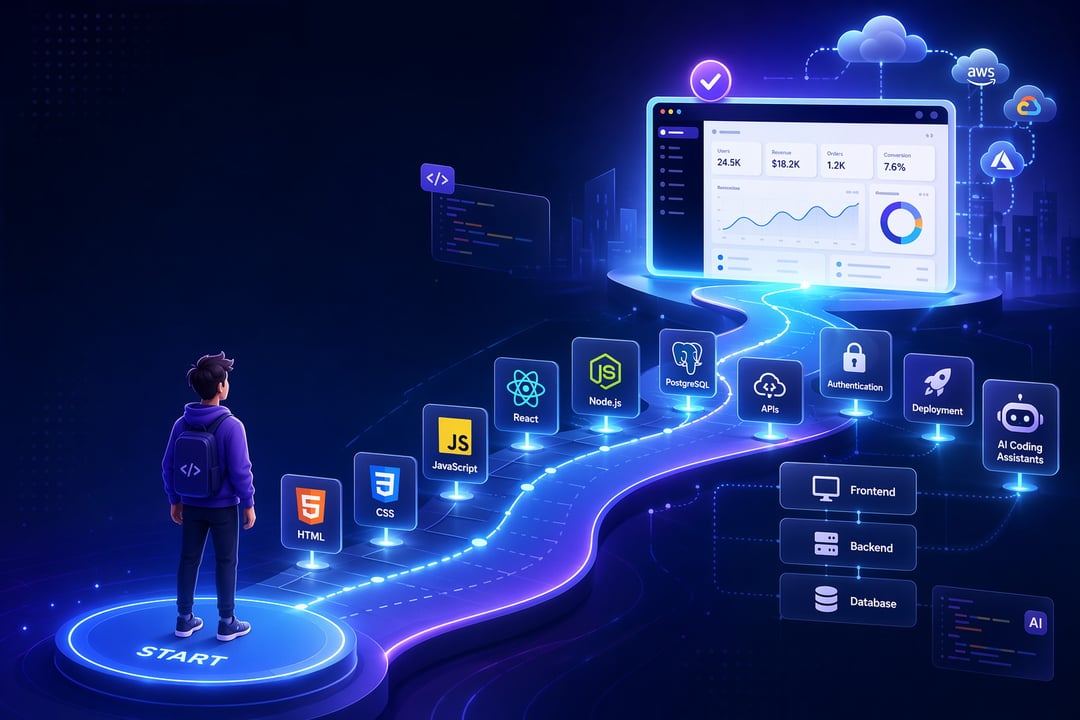
You get the idea for an app. Then you open a tutorial, and forty unfamiliar tool names hit you at once — React, Postgres, Docker, edge functions, ORMs. It reads like alphabet soup — and the quiet message underneath feels like you're already behind.
Here's the truth nobody leads with: full-stack development isn't one massive skill. It's a handful of small ones, stacked in a sensible order. This roadmap walks the actual path a beginner takes to build a full-stack web app in 2026 — minus the gatekeeping.
What "Full-Stack" Actually Means
Strip away the jargon and a web app has three layers. The frontend is everything people see and click — think of it as the storefront. The backend is the logic running behind the scenes, the kitchen where orders get processed. The database is where information lives between visits, like a filing cabinet that remembers your users after they close the tab.
"Full-stack" simply means you can work across all three. Nobody is born fluent in every layer. You learn them one at a time.
Step 1: Get the Fundamentals Down First
This is the step people skip — and it's the one they regret. HTML, CSS, and JavaScript are non-negotiable. Every shiny framework is built on top of these three. Skip the base and every error message later reads like a foreign language.
A fair benchmark: before you touch a framework, you should be able to build a simple page that reacts when someone clicks a button. That's it. Spend a few focused weeks here and the payoff compounds for years. Rush it and you'll spend those years confused about why things break.
Step 2: Pick Your Stack (Don't Overthink It)
Choosing tools paralyzes more beginners than actual coding does. Let's defuse it.
Frontend
React is still the most widely used and most hireable choice in 2026. Many beginners reach for Next.js, which bundles the frontend and backend together so there's less plumbing to learn upfront. Vue and Svelte are excellent too — none of these is a wrong answer.
Backend
The big shift this decade: modern meta-frameworks blur the line between frontend and backend, so you often don't need a separate server just to get started. When you do want one, Node.js keeps everything in a single language — JavaScript top to bottom.
Database
PostgreSQL is the safe default. It's free. It's everywhere. And it scales from a weekend project to a real product without forcing you to switch later.
The principle matters more than the picks. Choose a stack with a big, active community, then stop comparing and start building. The best stack is the one you actually finish something in.
Step 3: Connect the Pieces
Now you turn a pile of parts into a working app — and three concepts do the connecting.
APIs are the messengers. They carry requests from the frontend ("show me this user's orders") to the backend and bring the answer back. Authentication is how users sign in safely — and here's a firm rule for beginners: never build your own login system from scratch. Use a trusted service. Security is one place where reinventing the wheel gets people hurt.
The whole thing runs on a simple loop. A user clicks something. The frontend sends a request. The backend answers. The screen updates. Master that cycle and the rest is variation.
Step 4: Ship It
A project sitting on your laptop isn't an app yet. Deployment is what gives it a real URL that anyone can visit.
The good news is that this used to be genuinely painful and now it mostly isn't. Platforms like Vercel and Netlify have turned deployment into something close to a single click. So ship early. A rough app that's live in the world teaches you more than a perfect one hiding on your machine.
The AI Question: Helper, Not Autopilot
No honest 2026 roadmap can skip this one. AI coding assistants can scaffold projects, explain cryptic errors, and unstick you in seconds. For a beginner, that's a genuine superpower.
But here's where I'll plant a flag. These tools accelerate people who understand the fundamentals and quietly sabotage people who don't. AI writes code. It does not yet understand your project, your goals, or your edge cases for you. Treat it like a patient tutor sitting beside you — not a replacement for learning the craft.
Your Next Move
The real trap isn't choosing the wrong framework. It's trying to learn everything before you build anything.
So do this instead: pick one tiny project — a to-do list, or a personal page with a working contact form — and build it all the way through. Frontend, backend, database, deployed. One finished small thing will teach you more than ten ambitious projects you never ship.


