
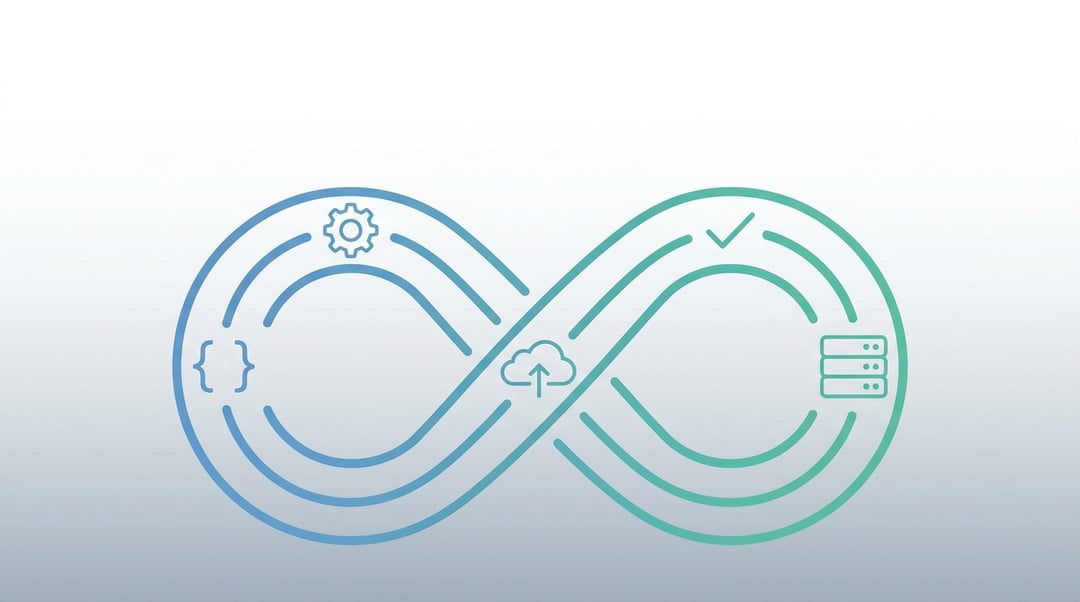
You know that phrase, "well, it works on my machine"? For years, that was the sound of two teams quietly going to war.
Developers wrote the code. IT and operations had to run it. And when something broke at 2 a.m., each side pointed at the other. The developers swore their code was fine. The ops team swore the servers were fine. Nobody was lying, exactly. They just lived in different worlds and only met at the moment things fell apart.
DevOps is what happened when people got tired of that fight. So let's talk about what it actually is, and why both sides ended up wanting it.
What DevOps Actually Means
The word is a mashup: Development plus Operations. That's the whole idea in a nutshell. Take the people who build software and the people who run it, and stop treating them like separate tribes.
Here's the part people get wrong, though. DevOps isn't a tool you buy. It's not a single app, and it's not just a job title you slap on someone. It's a way of working. A culture, plus a set of practices that make that culture possible.
Think about the old way. A developer would finish their code, "throw it over the wall" to operations, and walk away. Operations caught it, often with no real idea what was inside, and tried to make it run in the real world. DevOps tears that wall down. Now both teams share the work and share the blame, which sounds small but changes everything.
The Problem DevOps Was Built to Solve
Releases used to crawl. Deployments happened by hand, late at night, and they failed in creative new ways every time. Features that customers wanted sat finished but unshipped for weeks because nobody trusted the process.
And the human cost was real. Burned-out teams. Frustrated customers. A lot of finger-pointing that fixed nothing. DevOps exists because that friction was expensive, and somebody finally said there has to be a better way.
How DevOps Works in Practice
The core move is simple to say and harder to do: automate the boring repetitive stuff, and collaborate on the rest.
The piece you'll hear about most is CI/CD. Continuous integration means developers merge their code often, sometimes many times a day, and automated tests check it right away. Continuous delivery means you ship changes in small, safe steps instead of one terrifying giant release. Small changes are easier to fix when they go wrong, and they go wrong less often.
There's more underneath. Infrastructure as code, where you describe your servers in a file instead of configuring them by hand. Monitoring that watches everything and shouts early when something's off. Fast feedback loops so nobody waits a week to learn their change broke.
Picture a tiny example. A developer tweaks one line, pushes it, and within a few hours it's live for real users. Tested, deployed, watched. No 2 a.m. heroics. That's the difference.
Why Developers Use DevOps
Developers like fast feedback. With DevOps, they find out almost immediately whether their code actually works, instead of waiting around for a far-off release day.
They also spend less time firefighting and more time building, which is the part they signed up for. There's a sense of ownership, too. You ship your own work and watch it land, rather than handing it off and crossing your fingers. And honestly, automation taking over the dull, error-prone manual steps just makes the job better.
Why IT and Operations Teams Use DevOps
Operations cares about one thing above all: stability. And it turns out small, frequent releases break far less than huge, risky ones. Less drama, fewer surprises.
Automated deployments help, too, because a script doesn't fat-finger a command at midnight the way a tired human does. Monitoring gives the team real visibility, so problems get caught early instead of discovered by an angry customer. Maybe best of all, shared responsibility means operations is no longer the lone scapegoat when something fails.
The Shared Win — Why Both Sides Benefit
Here's the heart of it. DevOps isn't dev versus ops anymore. It's dev and ops, pointed at the same goal: reliable software, shipped fast.
You can see it's real and not just talk by the tools everyone's adopted. Git for tracking code. Jenkins for automating builds. Docker for packaging apps so they run the same everywhere. Kubernetes for managing all of it at scale. These exist because enough teams needed them.
Is DevOps Right for Every Team?
Quick reality check. DevOps is a shift in habits and culture, not a switch you flip overnight. It takes patience.
A small startup might adopt it lightly, almost by instinct. A big organization has to work harder, untangling years of old process. The payoff is real but it's a long game, not a quick fix. If you want a deeper, well-grounded primer, Atlassian's DevOps guide is a solid place to start.
The Bottom Line
DevOps closes the gap between building software and running it. That's really all it is, underneath the buzzwords.
Developers get speed. Operations gets stability. And everyone, including the customer, gets better software with less misery along the way. So if there's one thing to remember, it's this: DevOps was never about the tools. It's about two teams finally working toward the same thing.


