
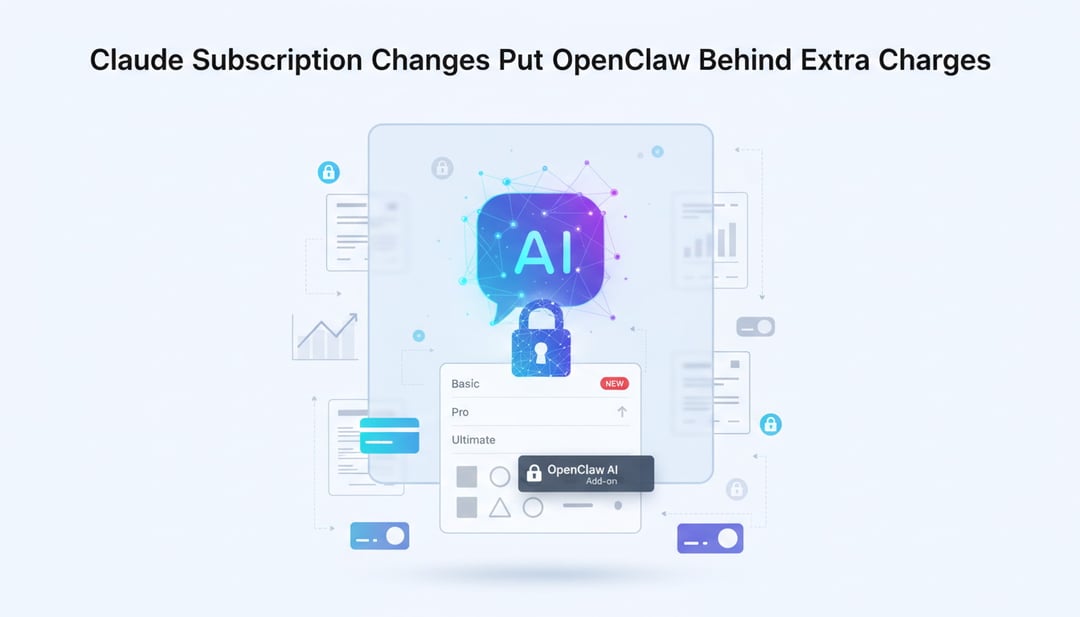
Anthropic Changes How Claude Works With OpenClaw
Anthropic has changed how Claude subscriptions apply to third-party tools, and the shift lands hard on people who used OpenClaw to extend what Claude could do. Regular Claude subscriptions no longer cover usage through outside tools like OpenClaw. Instead, that activity now falls under a separate pay-as-you-go billing model.
The practical effect is simple: a setup many users relied on is no longer included in the standard subscription. Anyone who still wants to use Claude through OpenClaw now has to pay beyond the base plan, either through extra usage bundles or with a Claude API key.
What the New Claude Billing Policy Means
Under the updated setup, Claude access inside third-party tools is treated differently from standard subscription usage. Rather than being included automatically, that usage now requires added spending.
That change reshapes the value of a normal Claude subscription for users who depended on OpenClaw for more advanced workflows. What had been part of an existing routine is now gated by additional cost.
Why OpenClaw Became Popular With Claude Users
OpenClaw was not framed as a minor or fringe use case. It gained traction because it could handle practical tasks such as emails, calendars, and even flight check-ins. That made Claude feel more like a working assistant rather than just a chat tool.
This broader utility is a big part of why the change feels significant. People were not just experimenting. They were using OpenClaw to push Claude into more capable, real-world workflows.
OpenClaw Turned Claude Into a More Practical Assistant
The appeal of OpenClaw came from how it extended Claude into task-oriented use. Handling email, managing calendars, and supporting flight check-ins pushed the experience closer to assistant-style automation.
That matters because the billing shift does more than raise costs. It changes access to one of the more useful ways people had found to make Claude do more.
Why Anthropic May Be Tightening Access
The material points to pressure on Anthropic’s infrastructure as a reported reason behind the move. OpenClaw’s popularity appears to have created enough strain to trigger a clampdown.
From that angle, this is not presented as a minor adjustment. It reads more like a response to growing demand and a decision to limit a pattern of use that had become difficult to support under the old model.
Infrastructure Pressure and the Claude Clampdown
The reported issue is not framed around a small pricing tweak. Instead, the change is described as a clampdown driven by the way OpenClaw use scaled.
If a tool becomes widely used for demanding workflows, that can reshape how a platform provider thinks about cost, access, and control. Here, the result is a clear separation between regular Claude subscriptions and third-party usage.
Why This Feels Bigger Than a Simple Price Update
The change is described as more than a billing adjustment. It signals a harder line around how Claude can be used outside Anthropic’s preferred structure. The message comes through pretty clearly: if users are building workflows in ways Anthropic did not design or monetize properly, that path may close fast.
That is why the move feels sharper than a normal subscription revision. It does not just increase cost. It redraws the boundary around what a paid Claude plan actually includes.
The End of a Popular Claude Workflow Shortcut
A major takeaway is that the workaround many users leaned on is effectively over in its old form. Using Claude credits inside OpenClaw to power advanced workflows is no longer covered by the standard subscription.
For power users, that shifts the entire equation. A familiar and valuable workflow now comes with extra fees, making the old approach much less attractive.
How the Change Pushes Users Toward Anthropic’s Own Ecosystem
There is also a strategic angle in the shift. By making third-party usage more expensive, Anthropic encourages users to stay inside its own ecosystem, including tools like Claude Cowork.
That may improve control for Anthropic, but it is a tougher outcome for people who preferred combining Claude with outside tools. For those users, flexibility takes a hit when the most useful integrations are no longer covered under the standard subscription.
Claude Cowork and Ecosystem Control
The pricing split creates a clear incentive. If third-party routes cost more, users may be more likely to choose Anthropic-controlled options instead.
That kind of move can strengthen platform control, but it also narrows the appeal for users who liked building custom setups around Claude and OpenClaw.
What Power Users Lose With the OpenClaw Paywall
The users most affected are the ones who were already pushing Claude beyond basic chat. They used OpenClaw to build more advanced, useful workflows, and they did so under the expectation that their Claude subscription covered that activity.
Now, that expectation no longer holds. The new system adds friction and cost to the exact kind of high-value usage that helped OpenClaw stand out.
Extra Usage Bundles and API Access Replace Included Use
Anthropic is still allowing access through third-party tools, but only under different payment paths. Users can keep using those tools with their Claude login through extra usage bundles, or they can use a Claude API key.
That means access is not gone outright. But it is no longer bundled into the regular subscription, which is the core issue driving frustration.
FAQ
Does a regular Claude subscription still cover OpenClaw usage?
No. Usage through third-party tools like OpenClaw is no longer covered by a regular Claude subscription.
How can users still access Claude through OpenClaw?
They can use extra usage bundles with their Claude login or use a Claude API key.
Why did this change happen?
The material says OpenClaw’s popularity reportedly put pressure on Anthropic’s infrastructure, leading to a clampdown.