
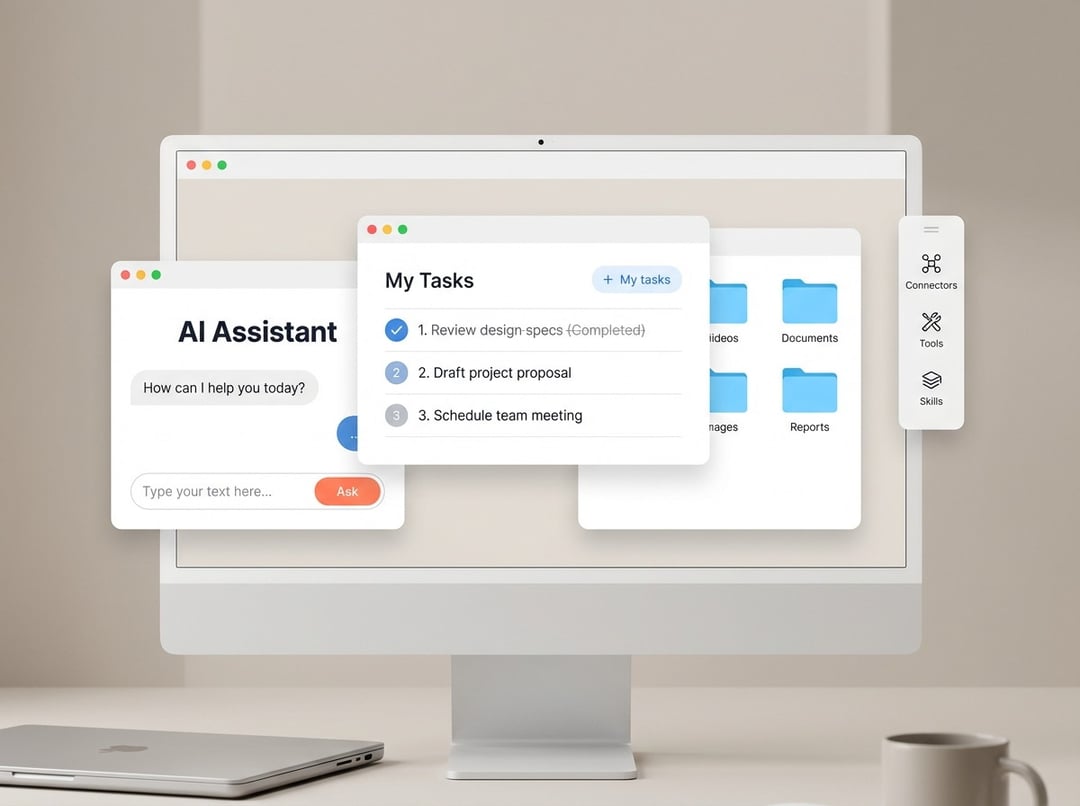
Claude Cowork reaches general availability on paid plans
Claude Cowork is moving past early testing and into a broader workplace role. On April 9, Anthropic said the product became generally available on all paid plans for macOS and Windows, alongside a set of enterprise features designed to support larger rollouts.
That combination matters more than the availability update alone. Anthropic is linking the release to role-based access controls for Enterprise, group spend limits, usage analytics, expanded OpenTelemetry support, and tighter connector permissions. Taken together, those additions are meant to make Cowork easier to manage across an organization.
Enterprise oversight tools for broader workplace adoption
Role-based access controls and connector permissions
The biggest shift is the management layer. Enterprise admins can now control access by provider, model, and feature. That gives organizations a clearer way to decide who can use what, instead of leaving those choices open across the board.
Tighter connector permissions push that same idea further. If Cowork is going to sit closer to internal information and team workflows, organizations need more control over how those connections are handled. The update reflects that need.
Group spend limits and usage control
Group spend limits give companies a way to manage usage across departments rather than leaving budgets up to individual employees. For larger teams, that changes Cowork from a personal productivity tool into something that can be governed at the organizational level.
And that’s really the point of this release. Broader deployment at work usually depends on controls like access settings and spending guardrails, not just on whether the software is available to install.
Usage analytics and OpenTelemetry support
Anthropic is also expanding the reporting view. Dashboard metrics and the Analytics API can track sessions, active users, connector activity, and adoption by team.
Broader OpenTelemetry support is designed to feed Claude usage into existing monitoring systems. That matters because companies often want new workplace tools to fit into systems they already use for visibility and oversight, instead of creating a separate layer they have to manage on their own.
Claude Cowork is expanding beyond technical teams
Anthropic made it clear that Cowork is no longer being framed mainly as a tool for technical teams. According to the company, most usage already comes from operations, marketing, finance, and legal.
That helps explain why this release leans so heavily on governance and monitoring. If the product is being used across non-engineering groups for project updates, research, and internal collaboration, then admin controls become central rather than optional.
Where Claude Cowork fits inside everyday business work
From specialist assistant to shared work layer
Anthropic’s broader message is about Cowork’s role inside a business. The product is being positioned less as a specialist assistant and more as a shared layer for everyday work.
That’s a meaningful shift. Instead of living in a narrow, code-focused lane, Cowork is being presented as something that can draw from connectors, internal information, and team-specific workflows across different departments.
Internal collaboration and team-specific workflows
Most use is already coming from non-engineering groups handling project updates, research, and internal collaboration. That suggests Cowork is being shaped around work that happens across teams, not just around isolated technical tasks.
In that setting, the enterprise features are not just add-ons. They support the idea that Cowork can function as part of shared workplace infrastructure, where multiple teams rely on the same system but still need clear oversight, usage tracking, and permission controls.
What broader Cowork adoption depends on
The next test is whether companies treat Cowork as a standard workplace tool or keep it in a narrower lane. General availability gives Anthropic a stronger opening, but broader adoption depends on whether admins see enough structure and oversight to support wider use across an organization.
That’s the real pressure point. The release is not just about reaching more users. It’s about proving that Cowork can work as a managed, visible, and controllable layer inside everyday business operations.