
After more than a thousand deployments you stop chasing shiny tools. You start chasing predictability. CI/CD pipeline best practices stop feeling theoretical and start feeling personal. Because every broken deploy costs trust. Every smooth release builds it.
Here is what actually held up after 1000+ pushes to production.
Why CI/CD Pipeline Best Practices Matter More Than Your Toolchain
Most teams obsess over tooling. Jenkins versus GitHub Actions. GitLab CI versus CircleCI. The debate feels important.
It is not.
Tools execute instructions. Pipelines reflect discipline. We migrated the same CI/CD pipeline across platforms with minimal performance variance. The stability came from deterministic processes not vendor features.
The real damage shows up when pipelines wobble. Deployments slow down. Engineers hesitate before merging. Hotfixes pile up. Eventually people batch changes into risky releases. That is when failure becomes expensive.
CI/CD pipeline best practices exist to remove drama from delivery.
Build Stability: The Foundation of Reliable CI/CD
If builds behave differently across environments your pipeline will never mature. Deterministic builds form the baseline.
Deterministic Builds or Nothing
Pin dependencies. Commit lockfiles. Version infrastructure definitions. Generate immutable artifacts once then promote them through environments.
Do not rebuild per stage.
Environment drift creates phantom bugs that waste hours. Production must mirror staging at the binary level. When we enforced artifact immutability our rollback success rate improved immediately.
Consistency compounds.
Fast Feedback Loops Create Momentum
Developers think in minutes not hours. A ten minute build feels manageable. A thirty minute build kills flow.
Optimize for sub ten minute pipelines when possible. Parallelize test suites. Cache dependencies aggressively. Use incremental builds where architecture allows.
Speed changes behavior. Faster pipelines encourage smaller commits. Smaller commits reduce risk.
Fail Fast and Loud
A failing pipeline should be unmistakable. Surface structured logs. Push alerts to shared channels. Expose clear failure reasons.
Silence breeds confusion. Clarity builds trust.
Deployment Best Practices That Actually Scale
Deployment strategy determines whether CI/CD becomes empowering or terrifying.
Small Frequent Releases Beat Heroic Launches
Large releases magnify blast radius. Small releases isolate change. This is not philosophy. It is risk mathematics.
Trunk based development enforces integration discipline. Merge daily. Deploy often. Reduce divergence.
After 1000+ deployments one pattern emerged. Smaller changes almost never caused systemic outages. Massive merges often did.
Feature Flags Over Long Lived Branches
Long lived branches decay. They drift from production reality. Integration becomes painful.
Feature flags decouple deployment from release. Ship dormant code. Activate selectively. Roll back instantly without redeploying.
This approach transforms deployment into a technical action rather than a business event.
Blue Green and Canary Without the Hype
Blue green deployment duplicates environments. Traffic switches only after validation. Canary releases expose changes to a small user subset first.
Use blue green for infrastructure shifts. Use canary for behavioral changes that need real traffic validation.
Both approaches reduce uncertainty. Neither requires complex tooling if architecture remains modular.
For deeper architectural patterns see the Google SRE guidance at https://sre.google/sre-book/.
Observability Turns Deployment Into a Feedback Loop
A pipeline passing does not mean success. Production decides success.
Define Success Before You Deploy
Track error rates. Monitor latency percentiles. Measure resource saturation. Define rollback thresholds before rollout begins.
We integrated metrics directly into release dashboards. That visibility reduced incident detection time significantly.
Monitoring closes the CI/CD loop.
Rollback Is a First Class Capability
Every deployment must include a reversal plan. Automate rollback triggers when feasible. Maintain backward compatible database migrations.
Never couple schema changes tightly with application releases. Expand first. Contract later.
When rollback feels easy teams deploy confidently. Confidence accelerates iteration.
For production observability standards explore the OpenTelemetry framework at https://opentelemetry.io/.
Cultural Lessons From 1000+ Deployments
Technology solves mechanics. Culture solves reliability.
Ownership Beats Hand Offs
If developers write code they own its deployment health. Shared responsibility reduces blame shifting. Incident resolution accelerates when creators stay involved.
DevOps is not a department. It is an accountability model.
Documentation Must Reflect Reality
Runbooks should match actual pipeline behavior. Keep diagrams updated. Remove obsolete steps immediately.
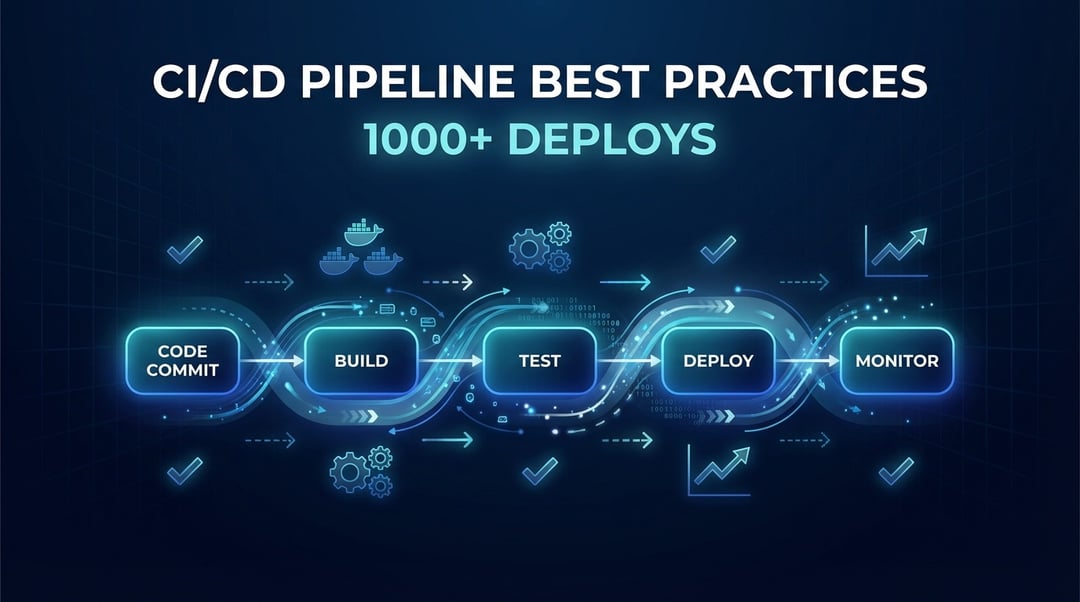
A simple conceptual model works well:
- Source control triggers build
- Build produces immutable artifact
- Artifact passes automated tests
- Deployment strategy controls traffic shift
- Monitoring validates production state
When teams visualize flow they spot weaknesses quickly.
Postmortems Without Blame Improve Systems
Every incident carries information. Analyze root causes not personalities. Document contributing factors. Convert lessons into pipeline safeguards.
Over time failure frequency declines. Not because people try harder. Because systems improve.
The CI/CD Maturity Curve
CI/CD maturity evolves in stages:
- Manual deployments with ad hoc scripts
- Automated builds with manual releases
- Continuous delivery with gated production
- Continuous deployment with automated safeguards
The inflection point occurs when predictability exceeds heroics. When engineers trust the pipeline more than manual intervention.
That trust takes repetition. It takes instrumentation. It takes discipline.
A Practical CI/CD Pipeline Best Practices Checklist
- Deterministic builds with pinned dependencies
- Immutable artifacts promoted across environments
- Sub ten minute feedback cycles
- Automated test gating before merge
- Deployment decoupled from feature release
- Observability integrated into rollout
- Automated rollback capability
- Shared ownership culture
Audit your current pipeline against this list. Identify the weakest link. Improve one dimension this sprint.
After 1000+ deployments one truth stands out. Stability scales faster than complexity. Nail the fundamentals. Deploy small. Monitor closely. Iterate relentlessly.
That is how CI/CD becomes boring in the best possible way.