
Christopher Nolan has never been shy about eyeing new technology with a raised eyebrow, and his latest comments on artificial intelligence land right in that tradition. The Oscar-winning director, whose fresh take on “The Odyssey” is currently topping the box office, says he finds it “pretty encouraging” to watch a wave of deep skepticism build around AI — and he’s especially heartened that so much of it is coming from younger audiences.
The remarks came during a conversation with interviewer Hugo Travers, who runs the YouTube channel HugoDécrypte. Travers reached for an image straight out of Nolan’s own film: the Trojan horse. He asked whether AI might be one of those things you happily let into your everyday life, only for it to turn into something else — something darker — the way that wooden gift concealed Greek soldiers ready to strike.
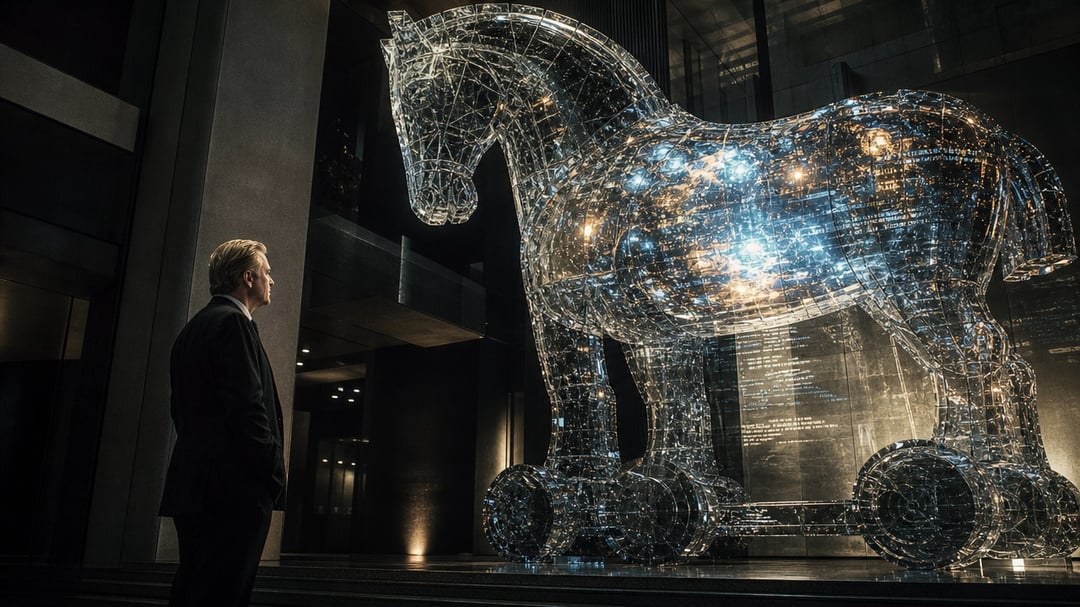
Nolan’s Trojan Horse Comparison, Made of Glass
Nolan didn’t reject the metaphor. He sharpened it. Laughing, he said AI is a Trojan horse that everybody already knows the Greeks are hiding inside. Then he pushed the image one step further, describing the technology as a transparent horse — one made of glass.
That’s the twist worth sitting with. The classic Trojan horse worked because nobody saw the danger coming. Nolan’s version flips that. The threat, as he frames it, isn’t hidden at all. People can see straight through it, and plenty of them don’t like what they’re looking at.
He backed that up with an observation about pace and pushback. In his telling, he’s never watched a technology move this fast while getting so thoroughly rejected by the public. The suspicion, he said, runs unusually deep — and it runs deepest among young people.
Why Nolan Thinks the Skepticism Is ‘Healthy’
For Nolan, this reaction isn’t a problem to be managed. It’s a good sign.
He pointed to how quickly people around the age of his own children have responded to AI-generated videos online — dismissing them, boxing them up, and coining the now-familiar term “AI slop.” Rather than reading that as knee-jerk negativity, he sees a useful instinct at work.
His argument breaks down into two parts:
- New technology always arrives bearing gifts. That much he grants. But those gifts, he said, still deserve a skeptical eye rather than automatic trust.
- The people handing over the technology deserve the same scrutiny. Their motives, in Nolan’s view, matter just as much as the tool itself.
Put those together, and you get his real point: the best outcomes come from questioning both the thing and the people selling it — not from blind faith that everything will simply turn out fine.
Hollywood’s AI Anxiety and Nolan’s Seat at the Table
Nolan stopped short of spelling out exactly what he sees as the danger. But he’s far from an outside voice on this one. AI has become a mounting worry across Hollywood, and it sat at the center of the writers’ and actors’ strikes in 2023.
His concern also carries institutional weight. Nolan serves as president of the Directors Guild of America, which secured a set of generative AI protections in its most recent contract. So when he talks about scrutinizing both the technology and its backers, he’s speaking from inside an industry that has already had to fight over exactly where those lines get drawn.
Not everyone connected to the film shares his measured tone, either. SpaceX CEO Elon Musk has been posting angrily about the movie’s nonwhite and transgender cast members — a reminder of how heated the conversation around “The Odyssey” has become well beyond the AI question.
A ‘Techno-Skeptic,’ Not a Technophobe
Nolan’s wariness toward new tech isn’t new. He’s famously kept his distance from tools like smartphones, and that resistance has earned him a strange double reputation — part Luddite, part pioneer.
The pioneer half isn’t a stretch. “The Odyssey” became the first feature film shot entirely on IMAX film and cameras, a technically ambitious feat that has more in common with pushing boundaries than avoiding them.
He draws that distinction himself. Asked whether he considers himself a technophobe, he rejected the label and offered a different one: techno-skeptic. His devotion to film, he explained, comes down to how it captures the world — in his view, it renders the way the eye actually sees better than any digital imaging system he’s encountered.
And his real complaint isn’t with innovation at all. It’s with how innovation gets sold.
New technology, he said, tends to be pitched to people at the expense of older systems that may still be perfectly valid and workable. That’s the pattern he watched play out in his own industry — the reflex to throw out something proven the moment something new arrives. In his words, the business nearly lost film entirely. For Nolan, that near-miss is the whole point: embracing what’s next shouldn’t mean discarding what already works.


