
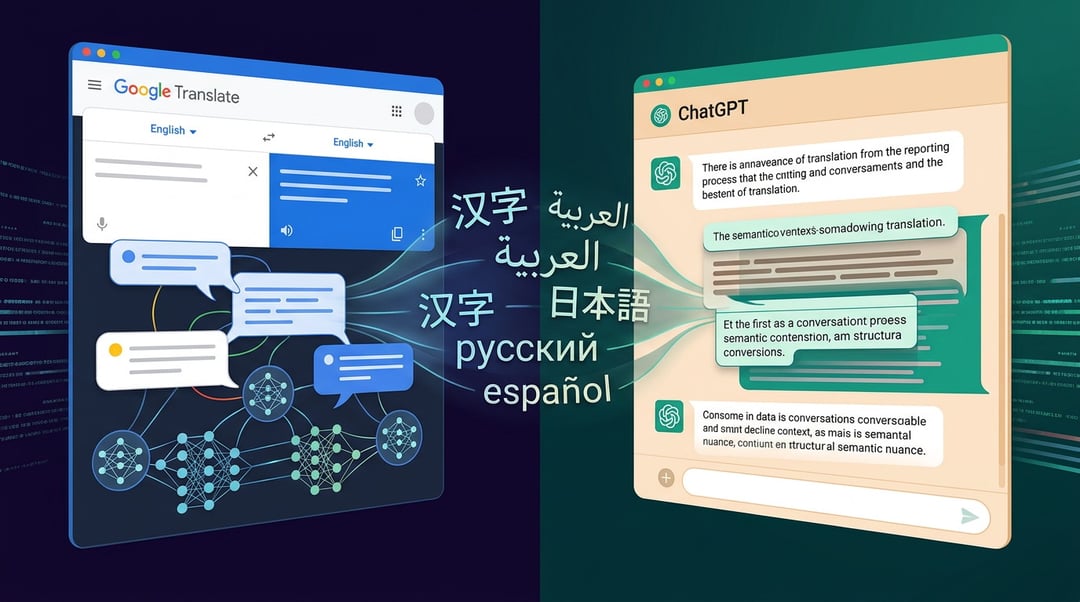
When you need something translated, you usually want one thing. Clarity. Fast.
Maybe you are reading a product review in Spanish. Maybe you are sending a work email in German. Maybe you are just trying to understand a menu in Tokyo.
Two names come up every time: ChatGPT Translate vs Google Translate.
They both translate language. They both use advanced AI. Yet they feel very different once you start using them seriously.
Here is what actually separates them.
What Is Google Translate and How Does It Work?
Google Translate is a purpose-built machine translation engine. It runs on Neural Machine Translation systems introduced in 2016. These systems process entire sentences at once rather than translating word by word.
Under the hood, it relies on transformer architectures first described in the landmark research paper “Attention Is All You Need” by Vaswani et al.
https://arxiv.org/abs/1706.03762
That architecture allows the model to analyze sentence structure holistically. It predicts meaning based on probability across billions of bilingual examples.
In simple terms, Google Translate specializes in language conversion at scale.
Where Google Translate Excels
- Supports over 100 languages.
- Translates instantly.
- Offers camera-based real-time translation.
- Works offline through downloadable packs.
- Integrates seamlessly with Chrome and Android.
If you need speed, it delivers. If you need quick comprehension, it rarely hesitates.
Where Google Translate Falls Short
However, Google Translate treats most inputs as isolated segments. It does not fully track deeper conversational context. It aims for statistical correctness rather than stylistic precision.
That difference becomes visible when:
- Tone matters.
- Cultural nuance matters.
- Industry terminology matters.
- Paragraph cohesion matters.
It translates what you wrote. It does not ask why you wrote it.
What Is ChatGPT Translate?
“ChatGPT Translate” is not a separate product. It refers to using ChatGPT’s large language model capabilities to perform translation tasks.
Unlike Google Translate, ChatGPT was not built exclusively for translation. It was trained on vast multilingual corpora to understand meaning, context, and intent across domains.
That changes the output significantly.
Context Is the Core Difference
ChatGPT processes entire passages. It tracks tone. It understands implied meaning. It can ask clarifying questions.
You can say:
- “Translate this formally.”
- “Make this sound casual.”
- “Localize this for a UK audience.”
- “Explain why you chose that phrase.”
Google Translate executes. ChatGPT interprets.
That distinction matters when translating:
- Business emails.
- Academic research.
- Marketing copy.
- Legal drafts.
- Long-form articles.
ChatGPT can also rewrite while translating. It can simplify. It can adapt for audience literacy level. It can adjust emotional tone.
That is not basic translation. That is contextual language modeling.
Limitations to Consider
ChatGPT is not optimized solely for translation latency. It may respond slightly slower. It does not offer built-in camera scanning or offline packs.
And because it generates text probabilistically, vague prompts may produce inconsistent outputs.
Precision requires precise instructions.
ChatGPT Translate vs Google Translate: Accuracy Compared
Accuracy depends on what you define as accurate.
Google Translate often performs exceptionally well on high-frequency language pairs like English and Spanish. It draws from enormous parallel corpora optimized specifically for bilingual mapping.
For short, clear sentences, it is extremely reliable.
ChatGPT shines when ambiguity enters the picture.
Consider the word “bank.” Is it financial? Is it riverbank? Context determines the answer.
ChatGPT evaluates surrounding sentences and adjusts accordingly. It maintains pronoun continuity across paragraphs. It preserves voice.
Google Translate focuses on direct semantic equivalence. ChatGPT focuses on communicative intent.
That difference becomes critical in professional environments.
Tone and Style Control
Here is where the gap widens.
Google Translate typically outputs neutral tone. It does not intentionally shape voice. It aims for structural correctness.
ChatGPT can translate and reshape tone simultaneously.
For example:
- Formal corporate tone.
- Conversational tone.
- Academic tone.
- Persuasive marketing tone.
- Child-friendly explanation.
This flexibility makes ChatGPT valuable for content localization rather than literal translation.
Localization goes beyond words. It adapts meaning for culture and context.
That capability is increasingly essential in global business.
Speed and Convenience
Google Translate dominates in raw speed.
Type a phrase. Get instant output.
It also offers live voice translation and image recognition. That makes it ideal for travel and real-time communication.
ChatGPT requires conversational input. It works best when you provide full context. It performs better with structured prompts.
For quick phrase checks, Google Translate wins.
For nuanced communication, ChatGPT often provides superior results.
Privacy and Data Considerations
Both tools process user input via cloud infrastructure.
Google provides enterprise-grade APIs through Google Cloud Translation. Documentation is available here:
https://cloud.google.com/translate/docs
ChatGPT usage depends on platform tier and API configuration.
For sensitive documents, always review platform data policies before submission.
No AI translation tool should replace secure, compliant human review for confidential contracts.
When Should You Use Each?
Ask yourself five questions:
- Is this casual or high stakes?
- Does tone matter?
- Is the text long or short?
- Does cultural nuance matter?
- Is speed more important than refinement?
Use Google Translate when:
- Traveling.
- Browsing foreign websites.
- Translating signs or menus.
- Checking single words.
Use ChatGPT when:
- Sending international business emails.
- Translating academic papers.
- Localizing website content.
- Drafting multilingual marketing copy.
One tool optimizes for accessibility. The other optimizes for adaptability.