
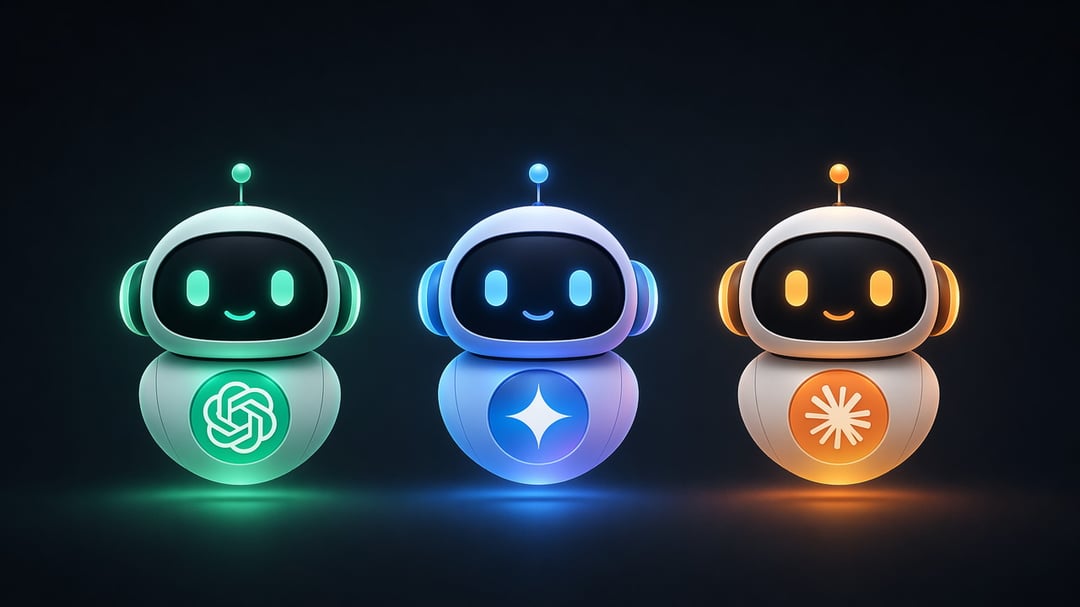
Three years ago, "best AI" meant "only good AI." There weren't many options and the bar wasn't exactly high. If it could write a coherent paragraph without hallucinating a fake law firm, people were impressed.
That era is over.
ChatGPT, Gemini, and Claude have each closed the quality gap in remarkable ways — but they've also carved out entirely different capability lanes. Picking the "best" one without context is like picking the best tool in a workshop without knowing what you're building. The honest answer in 2026 is that the right AI depends entirely on what you're actually trying to do.
Here's a clear-eyed breakdown.
Why "Best AI" Is Now the Wrong Question
The ceiling across all three models has gotten surprisingly close. General reasoning, language fluency, summarization — all three handle these well enough that casual users may barely notice the difference.
But the floor is where things get interesting. Each AI has a distinct weak spot, and each has a lane where it genuinely outperforms the others. The real question isn't which one is smartest. It's which one fits your workflow.
ChatGPT — The Ecosystem Powerhouse
ChatGPT remains the most widely adopted AI assistant in the world and that reach matters. The integration ecosystem around it — GPT Store apps, Zapier workflows, third-party plugins, API support — is the largest of any AI platform by a significant margin. If someone has built a no-code automation around an AI tool, it's almost certainly built around ChatGPT.
For creative work, ChatGPT still leads. Brainstorming, ideation, riffing through variations of an idea, writing in multiple voices — it handles these with a fluency that feels natural rather than mechanical. The multimodal features (voice mode, image generation via DALL-E integration, vision input) are also the most polished and well-documented of the three.
Where it stumbles: complex multi-step reasoning can drift. Long documents can lose coherence. And while hallucination rates have improved, ChatGPT still produces confident-sounding wrong answers more often than Claude does in factual domains.
Bottom line: ChatGPT is the best general-purpose, ecosystem-first choice. If you want the widest compatibility and the most creative flexibility, it's still the default for good reason.
Gemini — The Research and Productivity Engine
Gemini's sharpest edge is its integration with Google's world. If your workday runs through Gmail, Docs, Sheets, or Drive, Gemini feels less like a separate tool and more like an extension of the workspace you're already in. That native embedding is something neither ChatGPT nor Claude can genuinely replicate.
The other major differentiator is real-time web access. Gemini pulls live data natively and does it well — a meaningful advantage for research-heavy tasks, market lookups, news summarization, or anything where information freshness matters. The multimodal reasoning (text, image, video inputs together) is also the most capable of the three.
Where it stumbles: long-form writing. Gemini's prose tends to read a little flat — functional but not particularly engaging. Creative tasks produce competent output rather than inspired output. And persona or tone consistency across a long conversation can wobble.
Bottom line: Gemini is the right pick if you live inside Google's ecosystem or regularly need live, accurate, real-time information. For research-driven workflows, it's the strongest tool in the room.
Claude — The Reasoning and Writing Specialist
Claude is the outlier in this comparison — and deliberately so. Where ChatGPT chases breadth and Gemini chases integration, Claude has focused on depth. Long-context handling is a standout feature: Claude can process and reason across very large documents (200K+ token windows) with coherence that the others genuinely struggle to match at scale.
The writing quality is also distinctive. Claude produces prose that sounds like a person wrote it — nuanced tone, logical structure, consistent voice across long outputs. For content work, legal or technical document analysis, or any task that requires careful, structured thinking, it consistently delivers the sharpest output.
It's also notably less sycophantic. Where ChatGPT will sometimes tell you your idea is great before quietly correcting it, Claude tends to just tell you what it thinks. That directness is either a feature or an annoyance depending on what you're looking for.
Where it stumbles: real-time web access is more limited natively. Third-party integrations and no-code tooling built around Claude are still catching up to ChatGPT's ecosystem. And outside the tech world, it has the lowest brand recognition of the three.
Bottom line: For serious writing, deep document analysis, and complex reasoning tasks, Claude is the sharpest instrument in the set.
Which AI Wins by Use Case
- Long-form writing and content creation → Claude
- Creative brainstorming and ideation → ChatGPT
- Real-time research and live data → Gemini
- Google Workspace productivity → Gemini
- Coding assistance → ChatGPT or Claude (task-dependent)
- Complex document analysis → Claude
- Broadest everyday use → ChatGPT
Worth noting: these are snapshots. All three models update frequently and competitive positions shift with each major release. What's true in June 2026 may look different by December.
So Which AI Is Actually Best in 2026?
There's no universal winner — and anyone telling you otherwise is selling something.
For most general users, the decision is simpler than it looks:
- Choose ChatGPT if you want the broadest ecosystem, the most integrations, and strong creative output.
- Choose Gemini if your workflow runs on Google or you regularly need live, real-time information.
- Choose Claude if writing quality, analytical depth, and handling long or complex documents are your priority.
And here's the thing: most power users don't pick just one. They run two or three depending on the task — ChatGPT for ideation, Claude for the actual writing, Gemini for research. That's not indecision. That's using the right tool for the right job.
All three offer free tiers. The fastest way to find your answer isn't to read more comparisons — it's to try them back-to-back on the same real task. You'll know within a week which one fits how you think.