
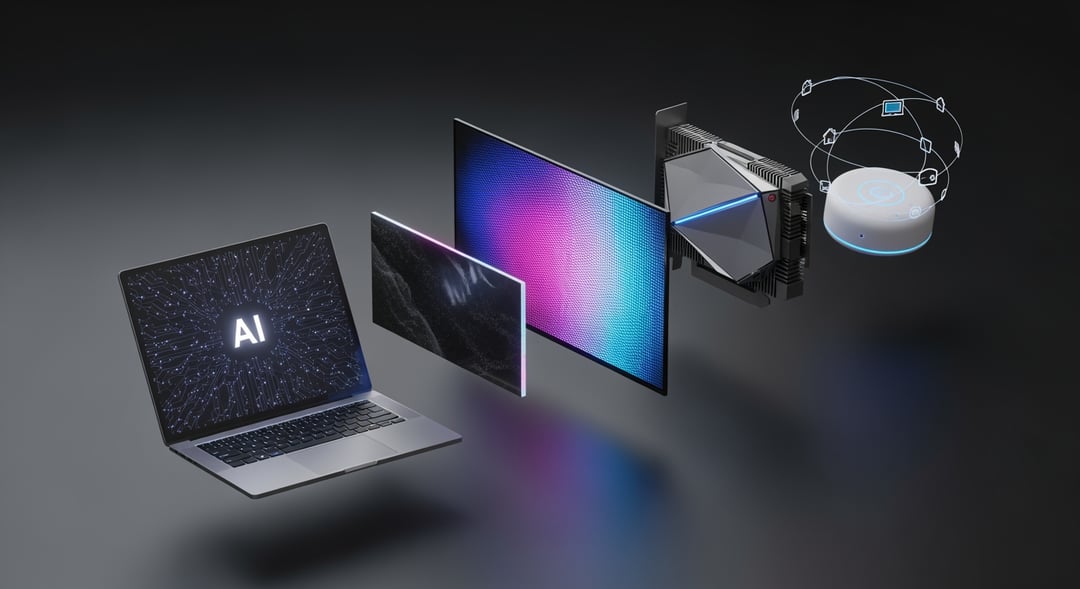
CES 2026 is coming to Las Vegas this January, highlighting how AI can be used in everyday life. The tech world is moving away from ideas and promises and focusing on real products, like AI-powered computers, advanced displays, and connected smart home devices. This CES 2026 preview examines the announcements that will define consumer technology for the coming year.
The AI PC Revolution Takes Center Stage
Intel, Qualcomm, and AMD prepare for a showdown at CES 2026 with three distinct processor architectures. Intel’s Panther Lake chips promise hybrid efficiency cores with integrated graphics capable of handling modern gaming workloads. Qualcomm’s Snapdragon X2 continues the Windows on Arm narrative by delivering exceptional battery life alongside powerful NPUs. AMD enters the fray with its rumored "Gorgon Point" APUs, building upon the impressive Strix Halo platform.
Microsoft’s Copilot+ PC initiative established a 40+ TOPS baseline for NPUs. Vendors at CES 2026 must demonstrate real-world utility beyond these raw specifications. Buyers should seek on-device transcription that functions flawlessly without draining power. AI video upscaling needs to render faster than real-time. Local LLM assistants must operate offline without noticeable latency.
Laptop form factors will undergo significant transformations thanks to these efficient silicon architectures. Lenovo may unveil a rollable Legion Pro gaming laptop that expands display space dynamically. The company could also introduce a Legion Go 2 handheld featuring SteamOS. Expect foldable screens and dual-display clamshells that were previously impossible due to thermal constraints.
Display Technology Enters a New Era
The television market undergoes a massive paradigm shift with Micro RGB LED technology moving from novelty to mainstream. Samsung plans to showcase its 2026 Micro RGB LED TV lineup ranging from 55 to 100 inches. LG will debut its first Micro RGB evo TVs in 75, 86, and 100-inch sizes. These displays offer pixel-level control previously reserved for professional cinemas.
OLED technology continues maturing alongside these advancements. LG’s "four-stack" OLED technology doubles brightness by stacking two layers. QD-OLED panels from Samsung and Sony will see refinements in peak brightness and longevity. Prices for 100-inch flagship TVs will finally break below the $15,000 barrier, making massive screens accessible to high-end consumers.
Modern TVs are evolving into active smart home hubs rather than passive displays. Manufacturers will heavily feature Wi-Fi 7 backhaul support for lower latency connections. The adoption of Matter and Thread protocols allows TVs to act as border routers for smart home networks. This eliminates the need for separate hubs while enabling seamless multi-admin control.
GPUs and Gaming Hardware Pivot Strategy
NVIDIA’s RTX 50 Super series appears to be postponed, marking a surprising shift for a CES usually dominated by GPU launches. Industry reports suggest board partners lack finalized technical specifications. Consequently, the focus shifts toward integrated graphics solutions from all three major chipmakers.
Intel, AMD, and Qualcomm all tout gaming performance from their integrated GPUs. These solutions now handle 1080p gaming at high settings without dedicated graphics cards. This expansion of the "gaming laptop" definition reflects improvements in memory bandwidth within unified memory architectures.
NVIDIA’s presence at CES 2026 will emphasize enterprise and robotics rather than consumer gaming. CEO Jensen Huang’s keynote likely details how Blackwell Ultra and upcoming Vera Rubin architectures power the Isaac robotics platform. The company’s $500 billion backlog in AI chips highlights that revenue is driven by hyperscalers and industrial partners.
The gaming section of the convention center will feature video glasses and XR devices. Companies like TCL, Rokid, and XREAL will showcase lightweight AR glasses designed for productivity. These devices feature improved color passthrough and OpenXR compatibility. The market is maturing toward practical utility rather than niche gaming applications.
Smart Home Ecosystems Reach Maturity
CES 2026 marks the year smart home robotics transition from novelty to functional reality. Beyond advanced robot vacuums with robotic arms, the show may debut humanoid robots performing household chores. LG’s CLOiD home robot features articulated limbs and deeper intelligence. Advances in computer vision enable machines to navigate complex environments and interact with objects.
AI transforms security cameras from passive recorders into active home automation components. New cameras will demonstrate context-aware monitoring capabilities. These systems distinguish between environmental movement and actual security threats with high accuracy.
The adoption of the Aliro standard revolutionizes smart locks at CES 2026. Expect locks featuring UWB (Ultra-Wideband) unlocking technology alongside palm recognition. Facial scanning systems move away from bulky keypads toward sleek minimalist designs. These locks integrate seamlessly with Apple HomeKey and Samsung digital key ecosystems.
Wi-Fi 7 mesh systems will showcase their ability to handle high-bandwidth streams simultaneously. Manufacturers are integrating smart home radios directly into routers. This eliminates the need for standalone hubs while simplifying setup for consumers. Energy management interfaces will provide dashboards that monitor consumption and automate routines using on-device AI.
The Road Ahead for CES 2026
CES 2026 establishes clear trends for the technology industry in the coming year. AI integration moves from marketing buzzwords to tangible features that improve daily life. The focus shifts toward practical applications in robotics, smart home automation, and computing. Tech enthusiasts and buyers should watch for demonstrations that prove these technologies deliver real value rather than empty promises.
The innovations unveiled at CES 2026 will set the stage for product releases throughout 2026. Companies that bridge the gap between data center power and consumer utility will emerge as leaders. This CES 2026 preview provides the foundation for understanding what to expect from the most important technology show of the year.