
Why the Debate Between Central Bank Digital Currencies (CBDCs) and Stablecoins Is Important
Money already feels digital. We tap phones at checkout, move funds through banking apps, and send payments across borders without touching cash. But here’s the important shift: Central Bank Digital Currencies (CBDCs) and stablecoins are not just faster versions of online banking. They represent two competing models for the next phase of money.
CBDCs come from central banks. Stablecoins usually come from private companies or blockchain protocols. That difference sounds technical at first, but it shapes everything: trust, privacy, regulation, payment speed, financial stability, and who controls the rails underneath everyday transactions.
In plain terms, the CBDCs vs. stablecoins debate asks one big question: should digital money be built mainly by public institutions or private innovators?
What Are Central Bank Digital Currencies?
A Central Bank Digital Currency, or CBDC, is a digital form of sovereign money issued by a central bank. Think of it as digital cash, although that phrase can oversimplify the design choices involved.
Cash gives people a direct claim on state-issued money. A CBDC could do something similar in digital form. Instead of holding only bank deposits or payment-app balances, users might hold digital central bank money through approved wallets, banks, or payment providers.
Central banks explore CBDCs for several reasons. They want more resilient payment systems. They want cheaper settlement. They want financial inclusion tools for people who lack access to traditional banking. They also want to preserve monetary sovereignty as private digital assets grow.
The Bank for International Settlements has documented strong global interest in CBDCs, with many central banks studying retail and wholesale use cases. Retail CBDCs target consumers and businesses. Wholesale CBDCs focus on banks, securities markets, and institutional settlement.
That distinction matters. A wholesale CBDC might quietly improve financial plumbing behind the scenes. A retail CBDC would sit much closer to daily life, which makes privacy, accessibility, and public trust far more sensitive.
What Are Stablecoins?
Stablecoins are digital tokens designed to maintain a stable value, usually against a fiat currency such as the US dollar. Their appeal is obvious. They move like crypto but price themselves like traditional money.
A dollar-backed stablecoin, for example, aims to stay worth one dollar. Users can send it across blockchain networks, trade it on crypto exchanges, use it in decentralized finance, or hold it as digital dollar exposure when local banking access feels limited.
Not all stablecoins work the same way. Fiat-backed stablecoins rely on reserves such as cash and Treasury bills. Crypto-collateralized stablecoins use digital assets as backing and often require overcollateralization. Algorithmic stablecoins attempt to maintain value through code, incentives, and market mechanics.
That last category deserves caution. When confidence breaks, algorithmic designs can unravel with brutal speed. Stable money needs more than clever software. It needs credible backing, transparent rules, and dependable redemption.
The Financial Stability Board has emphasized regulation, supervision, and oversight for global stablecoin arrangements because large-scale stablecoins can affect consumers, markets, and financial stability.
Central Bank Digital Currencies (CBDCs) vs. Stablecoins: Core Differences
The most important difference is the issuer.
A CBDC represents public money. Its credibility comes from the central bank and the legal framework of the state. A stablecoin represents private digital money. Its credibility depends on the issuer, reserve quality, redemption rights, audits, custody controls, and regulation.
That creates two very different trust models. With CBDCs, users trust public institutions. With stablecoins, users trust private issuers and the infrastructure around them.
Settlement also differs. CBDCs could settle in central bank money, which gives them strong finality inside the official monetary system. Stablecoins settle on blockchain networks, but their real-world value still depends on whether users can redeem tokens for fiat currency.
Technology adds another layer. CBDCs may use centralized ledgers, distributed ledgers, or hybrid architectures. Stablecoins usually operate on public or permissioned blockchains. Stablecoins often benefit from composability, which means developers can plug them into wallets, exchanges, lending protocols, payment apps, and automated contracts.
Still, technology is not the whole story. Governance matters more. A beautifully engineered stablecoin with weak reserves remains fragile. A CBDC with poor privacy protections may face public resistance no matter how efficient it looks on paper.
Privacy, Regulation, and Control
Privacy sits at the heart of the CBDCs vs. stablecoins discussion.
CBDCs raise concerns because state-issued digital money could create detailed transaction visibility. That does not mean every CBDC would become a surveillance tool. Design choices matter. Some systems may use tiered privacy, offline payments, transaction limits, or legal safeguards.
Stablecoins are not automatically private either. Public blockchains can expose transaction patterns. Blockchain analytics firms can trace flows across wallets, exchanges, and applications. Users may feel anonymous, but the network often remembers more than people expect.
Regulation also separates the two models. CBDCs exist inside the public monetary framework. Stablecoins must prove they can manage reserves, redemptions, financial crime controls, cybersecurity, disclosures, and consumer protection. The International Monetary Fund has repeatedly examined how digital money can affect monetary policy, financial integrity, and macro-financial stability.
The practical takeaway is simple. Digital money does not remove trust. It relocates trust.
Advantages of CBDCs
CBDCs offer strong public-sector credibility. Because a central bank issues them, they may carry lower issuer risk than privately issued stablecoins. During financial stress, that credibility could matter.
CBDCs may also support safer national payment infrastructure. If designed well, they could provide a public payment option that works alongside banks and private networks. Governments could distribute emergency payments faster. Businesses could settle transactions with less friction. Cross-border CBDC experiments may eventually reduce delays in international transfers.
But CBDCs come with hard trade-offs. If people move large amounts from bank deposits into CBDCs, commercial banks could lose funding. That may affect lending. Central banks must also solve cybersecurity, identity, offline access, and inclusion challenges before retail CBDCs can work at scale.
Advantages of Stablecoins
Stablecoins have one major advantage: they already work in live markets.
They move quickly across blockchain networks. Developers build with them. Traders use them. Businesses experiment with them. People in countries with unstable currencies often use dollar-linked stablecoins for practical access to digital dollars.
Stablecoins also support programmable payments. That means money can interact with smart contracts, automated treasury tools, escrow systems, and decentralized applications. It’s like giving money an API. That sounds dry, but it changes what financial software can do.
The weakness is equally clear. Stablecoins depend on trust in private structures. If reserves look uncertain or redemption becomes difficult, users may rush for the exit. A stablecoin can feel solid for years and still face a run in days.
How CBDCs and Stablecoins Could Coexist
The future will probably not belong to CBDCs alone or stablecoins alone. A layered system looks more likely.
CBDCs may provide public settlement infrastructure. Stablecoins may continue to drive private innovation. Banks may issue tokenized deposits. Fintech companies may build wallets, identity tools, compliance layers, and payment interfaces between these systems.
The real winner will be interoperability. Users will care less about ideology and more about whether payments feel fast, cheap, safe, and simple. Businesses will care about settlement speed, compliance clarity, accounting treatment, and customer reach.
So the best question is not “Which one wins?” It is “Which form of digital money fits which job?”
Practical Takeaway on Central Bank Digital Currencies (CBDCs) vs. Stablecoins
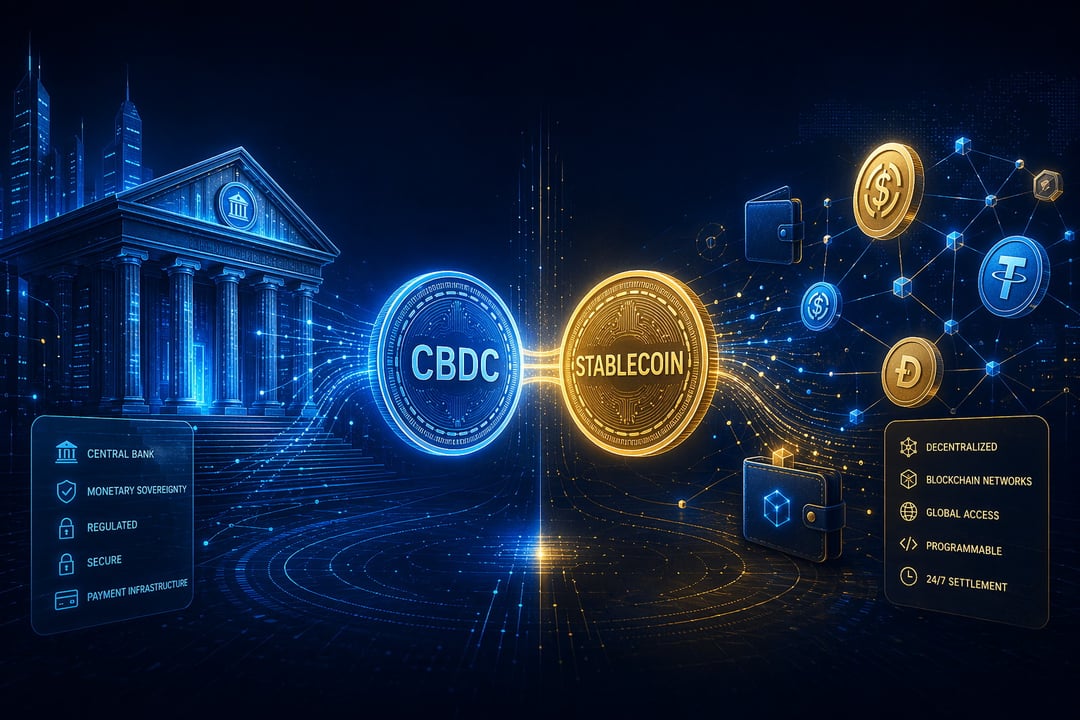
Central Bank Digital Currencies (CBDCs) vs. stablecoins is really a debate about public trust and private innovation. CBDCs prioritize sovereign backing, monetary stability, and official payment infrastructure. Stablecoins prioritize speed, programmability, and global accessibility.
Neither model is perfect. CBDCs must earn trust on privacy and usability. Stablecoins must prove resilience through transparent reserves, strong redemption rights, and serious regulation.
The future of money will likely be plural, not singular. And honestly, that may be the healthiest outcome.
FAQs
Are CBDCs the same as stablecoins?
No. CBDCs are issued by central banks while stablecoins are usually issued by private companies or protocols.
Are stablecoins safer than CBDCs?
Not usually. Stablecoin safety depends on reserves, transparency, redemption rights, and regulation. CBDCs may reduce issuer risk but raise privacy concerns.
Will CBDCs replace stablecoins?
Probably not. CBDCs and stablecoins serve different roles, so they may coexist across payments, settlement, and digital finance.