
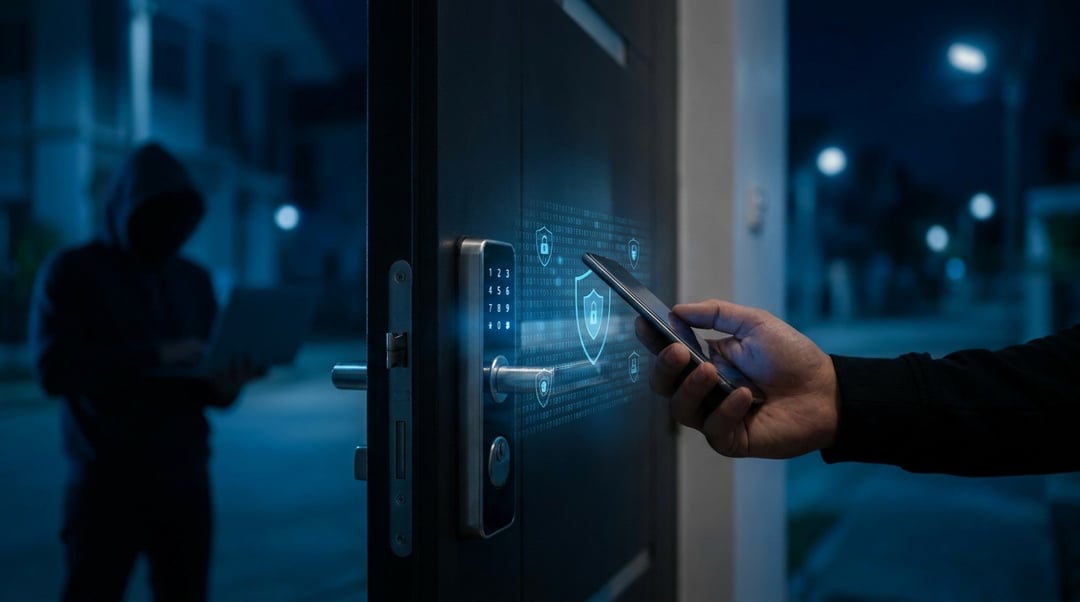
You're standing on your porch, arms full of groceries, tapping your phone to let yourself in. No fumbling for keys. It feels like the future. But here's the thing nobody mentions in the product photos: somewhere between your thumb and that deadbolt, a signal is flying through the air. And anything that travels through the air can be listened to.
So let's answer the question directly. Yes, smart locks can be hacked. The more useful question isn't whether it's possible. It's how likely it is for you, and what actually puts you at risk.
What a Smart Lock Really Is
A traditional deadbolt is a simple thing. One keyhole. One way in.
A smart lock is two things at once: a lock and a tiny computer connected to the internet. That changes the math. Every smart lock has three layers — the physical mechanism on your door, the wireless radio it uses to talk (Bluetooth, Wi-Fi, Z-Wave, or Zigbee), and the app and cloud account sitting behind it all.
Think of it like a house. More windows mean more comfort and light. They also mean more places someone could climb in, even if every window has a latch. That's the trade-off you're making.
How Smart Locks Actually Get Hacked
Forget the Hollywood version. The real attacks are less dramatic and far more preventable than you'd expect.
Weak or default passwords. This is the big one. Security researchers testing popular models have broken into vulnerable locks in under a minute, just by guessing the password the lock shipped with. People genuinely leave them unchanged.
Signal interception. Someone near your door captures the "unlock" command as it travels over Bluetooth or Wi-Fi, then replays it later — like recording someone say a password and playing the tape back.
Outdated firmware. Manufacturers find flaws and release fixes. Owners never install them. Researchers documented vulnerabilities in Sceiner-built lock firmware that let attackers within Bluetooth range open doors — affecting multiple brands that quietly used the same code.
Spoofing and phishing. A fake "manufacturer" email or a rogue Wi-Fi network that tricks you into handing over the credentials to your own front door. Security firms continue to flag these as a leading 2025 threat.
Notice the pattern. Most break-ins won't involve a screwdriver on your lock. They'll involve someone logging into your account from a couch somewhere far away. The weak link is usually the setup, not the metal.
How Worried Should You Actually Be?
Honestly? Less than the scary headlines suggest, but more than zero.
Most burglars aren't running Bluetooth relay attacks. They're walking the street looking for an unlocked window. Smart-lock hacking is real, but it matters most in specific situations — rentals with shared access, high-value targets, or messy disputes where someone tech-savvy holds a grudge.
This isn't a niche worry, though. Roughly 11% of U.S. households now use smart locks, so it's a mainstream question worth taking seriously.
Here's the honest framing: a well-configured smart lock from a reputable brand is often safer than a cheap traditional lock. A badly configured one is a genuine liability. The technology isn't the verdict. Your choices are.
How to Actually Lock It Down
Almost every real-world smart-lock breach traces back to something the owner could have fixed in ten minutes. So fix it.
- Change the default password immediately. Make it long and unique. This single step closes the most common door.
- Turn on two-factor authentication for the account. Even if someone steals your password, they're stuck without the second code.
- Enable automatic firmware updates, or set a monthly reminder to check. Those updates exist because flaws were found and patched.
- Secure your home Wi-Fi. Strong router password, WPA3 if your router supports it. Your lock is only as safe as the network it lives on.
- Buy from established brands with a track record of releasing patches. Skip the no-name locks running shared, unaccountable firmware.
- Keep a physical key backup somewhere safe. Redundancy isn't paranoia. It's just smart.
The Bottom Line
Can your smart lock be hacked? Technically, yes. But in the real world, almost every breach comes down to a weak password, a skipped update, or an unprotected account — not some genius cracking unbreakable encryption.
That's actually good news. It means you don't need to be a security engineer to be safe. You need to do five basic things, and do them consistently.
So go check your lock's settings. Right now, while you're thinking about it. The goal was never fear. It's walking up to your own front door knowing exactly how safe you really are.