
Channel Sounding: Precise Bluetooth Distance Tracking for Locks, Cars, and Trackers
There’s always been something a little… fuzzy about Bluetooth distance. You walk toward your smart lock and hope it unlocks. You tap “find my tracker” and trust that warmer/colder signal. But under the hood? It’s mostly been guesswork based on signal strength.
That’s where Channel Sounding changes things.
Instead of relying on RSSI (received signal strength indicator)—which can fluctuate wildly depending on walls, interference, even how you’re holding your phone—Channel Sounding measures distance far more accurately. We’re talking tens of centimeters, not vague estimates.
In live demos, users were able to:
- Set a specific unlock distance on a phone
- Walk within about two feet of a smart lock
- Trigger the deadbolt automatically and precisely
And here’s the big deal: it works over an encrypted, paired Bluetooth connection, which adds a meaningful layer of security compared to older positioning methods.
Why Channel Sounding Matters for Digital Car Keys and Trackers
If you’ve ever worried about someone spoofing your car key signal—or just struggled to locate your misplaced bag—this upgrade feels personal.
According to Bluetooth SIG representatives, digital car keys are expected to be the leading use case, followed by Bluetooth tracking devices. With improved precision, your phone can more reliably determine exactly how close you are to your vehicle or tracker.
Some phones, like the Google Pixel 10 series, are already shipping with Channel Sounding support. The catch? It’s not always clearly listed in product specs.
And that’s the quiet frustration here: the feature might be in your device… and you wouldn’t even know.
High Data Throughput (HDT): Bluetooth Speeds Jump to 8Mbps
Bluetooth has never been known for blazing-fast file transfers. That’s what Wi-Fi tools like Quick Share have been for.
But that might be about to shift.
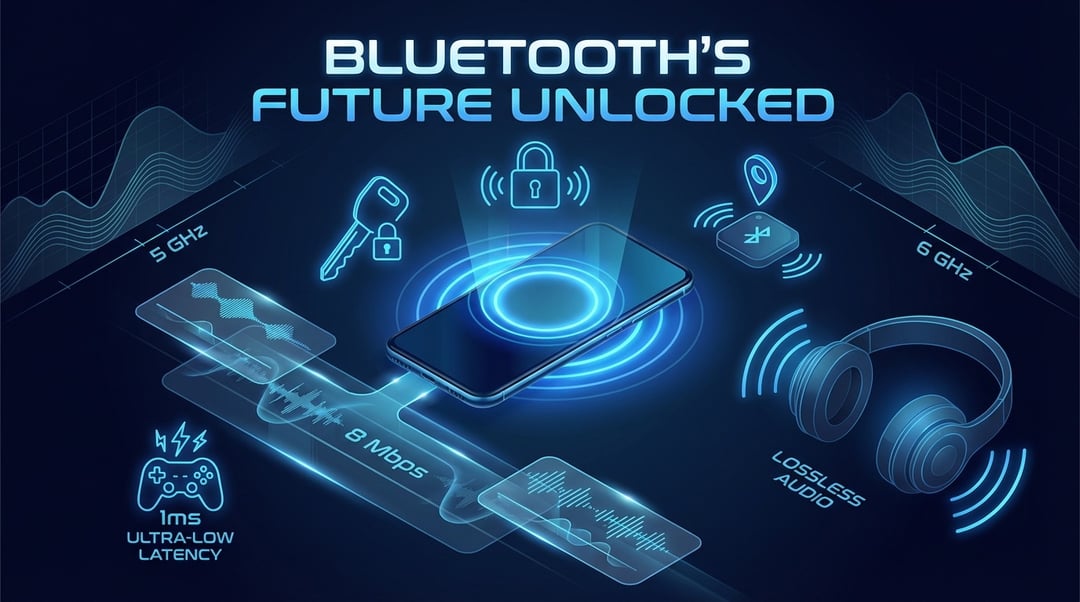
High Data Throughput (HDT) is expected to raise Bluetooth’s maximum data rate from 2.1Mbps to 8Mbps—nearly quadrupling current speeds.
That jump means something practical:
- Device-to-device file transfers could happen over Bluetooth alone
- Less reliance on Wi-Fi for quick local sharing
- Faster syncing between compatible gadgets
For everyday users, that translates to fewer workarounds. Less friction. Just tap and send.
HDT and the Future of Bluetooth LE Audio
HDT isn’t just about speed—it unlocks better sound.
It will support major upgrades to Bluetooth Low Energy (LE) Audio, including:
- A new codec for high-resolution and lossless audio
- Frameworks for spatial and surround sound
- Enhancements to the Auracast broadcast audio standard
If you care about audio quality—and let’s be honest, most of us do once we’ve heard the difference—this is where things get interesting.
But here’s the nuance: whether your existing headphones or speakers get these features depends on two things:
- Whether the Bluetooth chipset supports the required physical layer
- Whether the manufacturer actually pushes a software update
And that second one? It’s never guaranteed.
Even brands that have supported past upgrades, like Auracast, aren’t promising future updates yet. So compatibility may require careful shopping.
Ultra Low Latency: Reducing Gaming Controller Lag to 1ms
If you game, you know the feeling. You press a button. And there’s the tiniest delay. Sometimes you don’t notice it. Other times, it costs you the match.
Current Bluetooth controller latency sits around 7.5 milliseconds, which is already solid. But a new ultra low latency initiative aims to reduce that to 1 millisecond.
In fast-paced, twitch-heavy games, that difference isn’t theoretical. It’s real.
Part of this improvement is already available to developers, with additional components expected by mid-2026. For competitive gaming—especially on mobile or wireless setups—that’s a meaningful shift.
5GHz and 6GHz Bluetooth Expansion: Moving Beyond Crowded 2.4GHz
Let’s talk about congestion.
The 2.4GHz band—the one Bluetooth currently uses—is packed. Wi-Fi, microwaves, smart home gadgets. It’s crowded.
The Bluetooth Special Interest Group is exploring expanding Bluetooth LE into higher frequency bands around 5GHz and potentially 6GHz.
Why that matters:
- Less congestion
- Potentially better performance
- Access to unlicensed spectrum in some regions
In the U.S., 6GHz remains unlicensed, while other countries handle it differently. The 5GHz band is the first target for approval and rollout.
This isn’t a short-term change—but it signals where Bluetooth is headed. And it’s clear the goal is simple: less interference, more reliability.
The Real Shopping Challenge: How Do You Know What Your Device Supports?
Here’s the awkward part.
Bluetooth version numbers don’t confirm support for specific features like Channel Sounding or HDT. And manufacturers often don’t list these capabilities clearly in product specs.
So even as these upgrades roll out:
- You might own a compatible device without realizing it
- You might buy new hardware expecting features it doesn’t support
- Software updates may or may not bring improvements
In other words, the technology is evolving faster than the labeling.
And until that gap closes, buying Bluetooth gear may require a little extra research.


