
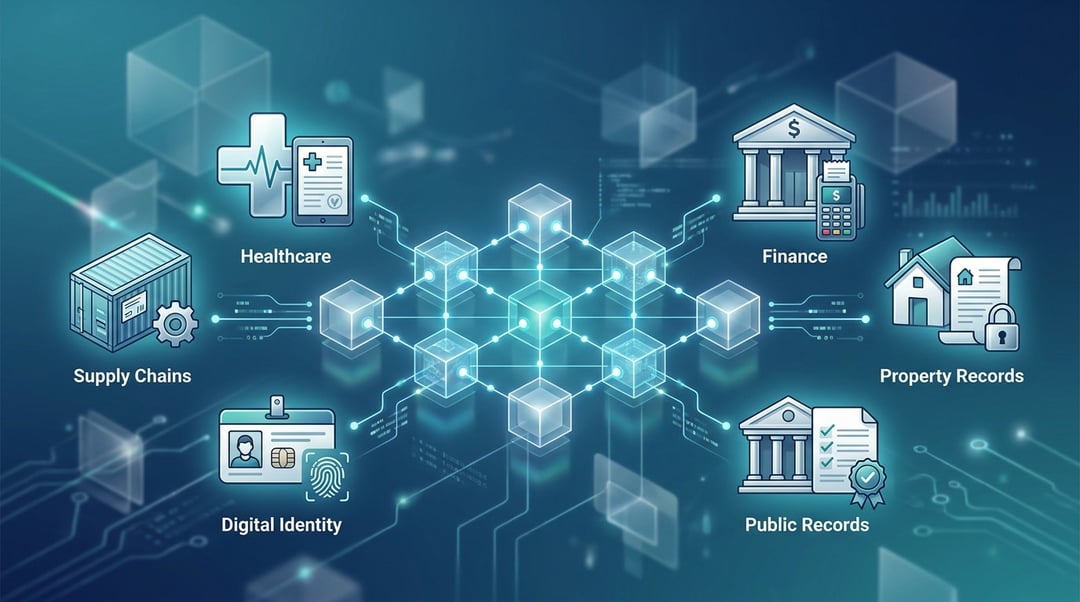
For a lot of people, “blockchain” still sounds like crypto trading, overnight millionaires, scams, and confusing charts with red and green candles. Fair enough. Crypto has dominated the conversation for years.
But blockchain is bigger than cryptocurrency.
At its core, blockchain is a way to keep records that multiple parties can inspect, verify, and trust without one central organization controlling every part of the system. Think of it like a shared digital notebook. Everyone approved to use it can see the same history, but nobody can quietly rip out a page and rewrite the past.
That simple idea has serious practical value. Not everywhere. Not for everything. But in industries where trust, verification, and audit trails matter, blockchain can solve problems that ordinary databases handle poorly.
What Blockchain Means Beyond Cryptocurrency
A blockchain is a digital ledger made of records grouped into “blocks.” Each block connects to the one before it, creating a chain of history. Once the network accepts a record, changing it later becomes extremely difficult because the change would need to match the rest of the chain.
That structure makes blockchain useful for more than money. It can record product movements, identity credentials, contracts, ownership histories, access permissions, compliance events, and public records.
The important part is not the buzzword. It is the trust model.
A traditional database usually has one owner. A bank, hospital, company, or government agency controls the system. That works well when everyone trusts that central party. Blockchain becomes interesting when several groups need to share records but do not fully trust one another.
For example, a manufacturer, shipping company, customs office, warehouse, and retailer may all need the same supply chain data. None of them wants another party secretly editing the record. A shared ledger gives them one version of the truth.
Blockchain Beyond Crypto in Supply Chains
Supply chains are one of the clearest practical uses of blockchain beyond crypto. Products move through many hands before reaching customers. Every handoff creates room for errors, fraud, delays, or missing paperwork.
Blockchain can help track goods from origin to final sale. A coffee brand might record where beans were grown, when they were shipped, which processor handled them, and when they arrived at the store. A seafood company might document the boat, catch location, cold-storage checks, and delivery route.
This matters because customers and regulators increasingly ask hard questions. Is this medicine authentic? Was this tuna legally caught? Did this luxury bag come from the real manufacturer? Did this food item pass through a contaminated facility?
A blockchain-based record can create a clearer chain of custody. It does not magically make every claim true, though. And this is where the hype often gets silly. If someone enters false information at the start, the blockchain preserves that false information very efficiently. Garbage in, garbage forever.
So the best supply chain systems combine blockchain with audits, sensors, barcode scans, RFID tags, and legal accountability.
Practical Blockchain Uses in Healthcare
Healthcare depends on sensitive records, strict privacy, and accurate coordination. That makes blockchain promising but also tricky.
One practical use is patient consent management. Instead of storing private medical files directly on a blockchain, a healthcare system can use blockchain to record who received permission to access which records and when. The medical data itself stays in secure off-chain systems. The blockchain stores proof of permissions and access events.
That distinction matters. Publicly placing medical records on-chain would be reckless. Recording verification events can be useful.
Blockchain can also improve drug traceability. Counterfeit medicine is a serious global problem. By tracking pharmaceuticals from manufacturer to distributor to pharmacy, healthcare networks can identify suspicious gaps, speed up recalls, and reduce dangerous fake products.
The U.S. Food and Drug Administration has explored supply chain modernization through the Drug Supply Chain Security Act, which shows how important traceability has become in medicine: FDA DSCSA overview.
Blockchain and Digital Identity
Digital identity may become one of the most useful blockchain applications because identity online is still a mess. We constantly prove who we are by sharing too much information.
Need to prove you are over 18? You often show a document with your full name, birthdate, address, and photo. Need to prove you earned a degree? You may send a scan that someone must manually verify.
Blockchain can support verifiable credentials. A university, employer, bank, or government agency can issue a digital proof. Another party can verify that proof without calling the original issuer or collecting unnecessary personal details.
Here is the real promise: you could prove a specific fact without exposing your whole life.
You might prove your age without sharing your full birthdate. You might prove a professional license without emailing a PDF. You might prove employment history without revealing unrelated private data.
The World Wide Web Consortium has developed standards around verifiable credentials, which are central to this future: W3C Verifiable Credentials.
Blockchain in Finance Without the Crypto Hype
Finance already runs on ledgers. So naturally, blockchain has practical financial uses beyond speculative tokens.
Banks and institutions can use shared ledgers for settlement, reconciliation, trade finance, and cross-border payments. Today, many financial processes still involve duplicated records across different institutions. Each party keeps its own database, then teams spend time reconciling differences.
A shared ledger can reduce that friction.
Smart contracts add another layer. A smart contract is software that executes rules when certain conditions are met. For example, an insurance payout might trigger after verified flight cancellation data arrives. A supplier might receive payment after a delivery scan confirms receipt.
But smart contracts are not magic judges. They follow code. If the code is flawed or the outside data is wrong, the result can be wrong too. In business, that means governance and dispute resolution still matter.
Blockchain for Property and Ownership Records
Real estate depends on proof of ownership. In many places, property records involve paper documents, fragmented databases, slow title checks, and expensive intermediaries.
Blockchain can create clearer ownership histories by recording transfers, liens, and title events in a tamper-resistant ledger. That could reduce fraud and make property verification faster.
Another related concept is tokenization. Tokenization means representing ownership rights as digital units. A building, artwork, or infrastructure project could theoretically be divided into digital shares.
Still, the legal layer matters more than the technology. A token is only useful if courts, regulators, and contracts recognize the claim behind it. Without legal enforceability, a token is just a fancy receipt.
Blockchain for Public Records and Voting
Governments can use blockchain for public records, permits, licenses, land registries, and audit trails. When citizens need to verify that a record has not changed, blockchain can provide transparency.
Voting is more complicated. People often say “put voting on the blockchain” as if that solves everything. It does not.
Elections require privacy, identity verification, accessibility, auditability, and protection against coercion. Those goals can conflict. Blockchain may help with parts of election infrastructure, especially audit trails, but secure voting needs far more than a shared ledger.
When Blockchain Actually Makes Sense
Blockchain works best when several conditions exist at once:
- Multiple parties need the same records.
- They do not fully trust one central owner.
- Tamper resistance matters.
- Audits are important.
- Participants can agree on rules.
- The cost of disagreement is high.
If one organization controls everything, a normal database is usually better. It is faster, cheaper, simpler, and easier to maintain.
That is the honest answer. Blockchain is not a universal upgrade. It is a specialized tool for shared trust.
The Future of Blockchain Beyond Crypto
The most useful blockchain systems may eventually become boring. And that is a good thing.
Most people do not think about internet protocols when they send an email or stream a movie. They just expect the system to work. Blockchain may follow the same path in supply chains, healthcare, finance, identity, and compliance.
The real future of blockchain beyond crypto is not about hype. It is about helping people agree on important facts when trust is hard, records are messy, and no single party should control the whole truth.