
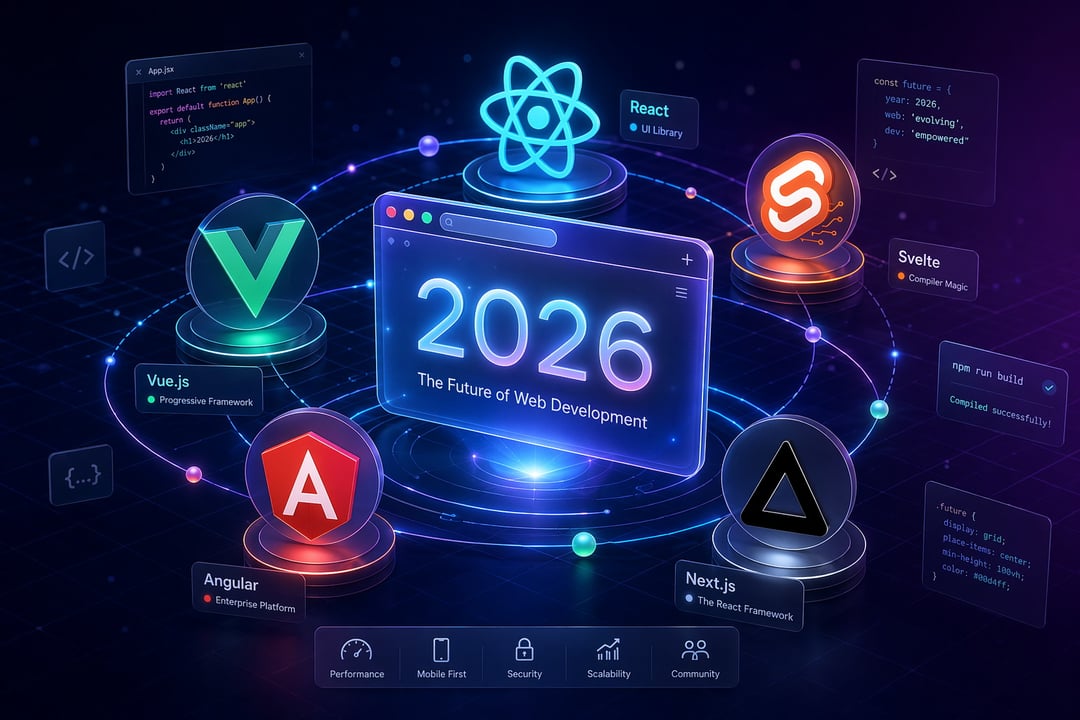
Choosing a framework used to be about finding the fastest option. That’s no longer the case. By 2026, almost all major frameworks are fast, work well on the server, and support TypeScript right away. Now, the real challenge is figuring out which one fits your project and your team best. This guide breaks down the top web development frameworks for 2026, highlighting what each one does best.
What Changed in Web Development Frameworks for 2026
Four main changes now shape the field. Rendering happens on the server first, so pages load faster and search engines can access all the content. Frameworks now update only the parts of a page that actually change, making things more efficient. Compilers take on more of the work, and TypeScript is now standard, not just an add-on. AI-assisted coding has gone from being a novelty to something developers use every day.
React 19 reflects these changes well. Its compiler automatically cuts down on unnecessary re-renders. Server Components send much less JavaScript to users' browsers. The key takeaway for 2026 is straightforward: pure speed no longer sets the top projects apart. How well a solution fits your needs matters more than just benchmark results.
The Best Frontend Frameworks to Use in 2026
React: Still the Default
React remains the safest choice for most teams. It owns the largest ecosystem, the deepest talent pool, and the most mature tooling. React 19 is stable across the industry. Its server-first model offsets the weight of older client-heavy patterns. Pick React when hiring depth and long-term support matter more than minimalism.
Vue: The Gentle On-Ramp
Vue earns its reputation for approachability. Newcomers grasp its syntax quickly. Its reactivity system stays predictable as projects grow. Recent releases sharpened rendering performance without complicating the developer experience. Choose Vue when momentum and a low barrier to entry matter most.
Svelte: Small Bundles, Clean Code
Svelte takes a different path. It compiles components down to lean JavaScript, so the browser downloads less and the page renders faster. Svelte 5 introduced runes, a clearer way to manage state. The trade-off is a smaller ecosystem. Reach for Svelte when performance is the product itself.
Angular: Structure for Scale
Angular suits large teams that prefer guardrails. It is opinionated, fully TypeScript-native, and built for applications that many engineers maintain at once. Recent versions trimmed bundle sizes and modernized its reactivity model. Choose Angular when consistency across a big codebase outweighs flexibility.
The Best Full-Stack and Meta-Frameworks for 2026
Next.js: The Application Workhorse
Next.js dominates serious application work. Version 16 stabilized faster builds and matured its advanced rendering features. Its tight React integration keeps everything in one place. Next.js fits dynamic, authenticated products best: dashboards, marketplaces, and SaaS platforms where every route carries user-specific logic.
Astro: Built for Content
Astro wins the content argument decisively. It ships almost no JavaScript by default, which produces excellent Core Web Vitals and strong search rankings. Better still, it lets you drop React, Vue, or Svelte components into the same project. For blogs, documentation, and marketing sites, Astro is hard to beat.
SvelteKit and React Router v7: Worth Knowing
SvelteKit has matured into a credible enterprise option. Meanwhile Remix merged into React Router v7. Advice that still treats the two as rivals is now outdated. Keep both on your radar as the ecosystem reshuffles.
The Best Backend Frameworks to Use in 2026
The server side stays healthy and varied. Node.js, paired with Express, NestJS, or Fastify, remains the most-used runtime and the natural home for AI agent backends. Django and Laravel deliver batteries-included productivity, which makes them favorites for rapid SaaS builds. For edge and serverless work, the Bun and Elysia pairing pushes raw throughput further than most alternatives.
How to Choose the Right Framework in 2026
When you get down to it, most projects come down to three main questions. Are you building a content site or an interactive app? What skills does your team already have? And where will your code run—on the edge, on a server, or as static files? The best framework is one that builds on your team’s existing strengths. Whenever possible, start with tools your team already knows.
Picking Your 2026 Stack with Confidence
No single framework won the year. That outcome benefits everyone. The field specialized instead, which means a genuinely right answer exists for your specific case. Reach for React or Next.js when building applications, Astro for content-heavy sites, Svelte for speed, and Vue for an easy learning curve. When two options feel close, build a small prototype in each. The code will tell you which one fits.
Further reading