
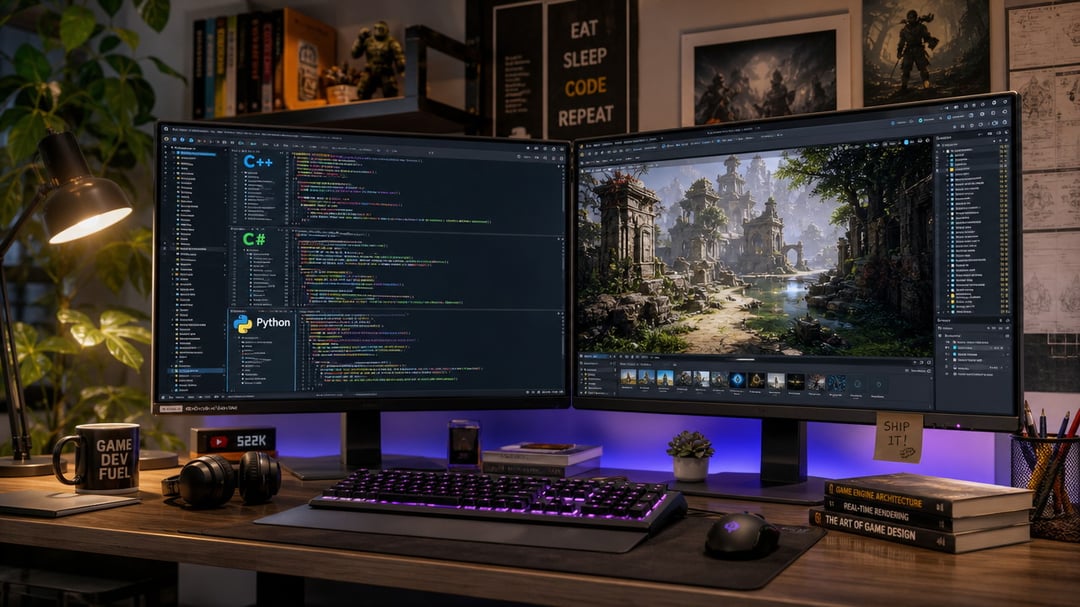
Choosing a programming language for game development is really choosing three things at once: an engine, a career path, and the kind of games you can actually finish. In 2026 the picture is clearer than it used to be. More games ship in C# than any other language. More revenue still flows through C++. And GDScript has become the fastest-growing option for independent developers in years.
There is no single winner. The right language depends on what you want to build and how quickly you need to ship.
What Actually Decides the Best Language
Performance requirements sit at the top of the list. A high-fidelity open-world title that must hold 60 frames per second on consoles has different needs than a 2D mobile game or a browser experience. Engine choice usually comes next. Most developers pick Unity, Unreal, or Godot first, then work with the language that engine favors. Learning curve and iteration speed matter just as much. A language that lets you test ideas in minutes will beat a theoretically faster one if you never finish the game. Finally, consider the job market and available resources. A large community means more answers when you get stuck and more people who can hire you later.
C++ – Still Required for High-End Work
C++ remains the language of AAA studios and custom engines. Unreal Engine is written in it. So are the majority of proprietary engines used by large teams. The language gives direct control over memory and hardware, which is essential when every cycle counts for complex physics, large worlds, or advanced rendering.
Studios hire C++ programmers for a reason. Titles that push current-generation consoles and high-end PCs almost always have C++ at their core. The cost is a steep learning curve and longer compile times. You manage memory yourself. Mistakes are easier to make and harder to debug. For developers aiming at big-studio roles or engine-level systems, that trade-off is usually worth it. For everyone else it is often unnecessary overhead.
C# – The Practical Choice for Most Projects
C# powers Unity, still the engine behind the largest share of indie and mobile releases. It also works well in Godot. The language sits in a useful middle ground: strong typing, solid performance with modern tooling, and far faster iteration than C++.
Most people who want to ship a game in a reasonable time end up here. The tooling is mature. The asset store and tutorial ecosystem are enormous. Jobs that mention Unity almost always list C# as a requirement. Garbage collection can cause occasional hitches if you are not careful, but for the majority of projects those issues are manageable. If your goal is to finish and release something—especially on mobile or across multiple platforms—C# is usually the highest-probability path.
GDScript – Built for Godot and Rapid Iteration
Godot’s native language, GDScript, was designed specifically for game logic. The syntax feels close to Python. Integration with the editor is tight. Compilation and reload times are short. That combination makes it excellent for prototyping and small-to-medium projects.
Godot itself has grown quickly. It now leads some major game jams and continues to gain ground among independent developers who prefer an open-source tool with no licensing surprises. GDScript is easy to learn and productive for both 2D and stylized 3D work. The main limitations are a smaller hiring pool than C# and a lower performance ceiling for the most demanding titles. For solo developers and small teams that value ownership and speed, it is often the best fit available today.
Other Important Languages
JavaScript and TypeScript dominate browser and web games. Frameworks such as Phaser and Babylon.js make it practical to ship experiences that run instantly in a browser with no install. Lua and its Roblox variant Luau remain the standard for embedded scripting and user-generated content. Python is excellent for prototypes, tools, visual novels, and AI systems, but it is rarely the right choice for the final real-time game loop. Rust continues to attract interest through engines like Bevy, yet commercial shipping history in games is still limited.
Matching Language to Goal
Want to ship an indie or mobile game as soon as possible? Start with C# and Unity or GDScript and Godot. Targeting AAA studios or engine programming? Learn C++ and work inside Unreal. Building for the web? Use TypeScript. Just beginning and want to understand fundamentals quickly? GDScript or Python will get you moving without the steepest walls.
Many real projects mix languages. High-level scripting often sits on top of a more performant core. That flexibility is useful once you have shipped at least one complete game.
Getting Started Without Overcomplicating It
Pick one engine and its primary language. Build small, complete projects instead of collecting endless tutorials. Ship something playable, even if it is rough. The language is a tool. Finishing teaches more than perfect theoretical choices.
In 2026 the practical advice is straightforward. For most people who want to release games, C# or GDScript offers the best combination of speed, resources, and results. C++ remains the gatekeeper for the highest-end work. Choose the path that gets you building today. Adjust later when your goals become clearer.