
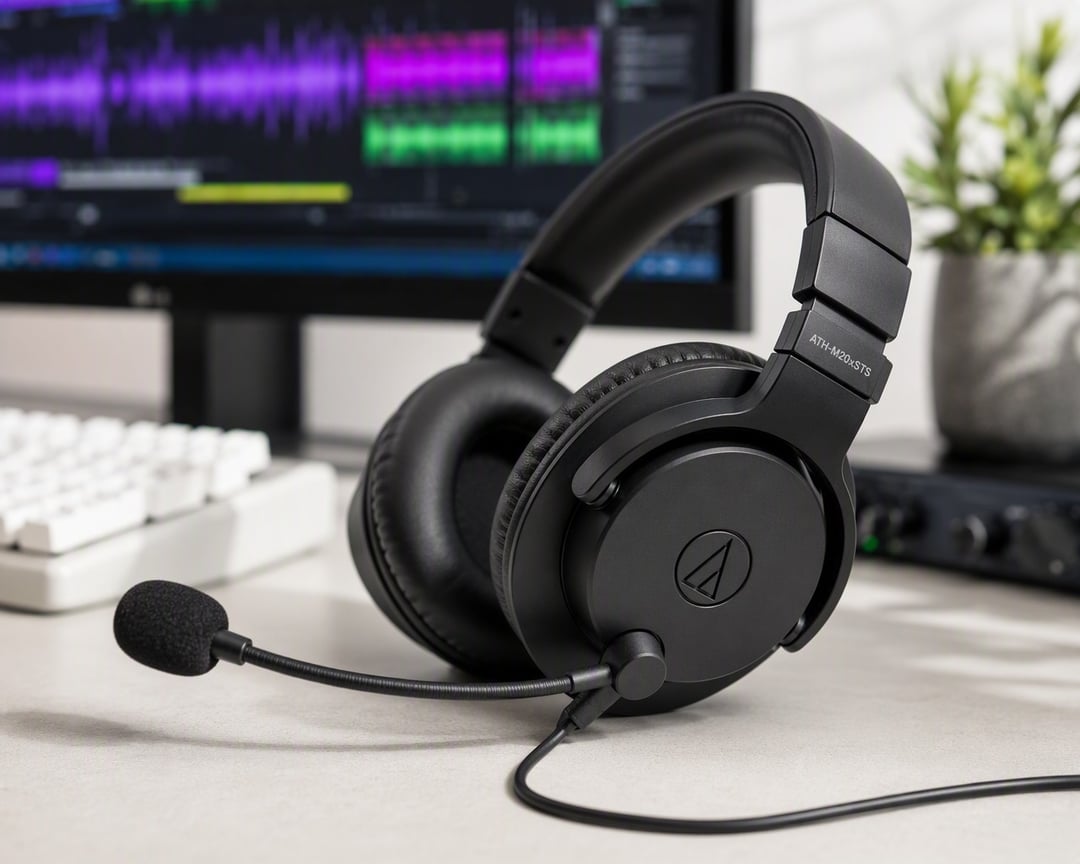
Gaming headsets often arrive packed with wireless options, surround sound modes, RGB lighting, and companion software. Audio-Technica takes a simpler path with the ATH-M20xSTS StreamSet. The wired headset concentrates on the core elements of headphones and a microphone.
Priced at $99, the ATH-M20xSTS draws its basic design from Audio-Technica’s ATH-M20x professional monitor headphones. It pairs those headphones with a cardioid condenser microphone based on the company’s 20 Series microphones.
Audio-Technica ATH-M20xSTS Design and Audio Specs
The ATH-M20xSTS uses 40mm drivers fitted with copper-clad aluminum voice coils. Frequency response spans 15Hz to 20kHz. The closed-back over-ear design includes drivers tuned for enhanced low-frequency performance.
A unidirectional condenser microphone sits on a flexible boom arm. The microphone is designed to focus on the user’s voice while reducing surrounding noise. Raising the boom arm automatically mutes the microphone.
The headset weighs around 230 grams. It ships with replaceable breathable mesh earpads intended to support comfort during longer gaming or streaming sessions.
Connectivity Options for the ATH-M20xSTS
A detachable 6.6-foot cable with a 3.5mm TRRS connector handles the wired connection. Audio-Technica includes USB Type-A and USB Type-C adapters that work with PCs, Macs, mobile devices, and compatible gaming consoles.
The ATH-M20xSTS offers no wireless connectivity, so there is no battery to charge and no dongle to manage. It also omits RGB lighting and virtual surround modes.
A Straightforward Approach to Gaming Headsets
At $99, the ATH-M20xSTS presents a no-nonsense gaming headset on paper. Instead of competing through an extended feature list, Audio-Technica centers the package on its established headphone and microphone experience.
Using familiar hardware does not automatically mean the ATH-M20xSTS will sound better than other gaming headsets in this price range. Testing would be required to make that determination. The design, however, directs attention to the two parts of a gaming headset that users rely on continuously.