
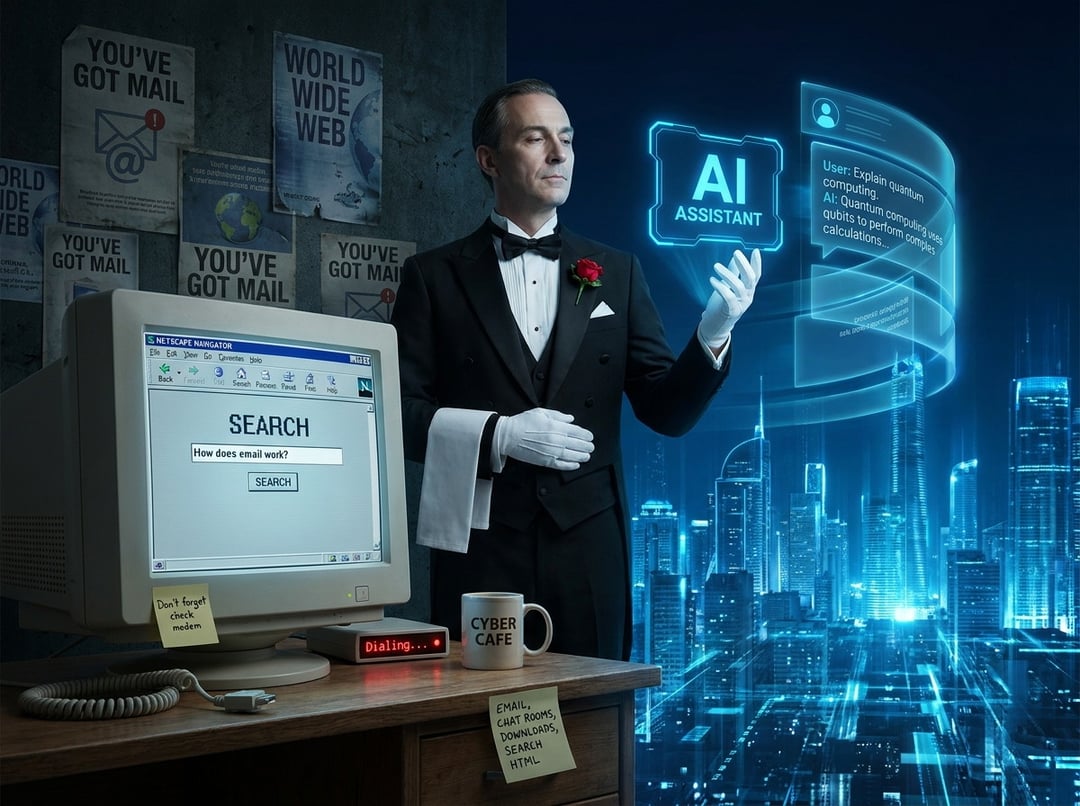
Ask.com officially pulled the plug on May 1, 2026. After almost 30 years online, the servers went dark, and a "Thank You" message appeared on the homepage. And honestly? It deserves a better send-off than just "old search engine finally dies."
Because here's the thing — Ask Jeeves wasn't just a relic. It was an idea that was simply born too early. And right now, in 2026, that idea is running the entire internet.
Ask Jeeves Launched in 1997 With a Radical Promise
Cast your mind back to 1997. Dial-up modems. AOL screen names. The electric thrill of "You've got mail." The early web was genuinely strange — exciting, but not exactly user-friendly. It felt like a maze, and getting anywhere useful required patience, guesswork, and a working knowledge of how search engines thought.
Because search engines back then didn't think like people. You'd type clipped, abbreviated fragments — not real questions — and hope the machine could fill in the gaps. Before that, there were web directories: static lists of links that may or may not have taken you anywhere helpful.
Ask Jeeves tried something different. When it launched, Wired described it as a search engine that accepted "queries in conversational English," with the company positioning it as the first natural language search agent on the internet. You could type a full, real question. No keyword gymnastics required.
What Ask Jeeves Could — and Couldn't — Do
To be fair, the output didn't exactly match the promise. The language parsing had real limits. Ask Jeeves couldn't reason through an open-ended question the way a large language model can today. But for simple who, what, where, and when questions, it returned something that actually felt like an answer — not just a pile of links to sort through.
That was enough to give it a personality. At a time when the web was still figuring out what it was, Ask Jeeves gave search a human face. The cartoon butler was essentially promising users what the internet would eventually become: a place where you could just ask a question and get a straight answer. That promise was real. The technology just wasn't there yet.
How Google Rewired the Way We All Search
Google showed up about a year after Jeeves and completely changed the game. Clean interface. PageRank algorithm. Fast, relevant results. It made search feel effortless, and it turned the search bar into the web's front door.
But here's the interesting part: Google didn't adapt to how people naturally wanted to search. It trained people to search in the way that worked best for the machine. We all learned "proper" search syntax — stripping full thoughts down to fragments that got the point across in as few words as possible.
"What is the best way to fix my laptop battery?" became "laptop battery not charging fix."
We learned when to use quotation marks, when to add brand names, when to include or exclude certain words. We met the machine halfway. And then, slowly, the machine met us even less than that — because once Google dominated, the entire web had to reorganize itself around Google's logic.
The "Googlefication" of the Internet
Headlines, metadata, article structures, product pages, entire business models — all shaped by what Google could crawl, rank, and surface. That drift has sometimes been called the "Googlefication" of the internet. The web didn't just use Google; it reshaped itself for Google.
With Ask Jeeves, a search was a plain English question. With Google, it became a discipline. People studied it, built careers around it, and called it SEO.
Ask.com tried to survive that shift. It dropped the Jeeves name in 2006 and rebranded, attempting to modernize and compete in a market Google had thoroughly defined. But by abandoning the butler, it lost the one thing that made it memorable. It kept going for nearly two more decades, even as cultural memory stayed attached to the character it had left behind.
AI Search Is Bringing the Question Box Back
If Ask.com had closed ten years ago, it would've felt like a clean ending — another dot-com era holdout finally switching off the lights. But closing in 2026 feels different. It feels like a historical loop snapping shut.
Because the question box is back. ChatGPT, Google's AI Mode, Perplexity, Microsoft Copilot, Gemini — all of them are encouraging users to do exactly what Ask Jeeves once asked of them: type naturally, write out a complete question, explain what you actually want. In return, you get a synthesized answer, not a ranked list of links you have to dig through yourself.
A 30-Year-Old Dream, Finally Delivered
Ask Jeeves was, in some ways, the internet's first mainstream rehearsal for this kind of search. It didn't ask users to translate their curiosity into keyword fragments first. You could just type what you were wondering about and see what came back.
The modern version is far more powerful than anything Jeeves could have managed. Today's AI chatbots summarize, interpret, and reorder information. They may, in many cases, remove the need to click through to a webpage at all — which is starting to reshape the relationships between publishers, search engines, and the open web in ways we're only beginning to understand.
But the core dynamic has shifted in a familiar direction. With Ask Jeeves, the question was whether the engine could understand what you were asking. With AI search, the question is whether you can trust it to give you accurate information — whether it might hallucinate or quietly mislead you.
The dream is the same one the web has been chasing for 30 years: a computer that understands a human question and hands back a genuinely useful answer. It's just that now the systems claiming to do it are finally powerful enough to come close.
The Butler Is Gone, but the Interface Won
Ask Jeeves didn't beat Google. It didn't define modern search infrastructure. For most people, it became a fond memory — school computer labs, dial-up connections, that cartoon butler patiently waiting to help. A relic of the early, weird web.
But it understood something important before the internet was ready to hear it. Most people don't want to learn search syntax. They don't want to study keywords or reverse-engineer what a ranking algorithm is looking for. They just want to ask a question and get an answer.
For a long time, Google made that unnecessary because its keyword search was extraordinarily effective. But as AI mode spreads across Google and chatbots become the default search interface for millions of users, the industry is moving away from the traditional web search model — and moving back toward something that looks a lot like the Ask Jeeves promise, only without the butler and with dramatically more sophisticated technology underneath.
That's the real legacy of Ask.com. Before anyone was prompting chatbots, millions of early web users were already typing full questions into a box and hoping something on the other side understood them. They were ahead of their time. So was Jeeves.