
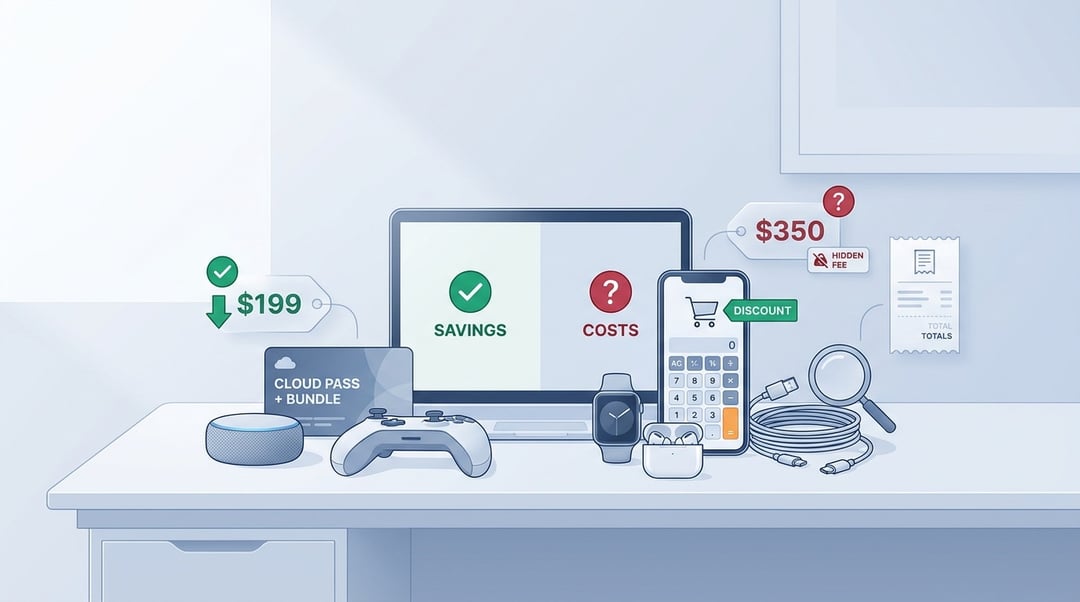
Tech bundles have a way of making us feel clever. You see the laptop with the mouse, case, antivirus, and “free” cloud storage. Or the phone with earbuds, a smartwatch discount, and a carrier plan that promises huge savings. It looks efficient. Neat. Almost responsible.
But here’s the catch: a tech bundle is only a good deal if you actually need what’s inside it.
That sounds obvious, I know. But bundles are designed to blur that exact line. They turn a simple purchase into a pile of extras, discounts, trials, and “total value” claims. Suddenly, you’re not asking, “Do I need this?” You’re asking, “Am I missing out if I don’t buy it?”
So, are tech bundles actually a good deal? Sometimes, yes. But only when the math, the products, and the long-term costs all make sense.
What Is a Tech Bundle?
A tech bundle is a package that combines multiple products or services into one offer. You might see a smartphone bundled with wireless earbuds, a laptop bundled with software, or an internet plan bundled with mobile service and streaming subscriptions.
Some bundles are hardware-focused. Think gaming consoles with controllers, headsets, and digital games. Others are subscription-based, like Apple One, Microsoft 365, Google One, or streaming packages. Then there are smart home bundles with cameras, speakers, sensors, and monitoring services.
The important thing to remember is this: “bundle” doesn’t always mean “discount.” Sometimes it just means several things have been grouped together in a way that makes the real price harder to compare.
And that’s where people get tripped up.
When Tech Bundles Are Actually Worth It
A tech bundle can be a smart buy when every major item solves a real problem for you. If you’re buying a new laptop and you already need a protective sleeve, wireless mouse, docking station, and office software, a well-priced bundle may genuinely save money.
The same goes for phone bundles. If the package includes a quality case, fast charger, and earbuds you would have bought anyway, the savings are real. Not theoretical. Real.
Good bundles also reduce what people in the tech world call total cost of ownership. That’s just a fancy way of saying the full cost of using something over time. The sticker price is only the beginning. You may still need accessories, repairs, storage, subscriptions, cables, adapters, or replacement parts.
A strong bundle lowers those future costs. A weak one just moves them around.
There’s also convenience to consider. Ecosystem bundles from companies like Apple, Google, Samsung, Microsoft, and Amazon can be useful because their products work smoothly together. Your photos sync. Your files follow you. Your earbuds pair quickly. Your smart speaker talks to your lights without needing three separate apps and a small emotional breakdown.
That kind of simplicity has value. It may not always be the cheapest option, but it can be worth paying for if it saves time and frustration.
When Tech Bundles Are a Bad Deal
The biggest problem with tech bundles is filler. These are the extra items that make the offer look generous but add little practical value.
Maybe the bundle includes cheap earbuds with poor battery life. Maybe it adds antivirus software you don’t need. Maybe it includes a printer that costs more in ink than it does in dignity. The advertised value might say $300 in extras, but if you would never buy those extras separately, they are not real savings.
Another common trick is pairing a desirable product with weaker inventory. A retailer might bundle a popular gaming console with an unwanted game, a low-quality headset, and a subscription trial. The package looks premium. In reality, it may be a way to clear stock that wasn’t moving on its own.
Subscriptions are another danger zone. A bundle may include three free months of cloud storage, identity protection, music streaming, or premium software. That sounds harmless until the trial renews at full price. One forgotten subscription can quietly eat the savings you thought you had.
Then there’s ecosystem lock-in. This one sneaks up on people. A smart home bundle might work beautifully at first, but what happens when every camera, bulb, speaker, and doorbell depends on one app or one company? Switching later becomes annoying and expensive. The bundle saves money today, but it may reduce your flexibility tomorrow.
How to Know If a Tech Bundle Is a Good Deal
The best way to judge a tech bundle is to break it apart.
First, list every item in the package. Then look up what each one costs separately from trusted retailers or the manufacturer’s store. Don’t rely only on the “total value” claimed in the ad. Companies often use full retail prices, even when those products are usually discounted elsewhere.
Next, divide the items into three groups:
- Things you definitely need
- Things you would enjoy but could skip
- Things you would never buy on their own
Only count savings on the first two groups. Be ruthless here. If the bundle includes a webcam, but your laptop already has one that works fine, don’t pretend the webcam is worth full price to you.
After that, check the long-term costs. Does anything auto-renew? Does the service become more expensive after six months? Are you locked into a contract? Is cancellation simple? Are the accessories good enough to last?
This is where many “deals” fall apart. A phone bundle may look great until you realize it requires a pricey unlimited plan for two years. A software bundle may seem cheap until you notice you only use one app. A smart home bundle may feel affordable until you need extra cloud storage for video recordings.
Also compare the bundle with building your own package. Sometimes buying the main product separately and choosing better accessories costs less. This is especially true for laptops, gaming setups, creator gear, and smart home devices.
Common Tech Bundles: Good Deal or Not?
Phone bundles can be useful when they include practical accessories or real carrier discounts. But be careful with trade-in rules, contract terms, and plan requirements. The headline savings may depend on conditions you don’t actually want.
Streaming bundles are worth it if your household regularly watches most of the included services. If you only care about one show on one platform, the bundle may just add more monthly clutter.
Software bundles work well for heavy users. Microsoft 365 makes sense if you use Word, Excel, OneDrive, and Teams. Adobe Creative Cloud can be essential for designers, editors, and photographers. But if you only need one tool once in a while, a full suite may be overkill.
Smart home bundles are great for beginners who want an easy setup. Still, check compatibility before buying. A cheap bundle is not so cheap if half the devices don’t work with your existing phone, speaker, hub, or Wi-Fi setup.
Red Flags to Watch For
Be cautious when a tech bundle leans too hard on “total value” instead of actual savings. That usually means the seller wants you to focus on the pile, not the usefulness of each item.
Other warning signs include:
- Vague subscription terms
- Auto-renewing trials
- Older models hidden in the details
- Poorly reviewed accessories
- Long contracts
- Confusing cancellation policies
- Discounts tied to mail-in rebates or trade-ins
- Countdown timers that push you to rush
A real deal can survive a little scrutiny. A bad one needs pressure and fine print.
Are Tech Bundles Actually a Good Deal?
Tech bundles can absolutely be a good deal. But only when they match your real needs, reduce your total cost, and make your setup easier without trapping you in services you don’t want.
The simplest test is this: would you still buy most of the items if they were sold separately?
If the answer is yes, the bundle may be worth it. If the answer is no, the savings are probably more theater than substance.
A good tech bundle should feel boringly obvious after you do the math. No mental gymnastics. No “maybe I’ll use this someday.” Just useful products at a lower combined price. And honestly, that’s the kind of deal worth taking.