
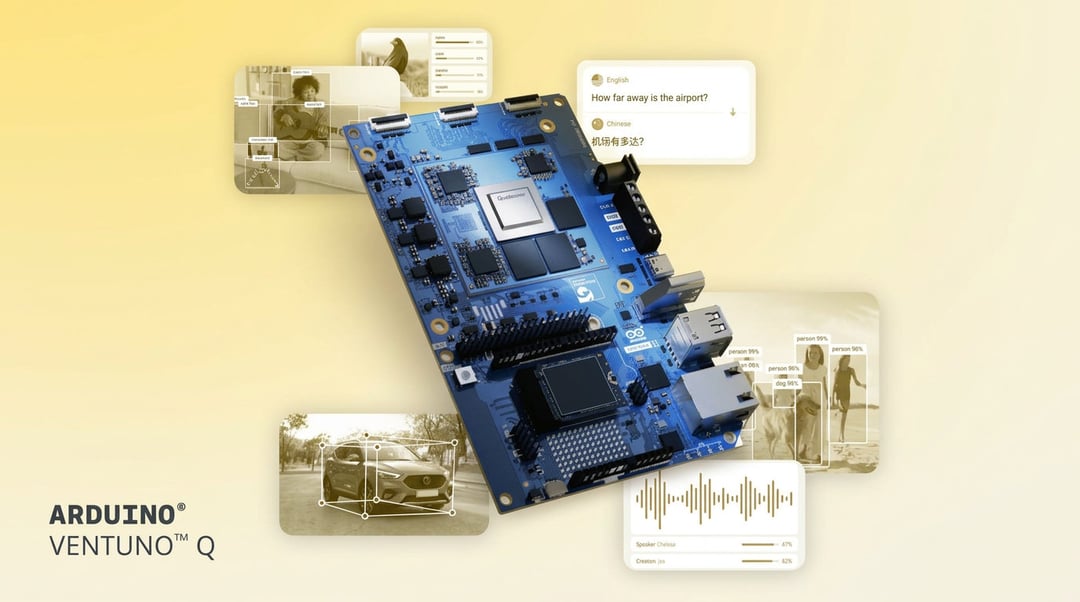
Edge AI Single-Board Computer Designed for Offline Autonomy
There’s something powerful about a machine that doesn’t have to “phone home” to think.
The Arduino VENTUNO Q, built in collaboration with Qualcomm, is designed to run fully autonomous AI agents completely offline. No constant cloud dependency. No waiting on remote servers. Just on-device perception, decision-making, and action—all happening locally.
At the heart of it is the Qualcomm Dragonwing IQ8 Series processor, paired with a dedicated STM32H5 microcontroller for deterministic, real-time control. Here’s what that really means: the board doesn’t just process data. It reacts. It makes decisions. It controls hardware in real time.
And that’s the shift. This isn’t just another single-board computer. It’s built for systems that interact with the physical world.
Qualcomm Dragonwing Processor with Up to 40 TOPS of AI Compute
Power matters when you're running AI at the edge.
The Dragonwing processor delivers up to 40 dense TOPS (trillions of operations per second) of AI performance. That’s serious compute for a board in this category. It enables simultaneous inference and complex workloads to run locally—without shipping data off-site.
Pair that with:
- 16GB of RAM
- 64GB of expandable storage
- On-device AI acceleration
And you’ve got a platform capable of handling demanding multitasking, generative AI models, and real-time vision processing all at once.
It’s not just about raw numbers, though. It’s about what those numbers unlock—machines that can see, think, and respond instantly.
Unified Architecture for Perception, Decision, and Actuation
Most systems split responsibilities: one device captures data, another processes it, something else controls motors or sensors.
VENTUNO Q merges all of that.
The architecture integrates AI acceleration with microcontroller-based real-time logic. So perception (like computer vision), decision-making (AI inference), and actuation (motor control, robotics output) all live on the same board.
That unified setup reduces latency. It improves reliability. And it eliminates reliance on external infrastructure.
In practical terms? A robot arm can visually detect an object, calculate its position, and execute a pick-and-place action—without ever reaching out to the cloud.
Robotics Applications: Vision-Guided Arms and Autonomous Navigation
This board was clearly built with robotics in mind.
It supports:
- Vision-guided robotic arms for pick-and-place tasks
- Service robots that can follow individuals through dynamic environments
- Autonomous machines navigating complex spaces using Visual SLAM and path optimization
Visual SLAM (Simultaneous Localization and Mapping) allows robots to understand and map their surroundings while moving through them. Combine that with onboard AI inference, and you get machines capable of adapting in real time.
Factories. Warehouses. Public spaces. Healthcare environments.
And because processing happens locally, systems remain responsive even without network connectivity.
Edge AI Vision Systems for Security, Traffic, and Quality Inspection
Edge AI is about immediacy.
VENTUNO Q enables proactive vision systems that can:
- Monitor security feeds with local visual language models
- Observe traffic patterns
- Perform automated quality inspections in industrial settings
All of this is handled directly on the device. No continuous data streaming to external servers.
That matters for latency. It matters for bandwidth. And it matters for data privacy.
When intelligence lives at the edge, response times shrink and operational resilience improves.
Generative AI and Local LLM Support on the Edge
This isn’t limited to traditional machine vision.
The board supports local large language models (LLMs) powered by Qualcomm AI Hub. That opens the door for:
- Offline voice assistants
- Gesture-responsive smart mirrors
- Interactive kiosks in transport hubs or healthcare desks
Generative AI workloads that typically rely on cloud GPUs can now run locally, depending on model size and optimization.
There’s something transformative about that—AI agents operating independently, embedded directly into physical environments.
Linux and Real-Time OS Support for Flexible Development
VENTUNO Q runs:
- Ubuntu and Debian Linux on the main processor
- Arduino Core on Zephyr OS for real-time control
That dual-environment approach supports both high-level AI development and precise hardware timing requirements.
Developers can use:
- Python scripts
- Arduino sketches
- Ready-to-use AI models like gesture recognition and object tracking
With Edge Impulse Studio integration, custom AI models can also be trained and deployed to the board.
This flexibility lowers the barrier for educators, innovators, and robotics engineers alike.
Industrial I/O, Camera Connectivity, and Hardware Expansion
Hardware compatibility is broad and practical.
The board includes:
- Industrial I/Os
- Multiple MIPI CSI camera connectors
- Audio and display support
- 2.5Gb Ethernet
It’s also compatible with:
- Arduino UNO shields
- Modulino nodes
- Qwiic sensors
- Raspberry Pi HAT expansions
That last one is interesting. Because while it enters the market as a potential Raspberry Pi competitor, it doesn’t isolate itself from existing ecosystems.
Instead, it bridges into them.
Positioning as a High-Performance Raspberry Pi Alternative
The Raspberry Pi has long been the go-to for accessible computing and prototyping. But VENTUNO Q aims higher in the AI and robotics space.
Where traditional SBCs often rely on cloud-based AI or external accelerators, this platform centers AI capability at its core.
Still, its long-term influence on established platforms remains uncertain. Adoption will likely depend on cost, availability, and how easily developers can transition their workflows.
But technically? It’s built to push edge AI forward.