
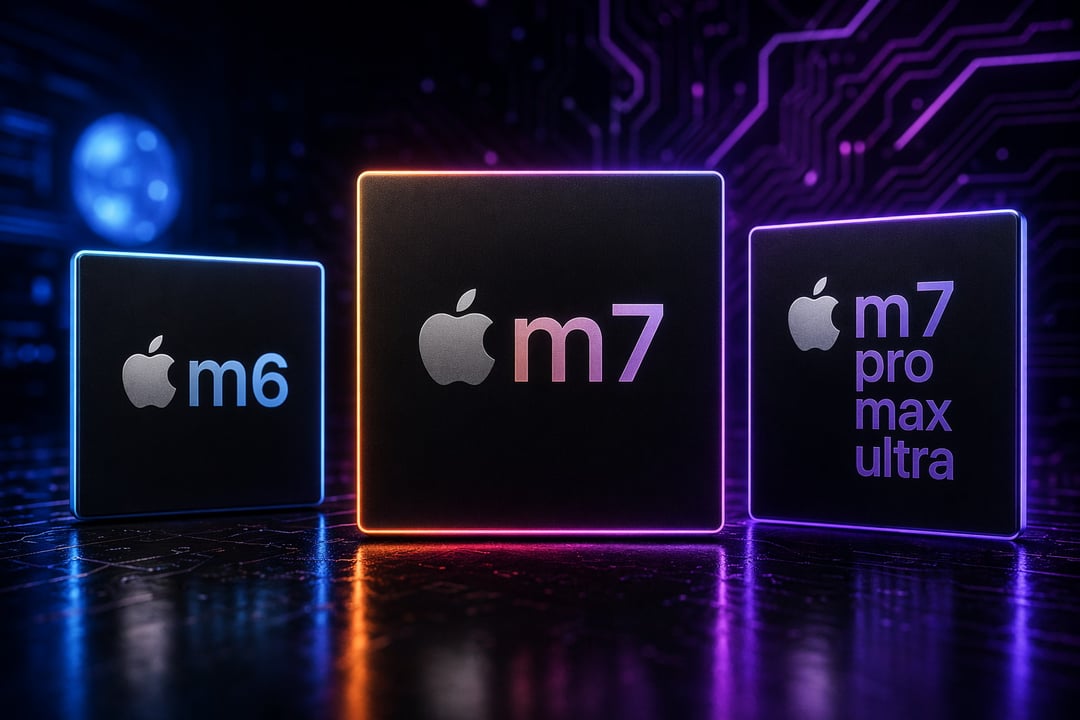
Apple is reportedly engineering its future M7 Ultra chip to handle as much as 1.5 terabytes of unified memory, a ceiling that would put Apple silicon on par with the maximum RAM configuration once offered in the 2019 Mac Pro. If accurate, this would mark the first time an Apple silicon Mac has matched that six-year-old benchmark, according to reporting from Bloomberg's Mark Gurman, who laid out the trajectory of Apple's chip lineup through the M8 generation in his Power On newsletter.
Why 1.5TB Is a Meaningful Number for Apple Silicon
Since Apple began transitioning away from Intel processors in 2020, unified memory capacity on its own chips has crept upward generation after generation, but it has never come close to touching the ceiling of the last Intel-based Mac Pro tower. That machine, in its priciest 24- and 28-core builds, could be configured with 1.5TB of DDR4 ECC memory spread across twelve DIMM slots. No Apple silicon Mac has matched that figure since — the current record holder is the M4 Max-powered Mac Studio that began shipping in early 2025, which tops out at 192GB.
The gap between that 192GB ceiling and the rumored 1.5TB capacity of the M7 Ultra illustrates just how far Apple still has to climb before its own silicon overtakes the memory headroom of its final Intel workstation.
M5 Ultra as the Next Step Before M7 Ultra
Before the M7 Ultra arrives, Apple is expected to ship a refreshed Mac Studio built around the M5 Ultra sometime around October 2026. Internal testing has reportedly pushed that chip's unified memory as high as 768GB, though component supply constraints could ultimately cap what Apple is able to offer at launch. Even at that ceiling, the M7 Ultra's planned 1.5TB capacity would represent roughly double what the M5 Ultra is expected to deliver — underscoring how aggressively Apple intends to scale memory across just two chip generations.
Apple Silicon Memory Ceilings at a Glance
|
Chip / Mac
|
Unified Memory
|
Status
|
|
2019 Mac Pro (Intel, 24/28-core)
|
1.5TB DDR4 ECC
|
Discontinued
|
|
M4 Max Mac Studio (early 2025)
|
192GB
|
Current Apple silicon high-water mark
|
|
M5 Ultra Mac Studio (~October 2026, expected)
|
Up to 768GB (tested)
|
Supply constraints may limit shipping configuration
|
|
M7 Ultra (in development)
|
Up to 1.5TB (planned)
|
Targeted for 2028
|
Mapping Apple's Chip Roadmap From M6 to M8
The path to the M7 Ultra runs through a reshuffled lineup. Rather than releasing higher-end M6 Pro and M6 Max variants, Apple is reportedly skipping those tiers entirely and moving forward with only a base M6 chip in late 2026. From there, the company shifts quickly into the M7 generation — codenamed "Andros" — starting in early 2027. The M7 Pro and M7 Max are expected to follow by the end of 2027, with the flagship M7 Ultra arriving after that, in 2028.
Gurman's reporting also indicates Apple is already at work on M8 chips, which are positioned to push on-device AI capabilities further still. The pace of this roadmap — compressing multiple chip tiers and generations into a tight multi-year window — signals how central AI performance has become to Apple's silicon strategy.
AI Workloads Are the Real Driver Behind the Memory Push
The M7 family's design centers on advances in on-device AI processing, including major upgrades to the neural processing unit. That focus helps explain why Apple is willing to push unified memory capacity so aggressively: large language models and other AI workloads increasingly depend on vast, fast-access memory pools rather than raw processing speed alone.
This is where Apple's system-on-chip approach offers a structural edge over traditional discrete architectures, in which memory, CPU, and GPU are separate components linked by comparatively slower pathways. By unifying memory directly into the chip package, Apple can let the CPU, GPU, and neural engine all draw from the same shared pool at high speed — an architecture that scales especially well as AI models grow larger and hungrier for memory bandwidth.