
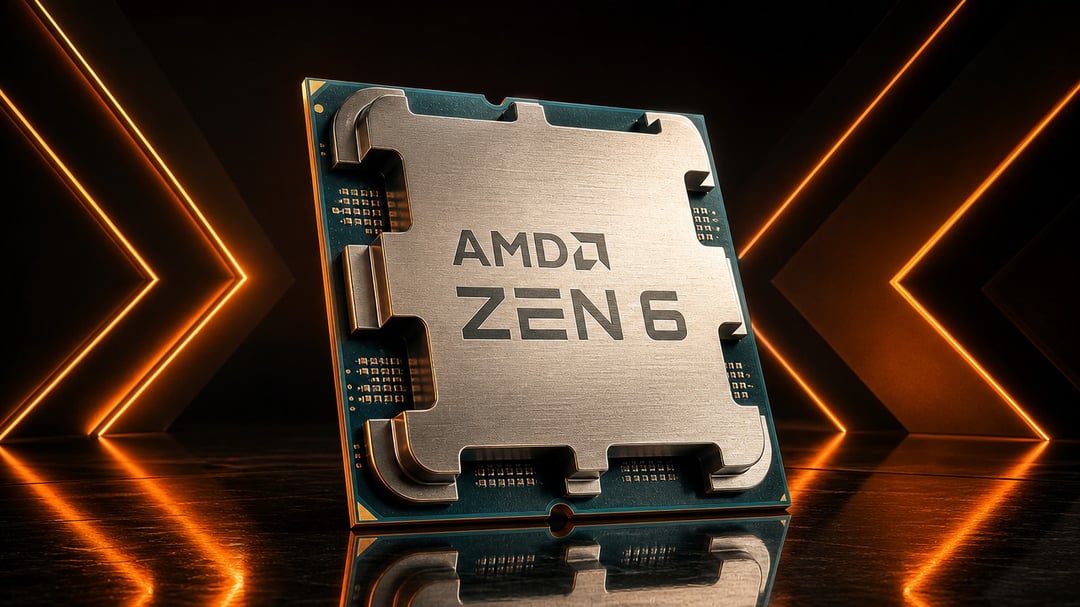
AMD documentation listed upcoming Zen 6 processors under the AM5 platform, providing the clearest indication so far that the company’s next desktop CPU generation will continue to use the current socket.
The listings cover the Medusa and Olympic Ridge product families. For current owners of Zen 4 or Zen 5 processors, that points to a possible path to Zen 6 without replacing an AM5 motherboard.
AMD has previously said it will support AM5 through 2027. Although the company has not formally announced Zen 6 or publicly confirmed its socket platform, the documentation aligns with repeated reports that AM5 support will extend through this generation.
Which Zen 6 CPU Families Support AM5?
The documents list three Zen 6 processor lineups, with two tied to AM5 support.
Olympic Ridge Desktop CPUs
Olympic Ridge is the codename associated with Zen 6 desktop processors. This family is listed as AM5-compatible and is expected to be aimed exclusively at desktop systems.
The chips are presumed to arrive under the Ryzen 10000 name. Reports suggest Olympic Ridge processors could include as many as 24 cores, which would exceed the core count of previous Ryzen CPUs. They could also use TSMC’s 2nm manufacturing process and reach clock speeds above 6.5GHz.
Those details remain expectations rather than formal AMD product specifications. Still, the AM5 listing offers a more concrete detail for desktop upgrade planning: Olympic Ridge is associated with the existing socket platform.
Medusa Zen 6 APUs
Medusa is another Zen 6 family listed in AMD’s documentation. Some Medusa APUs are designed for both AM5 and AMD’s mobile FP10 socket, while other Medusa processors are listed as FP10-only.
That split suggests Medusa will cover more than one type of system. AM5 versions are positioned for the desktop platform, while FP10 versions are intended for mobile use. Medusa APUs are expected in laptops and other low-power devices in 2027, with some reportedly using a 3nm process.
What AM5 Support Could Mean for Zen 4 and Zen 5 Owners
For people already using Zen 4 or Zen 5 CPUs on AM5 motherboards, the Zen 6 documentation suggests an upgrade may not require a new motherboard.
That matters because a socket change can turn a processor upgrade into a broader platform rebuild. With AM5 support listed for Olympic Ridge and some Medusa APUs, existing AM5 users may be able to move to Zen 6 while keeping their current motherboard.
The practical details have not been formally announced. AMD has not yet released Zen 6, and the available information does not confirm motherboard support requirements, firmware needs, or compatibility across individual AM5 boards. But the socket listing supports the expectation that AM5 will continue through Zen 6.
Expected Zen 6 Launch Timing
Zen 6 is expected to arrive in late 2026 or early 2027. AMD has not formally announced the generation, so the timing remains an expectation rather than a confirmed launch schedule.
Olympic Ridge desktop processors are expected to come first around that window. Medusa APUs are expected to appear in laptops and other low-power devices in 2027.
Zen 6 May Add a Third AMD Core Type
Leaked code indicates that Zen 6 could introduce a third AMD core type alongside Zen 6 and Zen 6C cores.
The reported tier-3 cores are described as ultra-low-power cores intended mainly for background and idle tasks. Zen 6 and Zen 6C cores would handle heavier workloads. The approach resembles Intel’s use of low-power E-cores for lighter tasks.
The ultra-low-power core design is not described as entirely new. It reportedly reuses elements from five earlier AMD processor generations:
- Zen 6 instruction set
- Zen 5 microarchitecture
- Zen 4 floating-point unit
- Zen 3 L2 cache
- Zen 2 L3 cache
The first indication of these cores appeared in leaked design documents connected to Sony’s rumored upcoming PlayStation handheld. That device is expected to use the ultra-low-power cores alongside Zen 6C cores.
AM6 Is Expected With Zen 7
AMD patents suggest that AM6 may arrive with Zen 7 rather than Zen 6. The new socket could support PCIe 6.0 and DDR6 memory while retaining compatibility with Zen 5 coolers.
That would make Zen 6 a likely final major CPU generation for AM5 before AMD moves to a new desktop socket platform. For now, AMD’s documentation points to continued AM5 support for both Olympic Ridge desktop CPUs and selected Medusa APUs.