
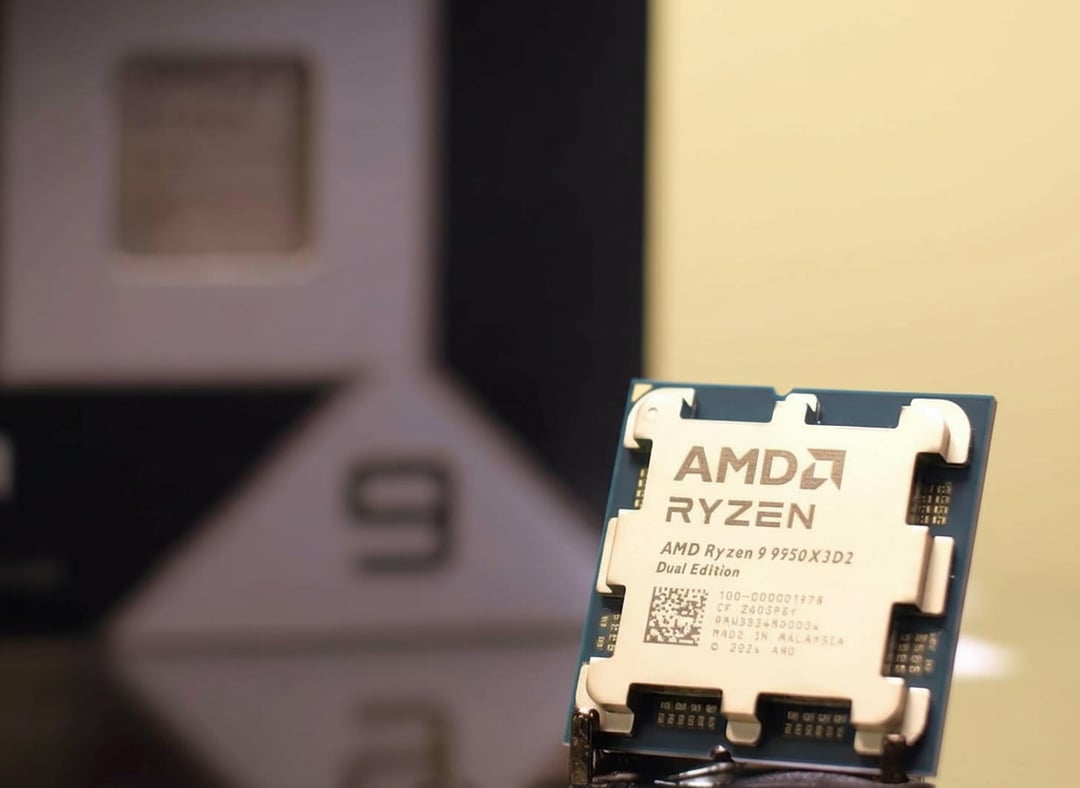
Early Ryzen 9 9950X3D2 Retail Listings Point to a Near-$1,000 Price
AMD’s Ryzen 9 9950X3D2 Dual Edition has appeared in early retail listings in Canada and the United Kingdom, giving the clearest indication yet of where the processor may land on price when it launches on April 22.
On PC-Canada.com, the chip showed up at CAD $1,373.99, which works out to roughly $985 USD. A similar Canadian listing also appeared on shopRBC.com. In the UK, Overclockers UK briefly listed the processor at £905.82 before adjusting the page. At the same time, some placeholder-style entries — including one priced at £100,000 — made it obvious that final launch pricing is still not fully settled in public-facing listings.
AMD has not announced an official MSRP for the Ryzen 9 9950X3D2, so these early numbers should be treated as signals rather than confirmation.
What Makes the Ryzen 9 9950X3D2 Different
Dual 3D V-Cache Across Both CCDs
The standout feature of the Ryzen 9 9950X3D2 is its dual-cache design. It is described as the first consumer CPU to place 3D V-Cache on both core complex dies. That changes the usual X3D formula in a meaningful way.
Earlier Ryzen X3D chips only placed 3D V-Cache on one CCD. That meant only half of the CPU cores got the benefit of the extra cache. With the Ryzen 9 9950X3D2, both CCDs carry stacked cache, so all 16 cores can take advantage of the expanded cache pool.
For buyers watching AMD’s high-end desktop lineup, that’s really the whole story here. This chip is not just another small refresh. The dual-cache layout is the key reason it stands apart.
Total Cache and Core Configuration
The processor is built on AMD’s Zen 5 architecture and comes with 16 cores and 32 threads. It carries a 4.3 GHz base clock and a 5.6 GHz boost clock.
Its total cache reaches 208 MB, split between 16 MB of L2 cache and 192 MB of L3 cache. AMD gets there by adding 64 MB of 3D V-Cache to each of the two CCDs.
That cache figure is the headline spec. And honestly, it’s easy to see why. The entire value proposition of this processor rests on the idea that fully extending cache benefits across both CCDs can do more than the earlier single-cache setup.
Ryzen 9 9950X3D2 Specs Show a Tradeoff in Clocks and Power
Slightly Lower Boost Clock
There is a small frequency concession compared with the standard Ryzen 9 9950X3D. The Ryzen 9 9950X3D2 boosts to 5.6 GHz, which is 100 MHz lower than the standard model.
That reduction is framed as a tradeoff tied to the extra power demands created by the second cache stack. So while the chip pushes cache higher and broadens its reach across all cores, it gives back a little on peak clock speed.
Higher 200W TDP
Power is another part of that tradeoff. The Ryzen 9 9950X3D2 carries a 200W TDP, up from 170W on the single-cache Ryzen 9 9950X3D.
That increase matters because it helps explain the product’s positioning. This is not being presented as a modest tuning exercise. It is a more aggressive version of AMD’s flagship mainstream desktop chip, with higher power requirements and a design clearly aimed at squeezing more out of cache-heavy workloads.
Expected Performance Gains From the Dual-Cache Design
AMD says the dual-cache layout should deliver productivity gains of around 5–10% in workloads such as DaVinci Resolve, Blender, and Geekbench multi-core.
That claim is tied directly to the change in cache placement. Since previous Ryzen X3D processors only gave one CCD the 3D V-Cache advantage, part of the CPU did not benefit from the larger cache. With the Ryzen 9 9950X3D2, AMD’s pitch is straightforward: all 16 cores now get access to that advantage.
For creators and developers, that is the practical angle AMD is leaning into. The chip is being positioned not just as a halo part, but as a processor meant to offer broader gains in real productivity workloads where more cores can actually make use of the cache expansion.
How the Price Compares to the Regular Ryzen 9 9950X3D
If the current retail listings are close to final launch pricing, the Ryzen 9 9950X3D2 would arrive at around $300 above the $699 launch price of the single-cache Ryzen 9 9950X3D.
That gap is significant. It places the new chip in much more premium territory and raises the obvious question: will the dual-cache design be worth paying that much extra for?
Right now, that answer is still open. Early listings offer a pricing direction, but they do not settle the value discussion. Some of the numbers already seen may simply be placeholders, and AMD still has not published an official MSRP.
Launch Timing and Market Positioning
AMD’s Senior Vice President Jack Huynh announced the processor on March 25 and highlighted its appeal for creators and developers. That messaging lines up with the performance claims AMD is making around applications like Blender and DaVinci Resolve.
The release date is set for April 22. On that same day, Alienware is expected to ship an Area-51 desktop configured with the processor.
That matters because it shows the chip is not only being positioned as a retail enthusiast part. It is also moving directly into premium prebuilt systems, which tends to reinforce its flagship status.
What to Watch After Launch
Independent reviews are expected around launch, and those will be the real test of the Ryzen 9 9950X3D2’s place in AMD’s stack.
The core question is simple: does putting 3D V-Cache on both CCDs justify the premium over AMD’s already expensive mainstream desktop flagship? Early retail listings suggest buyers may need to pay close to $1,000 to find out.
Until official pricing and third-party benchmarks arrive, the Ryzen 9 9950X3D2 looks like a technically distinctive processor with unusually high expectations attached to it.