
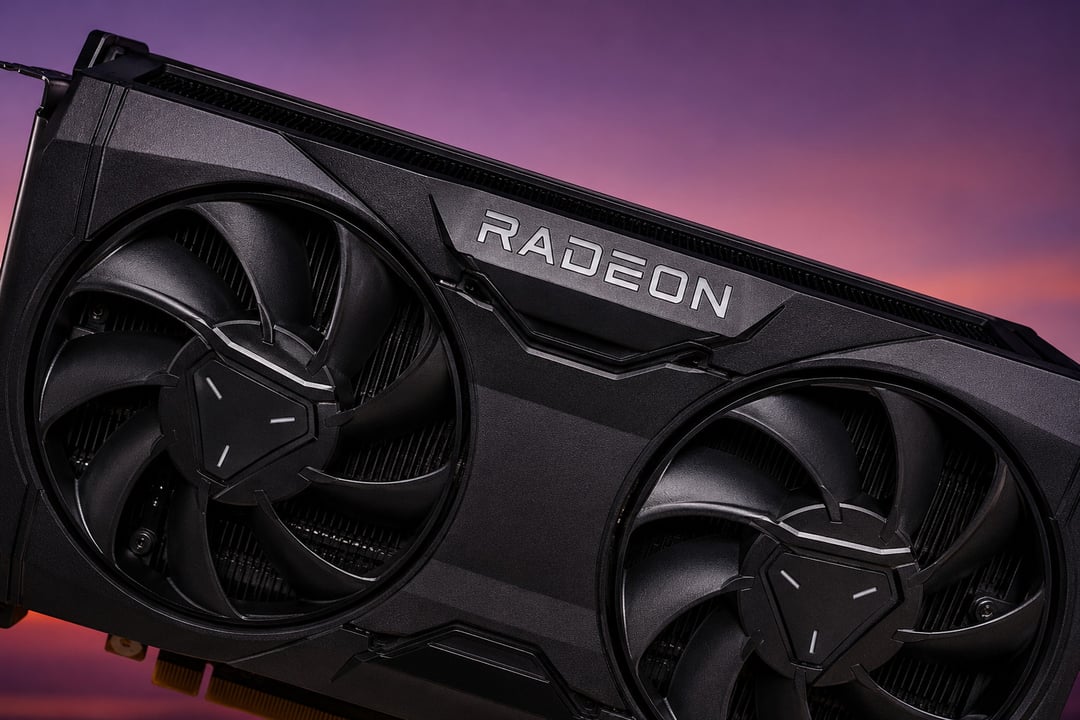
Word from AMD's board partners is that a price increase is already locked in. According to a leak circulated by ChannelGate on Weibo and picked up by VideoCardz, AMD has told its AIB partners that GPU and memory bundles will cost at least 10% more starting in August. That comes only days after reports that Nvidia is pushing through a much steeper hike of its own, which makes this look less like a one-company decision and more like the whole graphics market moving in the same direction at once.
What AMD Actually Told Its Partners
The notice covers GPU and memory kits sold as bundles to add-in board partners — the companies that turn AMD silicon into the cards you actually buy. A minimum 10% bump on that bundle is the figure being reported.
Whether standalone graphics cards get the same treatment is the open question, and it would be surprising if they didn't. When the cost of the core components rises for every partner at the same time, that cost tends to land on the shelf price eventually. Nobody absorbs a 10% increase out of goodwill.
The RX 9050 Is the Clearest Warning Sign
AMD recently rolled out the RX 9050 at $279. On its own, that's a reasonable-looking budget number. Put it next to the RX 9060 XT, though, and the picture gets strange: the 9060 XT carries double the graphics memory for just $20 more. When $20 buys you twice the VRAM, something in the pricing structure has come loose.
There's a more telling detail here, too. AMD is reportedly planning to bring back graphics cards with 4GB of onboard memory — a configuration that had largely been left behind. Reviving it now says a lot about how expensive memory has become.
Street Prices Left MSRP Behind a While Ago
The RX 9050 launched under $300. Good luck finding one anywhere near that today. The most optimistic figure floating around is roughly $450, and that's the floor, not the average. XFX is asking about $490 for its version. Gigabyte is listing one at $550 in the US.
That's a card whose sticker price and actual price have almost nothing to do with each other anymore. And the August increase hasn't even taken effect yet.
|
Card
|
Launch price
|
Where it stands / could go
|
|
RX 9050
|
$279 (under $300)
|
$450 at best; $490 from XFX, $550 from Gigabyte
|
|
RX 9060 XT
|
—
|
Only $20 above the 9050, with double the memory
|
|
RTX 5060 Ti
|
$429
|
Up to $760 after revised pricing
|
|
RTX 5070 Ti
|
—
|
Up to $1,400 in the US
|
How AMD's Increase Stacks Up Against Nvidia's
AMD's 10% isn't in the same league as what Nvidia is reportedly doing, and that's worth saying plainly. Nvidia's revisions are brutal by comparison. The RTX 5060 Ti arrived at $429; once the new pricing lands, it could climb as high as $760 — close to double what it cost at launch. The RTX 5070 Ti could reach $1,400 in the US.
The uncomfortable part of the leak is what it predicts about the gap between the two brands. Once AMD's hike goes through, the affected Radeon cards are expected to land in the same price bracket as Nvidia's post-increase lineup. The value argument that usually gives Radeon its opening — similar performance, friendlier price — gets a lot harder to make when both companies are asking for the same money.
Memory Costs and the AI Squeeze
The reason underneath all of this isn't gaming demand. It's memory. Prices for it are climbing because of AI, and graphics cards need a lot of it. That's why AMD is bundling GPUs and memory kits together in the price notice, why a card with 4GB of VRAM is suddenly back on the table, and why a $20 gap can separate two products with wildly different memory configurations.
It also means the 10% figure is a starting point rather than a ceiling. With memory costs still under pressure from AI demand, card prices can keep drifting upward well past this August adjustment. Nothing about the current setup suggests a natural stopping point.
How Long This Lasts
The most sobering piece of the whole situation is the timeline. By conservative estimates, the market may not settle down until 2028. That's not a bad quarter or a rough launch window — that's years of elevated pricing baked in before anything resembling normal returns.
For anyone building or upgrading a PC right now, that changes the math on waiting. The usual advice is to hold out for the next generation or the inevitable price correction. Here, the correction isn't on the calendar, and the next adjustment on the books moves in the wrong direction.
What Buyers Are Left With
The entry-level tier is where this hurts most. A budget card that lists at $279 but sells for $490 isn't really a budget card — it's a mid-range purchase wearing a budget label. And when a modest step up in model number costs $20 but doubles your memory, the smart move within the lineup gets harder to spot, because the pricing no longer tracks the hardware in any sensible way.
Meanwhile, the reintroduction of 4GB cards means the bottom of the market may get cheaper in name only, with the savings coming out of the memory you'd actually want in a modern system.