
AMD Expands Aggressively into Virtualized 5G and Edge Deployments
Telecom networks are changing. Quietly, but in a way that really matters.
Operators aren’t relying on tightly controlled, proprietary hardware like they used to. They’re moving toward virtualized radio access networks (vRAN), built on standard server platforms. And in that shift, the processor becomes everything. It’s the muscle. The traffic cop. The thing that decides whether your network scales smoothly—or stalls.
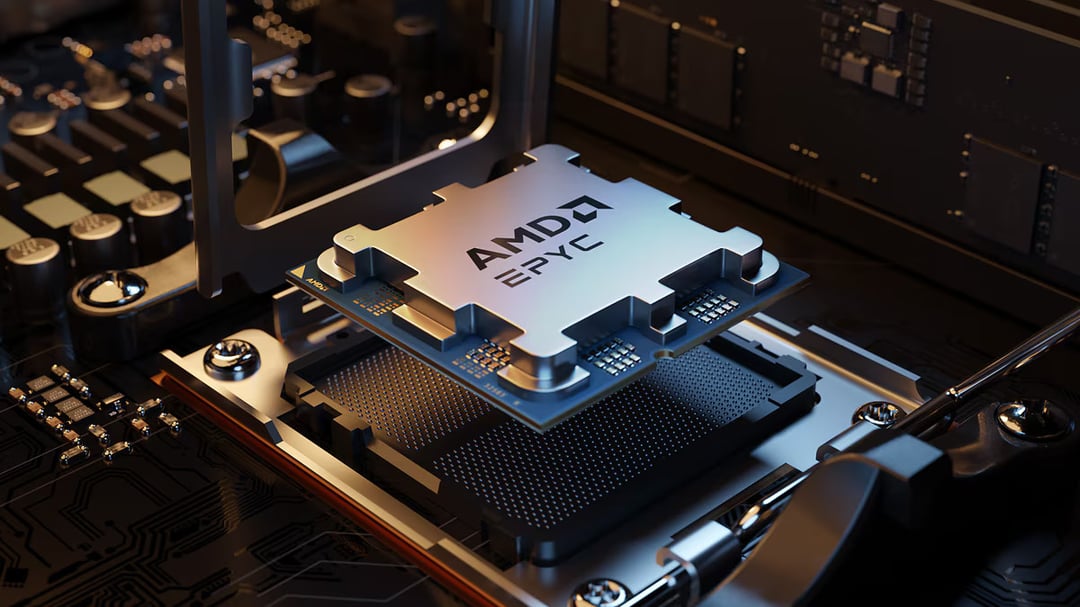
AMD’s 8005-series EPYC processors, codenamed Sorano, are built with that exact reality in mind. This isn’t just another data center chip. It’s designed specifically for telecom and edge infrastructure, where consistency and efficiency matter as much as raw performance.
And here’s the headline: up to 84 Zen 5 cores in a single processor.
That’s a serious jump from the previous Siena generation.
84 Zen 5 Cores Designed for Telecom Network Workloads
Higher Core Density for Layer 1 and Layer 2 Processing
In telecom environments, workloads are dense and relentless. You’re handling Layer 1 and Layer 2 processing continuously. No breaks. No forgiveness.
Sorano pushes core counts to 84 Zen 5 cores, giving operators more compute headroom inside each server. More cores mean more parallel workloads. More virtualized functions running simultaneously. And potentially fewer physical servers needed to do the same job.
But here’s what really matters: telecom buyers don’t just chase core numbers. They care about whether those cores translate into real, measurable gains in network capacity.
AMD is clearly betting that they do.
225W Power Envelope with Potential Lower-Watt Variants
Sorano is rated at up to 225 watts, which puts it firmly in high-performance territory. But based on earlier designs like Siena, lower thermal envelope versions may follow.
And that’s not a small detail.
At the edge—where deployments might sit in constrained environments with tighter thermal limits—power efficiency directly affects operating costs. Cooling, space, energy consumption… it all adds up. Sometimes the difference between profitability and strain comes down to wattage.
If sub-100W variants emerge, they could be particularly attractive for edge sites where environmental tolerances are strict and infrastructure budgets are tight.
Zen 5 Architecture with 512-Bit Data Path for Vector Instructions
Sorano integrates a full 512-bit data path for vector instructions, reflecting broader architectural changes in Zen 5.
Why does that matter?
Because telecom workloads—especially in virtualized RAN—depend on highly parallel, compute-heavy operations. A wider data path improves throughput in vectorized workloads, which directly impacts how efficiently network functions execute.
In environments where predictable latency matters more than peak clock speeds, architectural improvements like this carry real weight.
It’s not about flashy benchmarks. It’s about consistent, sustained performance under load.
Improved LDPC Decoding Efficiency in 5G Networks
Low-Density Parity Check Decoding as a Core 5G Requirement
One of AMD’s central claims around Sorano involves improvements to low-density parity check (LDPC) decoding.
If that sounds technical, here’s what you need to know: LDPC decoding is foundational to 5G networks. It’s part of how data is transmitted reliably at high speeds. And it’s computationally demanding.
Better efficiency in LDPC handling means something practical: you free up CPU resources.
According to AMD, improved LDPC efficiency allows operators to reallocate compute capacity to additional Layer 1 and Layer 2 tasks. That could translate into more network functions running per server in a data center or edge facility.
In other words, more value from the same hardware footprint.
Network Capacity Scaling and Infrastructure Economics
Telecom is a conservative industry. Purchasing cycles are slow. Vendor relationships run deep.
So just increasing core counts isn’t enough.
The real question is whether Sorano can materially improve network capacity scaling. If operators can run more workloads per server, reduce hardware sprawl, and improve energy efficiency, that shifts the economics of telecom infrastructure.
But if gains are incremental? Adoption becomes harder.
AMD is positioning Sorano as more than just a core-count upgrade. It’s aiming at efficiency gains that ripple across the entire infrastructure stack.
AMD vs Intel in Telecom Infrastructure
Intel Xeon 6E and Xeon 6 SoC Competition
AMD’s move doesn’t happen in a vacuum.
Intel continues to develop telecom-focused processors, including the Xeon 6E and Xeon 6 SoC lines. The Xeon 6700E scales up to 144 efficiency cores, emphasizing density and lower power draw over advanced instruction features.
Meanwhile, the Xeon 6 SoC integrates accelerators tailored for vRAN workloads. It also includes high-speed networking and support for AI and media tasks—functions that might otherwise require a GPU in broader deployments.
Intel isn’t standing still. Not even close.
Vendor Relationships and Market Realities
Companies like Ericsson and Nokia continue deploying Intel-based platforms in commercial networks. That matters. Long-term partnerships influence procurement decisions in telecom.
For AMD to gain meaningful ground, it must demonstrate measurable advantages beyond specifications on paper. Performance-per-watt, LDPC efficiency, total cost of ownership—those are the levers that move conservative buyers.
Sorano may represent the last major Zen 5 EPYC release before AMD’s next-generation server CPU, Venice, arrives. That makes this launch strategically important. It sets the tone before the next architectural leap.
Whether it fundamentally shifts telecom infrastructure economics remains uncertain. Core increases alone rarely determine purchasing cycles in this space.