
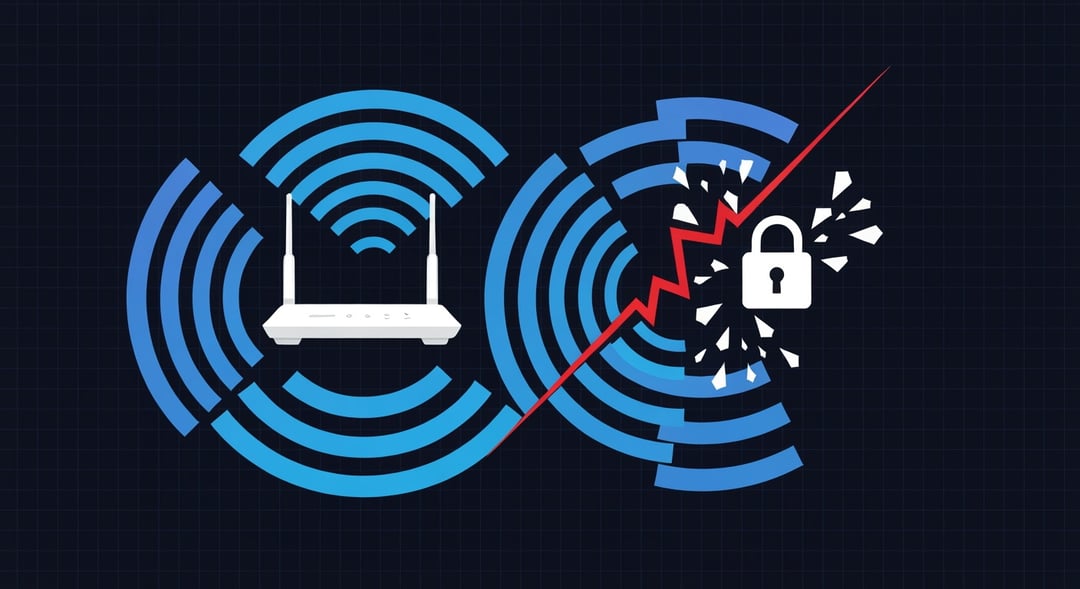
Wi-Fi Client Isolation Is Fundamentally Broken
Wi-Fi Client Isolation is designed to stop devices on the same network from communicating directly with each other. In theory, that means if someone joins your Wi-Fi, they can’t snoop on your laptop, phone, or internal systems.
But researchers from the University of California, Riverside found that this protection is “fundamentally broken.”
Their analysis examined client isolation across three critical layers:
- Wi-Fi encryption
- Internal packet switching inside access points
- IP routing through the gateway
What they discovered challenges a long-standing assumption in both home and enterprise environments: client isolation cannot be treated as a reliable security boundary.
The vulnerability, named AirSnitch, enables malicious users connected to the same Wi-Fi network to bypass isolation controls and interfere with other devices.
How the AirSnitch Attack Bypasses Network Encryption
AirSnitch introduces multiple techniques that undermine Wi-Fi encryption protections and allow attackers to manipulate traffic inside the network.
Abusing the Shared Wi-Fi Group Key (GTK)
Attackers can exploit weaknesses in the shared group key mechanism, which is used to manage broadcast and multicast traffic. By manipulating this mechanism, malicious users can inject or intercept network traffic intended for other devices.
Gateway Bouncing (Layer 3 Routing Exploit)
Gateway bouncing leverages IP routing behavior at the gateway level. Instead of communicating directly with a victim device, the attacker reroutes traffic through the network gateway to bypass isolation restrictions.
Port Stealing via MAC Spoofing
Port stealing allows attackers to impersonate legitimate devices by spoofing MAC addresses. This manipulation can redirect traffic flows and intercept communications not intended for the attacker.
Broadcast Reflection Without GTK Access
Even without direct access to the group key, attackers can exploit broadcast reflection techniques to inject malicious traffic into the network.
Full Machine-in-the-Middle (MitM) Attack Combination
By combining port stealing and gateway bouncing, attackers can execute a full machine-in-the-middle (MitM) attack. This enables:
- Traffic interception
- Data manipulation
- Session hijacking
The researchers warn that these attack primitives could support advanced exploitation techniques such as:
- Cookie stealing
- DNS poisoning
- Cache poisoning
Intercepting Internal Wired Devices
AirSnitch is not limited to wireless devices. By spoofing MAC addresses, attackers can intercept traffic destined for internal wired devices, effectively “wiretapping” the network at a broader level.
Scope of the Wi-Fi Vulnerability: Home and Enterprise Networks at Risk
The issue is widespread.
Every router and network tested in the research was vulnerable to at least one AirSnitch technique. This includes:
- Home Wi-Fi routers
- Enterprise access points
- University networks
The vulnerability is not confined to consumer-grade equipment. Enterprise deployments that rely on client isolation for internal segmentation face similar exposure.
The researchers describe AirSnitch as capable of breaking worldwide Wi-Fi encryption assumptions and potentially enabling advanced cyberattacks at scale.
Cybersecurity Risks Enabled by AirSnitch
The ability to inject, intercept, and manipulate traffic within a supposedly isolated Wi-Fi environment creates significant security risks:
- Credential theft through cookie stealing
- DNS manipulation and redirection
- Cache poisoning
- Session hijacking
- Internal network surveillance
Because attackers only need to be connected to the same Wi-Fi network, shared environments such as offices, campuses, and multi-tenant spaces are particularly exposed.
How to Protect Your Network from AirSnitch Attacks
Since Wi-Fi client isolation cannot be treated as a dependable safeguard, security strategy must shift toward stronger layered defenses.
Implement Proper Network Segmentation
Do not rely solely on client isolation. Instead, segment networks using robust architectural controls that separate sensitive systems from general user access.
Avoid Sharing Credentials
Minimize credential reuse across devices and services. Shared credentials increase exposure when interception techniques are used.
Improve Group Key Handling
Ensure group key management practices are carefully configured and monitored. Weak key handling contributes directly to broadcast and multicast abuse.
Use Strong End-to-End Encryption Everywhere
End-to-end encryption significantly reduces the impact of interception attacks. Even if traffic is captured or rerouted, properly encrypted communications remain unreadable.
Encryption should be enforced consistently across:
- Web applications
- Internal services
- Enterprise tools
- Cloud platforms
Layered encryption ensures that even if Wi-Fi defenses fail, sensitive data remains protected.