
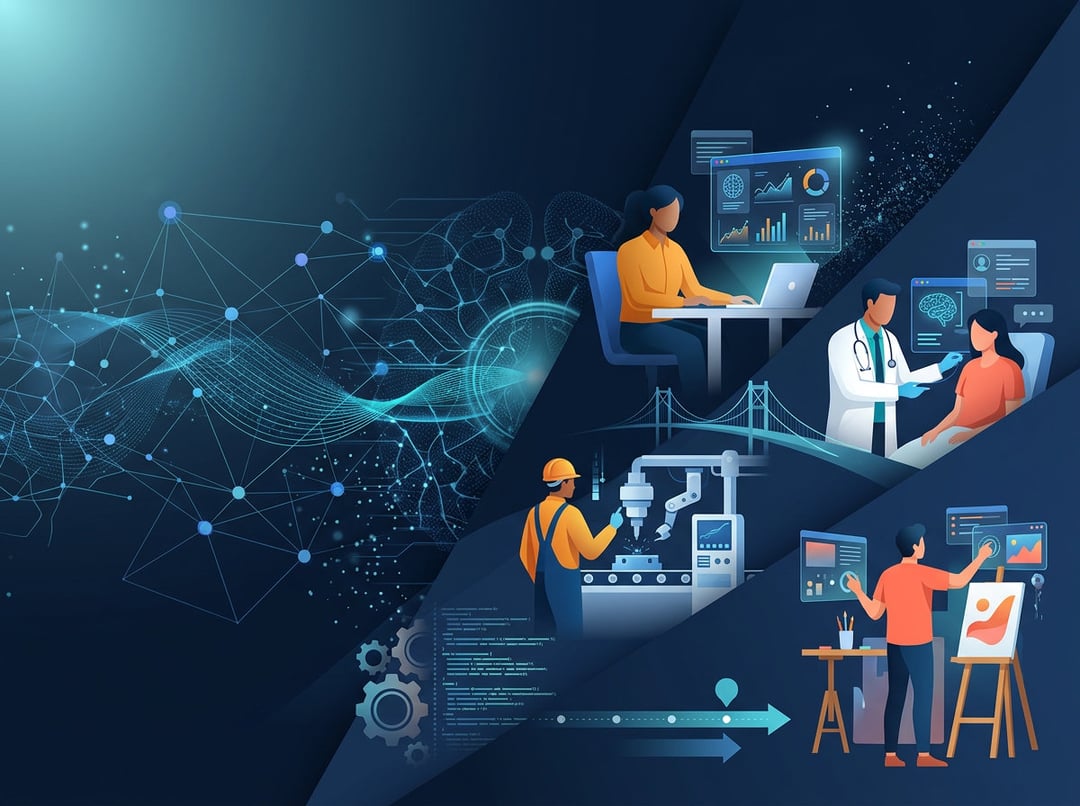
Artificial intelligence is no longer a speculative technology. It now writes reports, detects diseases, generates code, and manages logistics networks. As capability accelerates, the central question becomes unavoidable: how will AI impact jobs in the next decade?
The answer is neither mass unemployment nor seamless harmony. Instead, the next ten years will bring structural labor market shifts, rapid task reallocation, new job categories, and intensified skill polarization. Understanding these forces requires separating automation from augmentation and disruption from evolution.
Why the Next Decade Marks an Inflection Point
Previous waves of automation targeted repetitive manual labor. Today’s AI systems target cognitive tasks once reserved for educated professionals. Large-scale foundation models process language, images, audio, and structured data within unified architectures. This multimodal capability compresses what once required separate software stacks.
Compute power compounds the trend. Specialized AI accelerators from firms like NVIDIA and AMD drive exponential performance gains. Cloud platforms distribute these capabilities globally at marginal cost. Consequently, deployment cycles shrink from years to months.
The result resembles past general-purpose technologies such as electricity or the internet. According to research from the National Bureau of Economic Research, general-purpose technologies restructure entire industries rather than optimize isolated functions. AI now occupies that role.
Automation vs. Augmentation: Moving Beyond the Binary
Public debate often frames AI as either job destroyer or productivity miracle. That framing obscures reality. Most occupations consist of task bundles rather than singular functions. AI substitutes specific tasks while leaving others intact.
Consider legal practice. AI tools analyze contracts and perform due diligence with remarkable speed. However, courtroom advocacy, negotiation strategy, and client counseling still require human judgment. The job evolves rather than disappears.
This task decomposition model explains why economists at the OECD and McKinsey emphasize exposure rather than elimination. High exposure does not equal total replacement. Instead, it signals workflow redesign.
Augmentation will likely dominate. Doctors use AI to interpret imaging data more precisely. Engineers deploy generative design software to test thousands of prototypes. Marketers analyze predictive analytics outputs to refine campaigns. Productivity expands while human oversight persists.
Sector-Level Impact: Where AI Will Reshape Work Most Intensely
Knowledge Work and Professional Services
AI-driven analytics automate financial modeling, compliance monitoring, and risk assessment. Accounting firms increasingly integrate machine learning systems to audit large datasets in real time. Consulting firms embed predictive models into strategic planning. Knowledge workers must now interpret AI outputs rather than manually generate baseline analysis.
Creative Industries
Generative AI reshapes content production. Tools create visual assets, draft scripts, and compose music. This capability shifts value toward direction, curation, and strategic storytelling. The professional edge moves from production to orchestration.
Intellectual property frameworks struggle to keep pace. Regulatory agencies worldwide continue evaluating copyright implications for AI-generated material.
Healthcare
AI augments diagnostics through image recognition and pattern detection across genomic and clinical data. Studies published by institutions such as Stanford Medicine demonstrate diagnostic accuracy improvements in radiology when AI assists clinicians. Administrative automation further reduces paperwork burdens. Healthcare employment may shift toward patient interaction and oversight of automated systems.
Manufacturing and Logistics
Robotics integrated with AI vision systems enable adaptive automation. Warehouses deploy autonomous vehicles guided by machine learning algorithms. Predictive maintenance reduces downtime through real-time sensor analysis. These systems demand technicians who manage robotics ecosystems rather than operate individual machines.
New Job Categories Emerging from AI Expansion
Technological displacement historically generates new professions. AI follows this pattern.
Emerging roles include:
- AI auditors who evaluate bias and model integrity
- Data curators who prepare structured training datasets
- Human-AI interaction designers who optimize collaboration interfaces
- Algorithmic governance specialists who align systems with regulatory frameworks
Hybrid professions will expand. Doctors will interpret AI diagnostics. Lawyers will oversee automated contract review platforms. Engineers will supervise generative design systems.
In each case, the professional advantage lies in strategic oversight rather than repetitive execution.
Economic Implications: Productivity, Wages, and Inequality
Productivity growth may accelerate as AI reduces marginal task costs. Historical precedent suggests that general-purpose technologies expand GDP over time. However, distribution effects remain uneven.
Highly skilled workers who use AI could see higher wages. Meanwhile, jobs in the middle that involve routine thinking tasks may face pay cuts. This divide is similar to what happened during previous waves of automation.
Corporate structures may also evolve. AI reduces coordination costs. Smaller firms can scale operations with minimal staff. A single entrepreneur equipped with AI tools may manage functions once requiring entire departments.
Policymakers therefore confront dual imperatives: stimulate innovation while cushioning transitional displacement.
Skills That Will Define Career Resilience
The next decade will reward adaptability. Technical fluency becomes baseline. Workers must understand how AI systems function at a conceptual level even if they do not build models themselves.
Three skill clusters will dominate:
- Analytical reasoning: framing problems clearly and evaluating AI-generated outputs
- Systems thinking: understanding how automated processes interact across organizations
- Human differentiation: empathy, negotiation, leadership, and ethical judgment
Continuous learning replaces static credentials. Online platforms and micro-certifications expand rapidly. Employers increasingly prioritize demonstrable capability over traditional degrees.
Policy and Institutional Adaptation
Governments experiment with reskilling subsidies, wage insurance models, and AI governance frameworks. The European Union’s AI Act provides an early regulatory blueprint focused on risk classification and transparency requirements. Other jurisdictions will refine similar structures.
Education systems must also pivot. Curriculum redesign should emphasize interdisciplinary thinking and computational literacy. Lifelong learning infrastructure will determine long-term workforce stability.
Risks and Structural Uncertainty
Forecasting remains inherently uncertain. AI development may exceed expectations or encounter technical plateaus. Geopolitical competition could accelerate deployment. Ethical failures could erode public trust.
Nonetheless, ignoring AI’s trajectory carries greater risk than engaging with it. Historical resistance to automation rarely preserved obsolete job functions. Instead, societies that invested in transition mechanisms adapted more successfully.
Strategic Preparation for the Next Decade
People should see AI as a partner, not a rival. Learning to use tools that boost productivity gives you an advantage. Concentrating on defining problems, instead of repeating tasks, helps you stay valuable.
Organizations must redesign workflows intentionally. Simply layering AI onto legacy systems yields marginal gains. Structural integration generates compound benefits.
The question is no longer whether AI will impact jobs in the next decade. It already does. The decisive variable lies in how quickly workers, businesses, and institutions recalibrate.
Work will not vanish. It will transform. Those who adapt deliberately will shape the new labor architecture rather than react to it.