
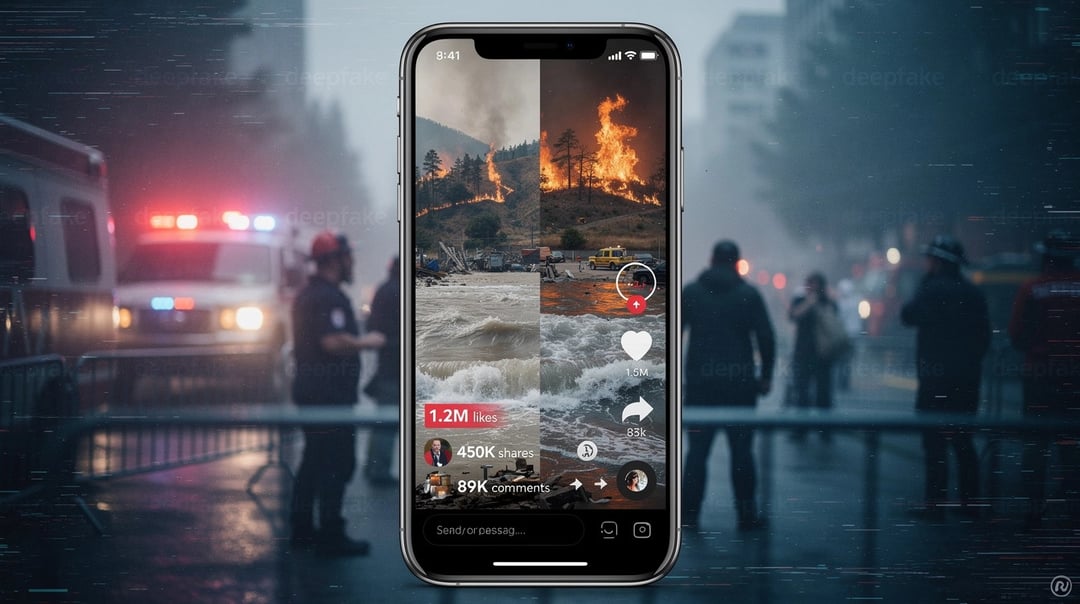
An earthquake hits. Within minutes, your feed fills with collapsed buildings, screaming, dust clouds, water where a street used to be. Some of it happened. Some of it happened somewhere else, years ago. And some of it never happened at all — it was generated by a model an hour ago by someone who wanted the traffic.
That's the situation around recent disasters in Venezuela and China, where recycled clips and synthetic footage flooded social platforms alongside the real thing. The result is a feed that gets harder to trust exactly when people need accurate updates fastest.
Why Disasters Attract Fake Footage So Quickly
There's an ugly race built into how this works. People want proof of what happened right now, and AI slop can hand them something dramatic before reliable reporting catches up. Verified updates end up competing with fiction at the precise moment confusion pushes people to go looking for answers.
The incentive is simple. A dramatic clip, a caption tying it to an unfolding event, and enough reach to outrun anyone bothering to check where it came from — that's the whole recipe. AI makes the raw material more convincing and cheaper to produce, but speed is doing a lot of the heavy lifting. A fake that spreads before anyone can trace it doesn't need to be a masterpiece.
The Venezuela Earthquakes: Old Footage, New Labels
What spread around Venezuela's earthquakes wasn't purely a synthetic media problem. A good portion of it was ordinary recycling. Real videos from unrelated disasters were reassigned to Venezuelan locations. Older footage from Venezuela itself came back around presented as breaking news.
This is the part people underestimate. Once you strip the date and the original context off a recording, a completely authentic video deceives just as effectively as a generated one. There's no artifact to spot, no telltale glitch in the shadows or the hands. The lie isn't in the pixels — it's in the caption. And caption-level fraud takes seconds to produce, which is why it keeps working on live events.
China's Floods: What AI Actually Added
The fabricated posts circulating during severe weather in China show what changes when producing convincing fakes gets cheap. This wave included manufactured flood scenes and false reports of power outages. Some generated images placed bodies in floodwaters. The bogus outage claims sent residents out looking for emergency supplies.
That last detail is worth sitting with. This wasn't just noise polluting a timeline — it changed what people did in the middle of a weather emergency. Someone chasing follower counts produced a claim, and strangers rearranged their day around it.
Many of these posts existed to pull in followers and traffic, with money as the eventual goal somewhere down the chain. That business model explains the quality ceiling. The footage never has to survive a careful look. It only has to hold up long enough for a frightened or curious viewer to hit share.
Why the First Clips Deserve the Most Suspicion
Here's the pattern worth internalizing: the earliest viral videos tend to surface in exactly the window when reliable context doesn't exist yet. That gap is the opening. Dramatic footage gets an advantage from timing alone, even when nobody can say who recorded it, when it was recorded, or whether it depicts the current disaster at all.
The natural defensive reaction — assume everything is fake — creates its own problem. Blanket skepticism throws out genuine eyewitness material, which is often the only documentation coming out of an area before professional coverage arrives. Treating real survivors' footage as garbage isn't a fix.
The more workable position is narrower: treat disaster footage as unverified rather than fake, and hold it there until three basics check out.
If you can't establish those three things, the honest move is to leave it alone. Not debunk it, not quote-post it, not share it with a disclaimer — just don't pass it along. Reverse image search handles a surprising share of this in under a minute, and it catches recycled real footage that no AI detector would ever flag.
What This Means for Anyone Following a Live Emergency
The practical takeaway isn't a detection technique. Detection tools chase a moving target, and half this material isn't synthetic anyway.
The takeaway is about pacing. Engagement farming depends entirely on the gap between an event happening and reliable information arriving. Everything in that window is optimized for immediate emotional reaction, because that's the only thing that travels fast enough to matter to the people producing it. Slowing down by even a few hours removes most of your exposure — not because verified information is always right, but because it's had time to acquire a location, a date, and a name attached to it.
And there's a smaller responsibility folded into this. Every share of unverified disaster footage is a small contribution to someone's traffic numbers. If the basics can't be traced, sharing it means helping a content farm convert another person's emergency into feed filler. That's a low bar to refuse to clear.