Google Reports That 75% of Its New Code Is Now AI-Generated
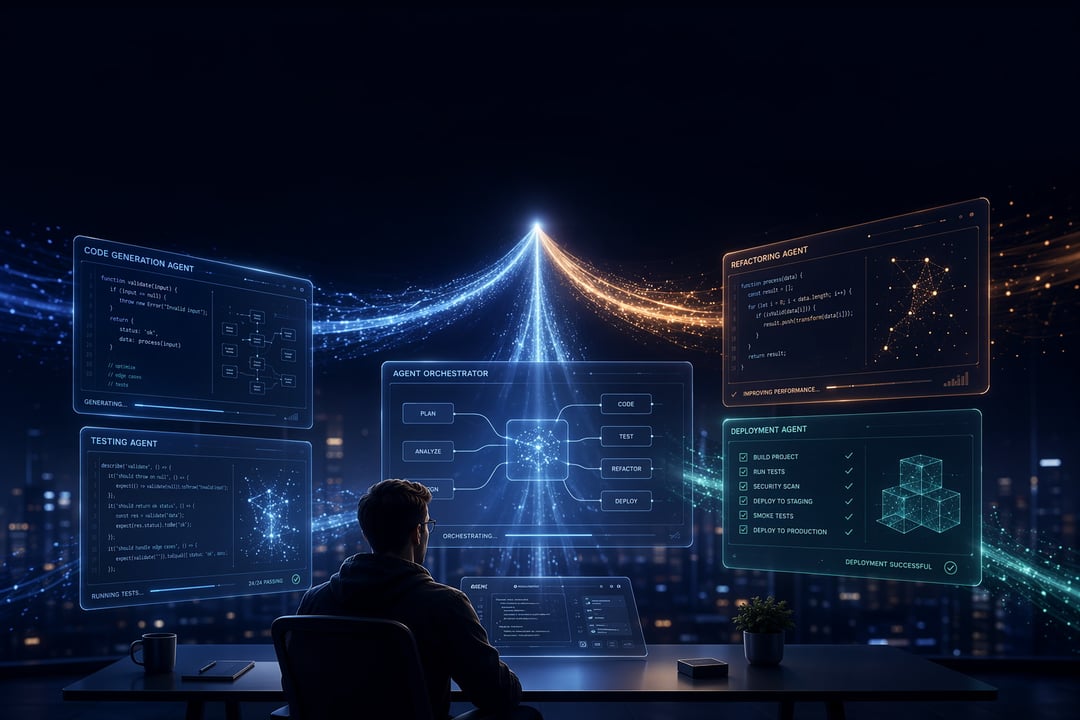
At Google Cloud Next '26 in April, chief executive Sundar Pichai disclosed that artificial intelligence now writes 75% of all new code produced at the company, with every contribution approved by an engineer before it ships. That share has climbed steeply over a short window — from roughly 50% the previous fall and just 25% in late 2024. Pichai framed the milestone as evidence that the organization is moving toward genuinely agentic workflows, in which AI systems take on larger portions of the development cycle while people supervise the results.
The headline figure deserves a careful reading. It counts code that AI suggests and that humans then accept or revise, rather than software written and deployed without oversight. Every commit still moves through human review and automated testing before it reaches production. In other words, the 75% number describes how much of the raw output originates with AI, not a wholesale handover of engineering judgment to machines.
The AI Coding Arms Race: Microsoft, OpenAI, and Anthropic Compete for Developers
Coding has become the central battleground among the largest AI labs. The contest now pits Microsoft, Google, Anthropic, and OpenAI against one another for the loyalty of professional developers, with Anthropic's Claude Code currently out in front when it comes to enterprise adoption.
The competition produced a flurry of announcements within a single stretch. Microsoft used its Build conference on June 2 to introduce MAI-Code-1-Flash, the company's first model engineered specifically to turn written descriptions into working source code. On the same day, OpenAI expanded its Codex platform with six new workplace plug-ins and was recognized as a Leader in the 2026 Gartner Magic Quadrant for Enterprise AI Coding Agents. The timing underscores how quickly the field is consolidating around tools that promise to compress the distance between an idea expressed in plain language and a functioning application.
From Writing Code to Supervising AI Agents
The day-to-day reality inside engineering teams is shifting in a fundamental way. The constraint used to be how much code a team could physically write. Now the bottleneck has moved downstream — to how much code teams can review, secure, and deploy. AI handles a growing share of the repetitive groundwork, including boilerplate, test scaffolding, and small bug fixes, while human engineers concentrate on the work that machines handle poorly: system architecture, trade-offs that require business context, and the careful inspection of AI output for subtle errors that automated checks might miss.
That redistribution of effort effectively recasts the engineer as a supervisor of autonomous agents rather than a line-by-line author. The skill that matters most is no longer raw typing speed but the judgment to direct AI work, catch its mistakes, and decide what is safe to ship.
No-Code Platforms Open Software Development to Non-Engineers
The transformation reaches beyond professional teams. Platforms such as Lovable and Base44 let people with no technical background assemble full-stack applications from plain-language prompts, without writing a single line themselves. These tools do not produce throwaway mockups — they generate real, exportable code and automatically manage backend logic, databases, and authentication. The practical effect is that building functional software is no longer confined to those who can read and write programming languages.
A Mixed Labor Market for Software Engineers
For all the anxiety surrounding automation, the employment data resists a simple narrative. Software engineering job postings in the United States reached a three-year high in the first quarter of 2026, rising roughly 30% — even as technology companies announced more than 52,000 layoffs over the same period. A Citadel Securities analysis found that software engineering listings on Indeed grew 11% year over year, outpacing overall job growth. Looking further out, the Bureau of Labor Statistics projects 15% growth in software developer employment through 2034.
|
Indicator
|
Figure
|
|
US software engineering job postings, Q1 2026
|
Three-year high, up ~30%
|
|
Tech layoffs announced, same period
|
More than 52,000
|
|
Indeed software engineering listings
|
Up 11% year over year
|
|
BLS projected developer employment growth through 2034
|
15%
|
Entry-Level Developers Feel the Squeeze
The strain is not spread evenly. It is concentrated at the bottom of the career ladder, where employment for developers aged 22 to 25 has fallen by nearly 20% since ChatGPT launched. At the same time, demand keeps rising for senior engineers, AI specialists, and people capable of integrating complex systems. MIT research scientist Frank Nagle has argued that the companies that fare best will combine junior staff who function as AI power users with experienced professionals who understand why systems fail in the first place — a pairing that values both fluency with new tools and the hard-won intuition that comes only with time.


