
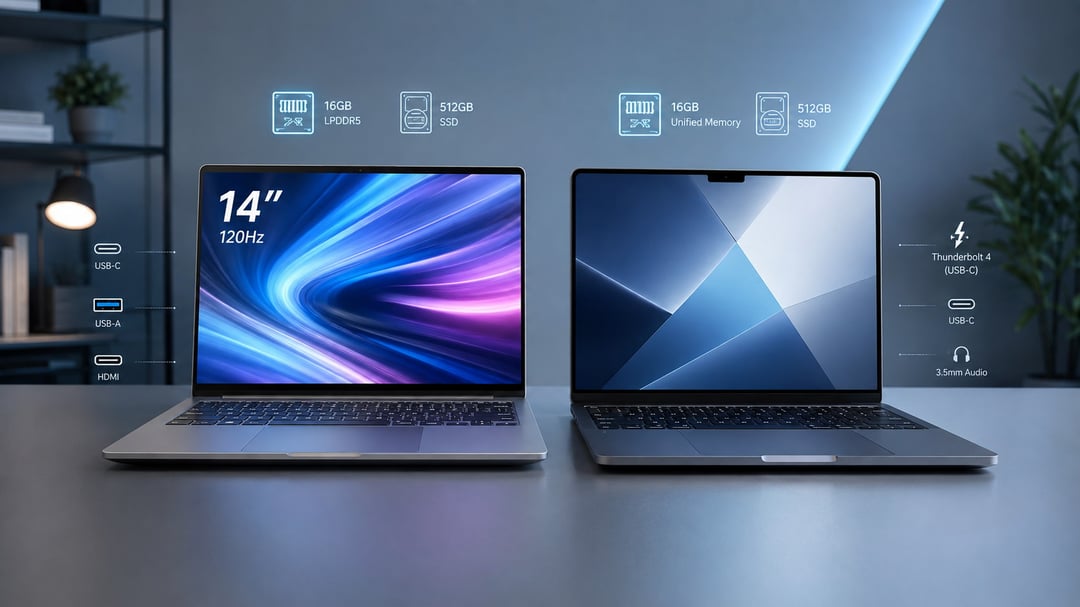
Acer has introduced a new Go Air configuration in China built around Intel’s recently released Core 5 320 processor. The model includes 12GB of LPDDR5 memory and a 512GB SSD, with a listed price of CNY 5,499, or roughly $815 after currency conversion.
Availability outside China has not been announced for this configuration. However, it appears nearly identical to the Acer Swift 14 shown during Computex 2026.
The Acer Go Air enters a segment where lower-cost Windows laptops are being measured against Apple’s MacBook Neo. Its specifications make the comparison especially close at the 512GB storage level, where Acer offers more memory, a 120Hz display, and a broader port selection.
Acer Go Air Configuration and Price
The new Acer Go Air uses an Intel Core 5 320 processor, 12GB of LPDDR5 memory, and a 512GB SSD. At its converted price of about $815, it sits above the entry price of Apple’s MacBook Neo.
Apple lists the MacBook Neo with 8GB of unified memory and 256GB of storage for $699. Upgrading the MacBook Neo to 512GB raises its price to $799, while memory remains at 8GB.
That leaves the two models close in price at the 512GB level. Still, the approximate $16 difference should not be treated as a direct retail comparison. Currency conversion, regional pricing, and taxes can all change the final cost.
|
Model
|
Memory
|
Storage
|
Listed or Converted Price
|
|
Acer Go Air
|
12GB LPDDR5
|
512GB SSD
|
CNY 5,499, roughly $815
|
|
MacBook Neo
|
8GB unified memory
|
256GB
|
$699
|
|
MacBook Neo
|
8GB unified memory
|
512GB
|
$799
|
Acer Go Air Display vs. MacBook Neo Display
The Acer Go Air has a 14-inch IPS display with a 1920 x 1200 resolution, a 120Hz refresh rate, and DC dimming. The MacBook Neo uses a smaller 13-inch IPS display with a 2408 x 1506 resolution. Apple rates the MacBook Neo display at 500 nits of brightness.
The two laptops offer different display strengths.
Apple’s panel has the advantage in resolution and pixel density. Acer’s screen reaches twice the maximum refresh rate, which affects scrolling, animations, and compatible games. The Go Air’s 120Hz refresh rate stands out on a relatively inexpensive productivity laptop.
Thunderbolt 4 and USB Port Differences
Port selection is another area where the Acer Go Air has a different approach from the MacBook Neo.
Acer includes:
- Two Thunderbolt 4 ports
- One USB-A port
The MacBook Neo has two USB-C ports. One supports USB 3 speeds of up to 10Gbps and DisplayPort. The other is limited to USB 2 speeds of 480Mbps. Apple officially supports one external display at up to 4K resolution and 60Hz.
On paper, the Go Air offers faster connectivity through its Thunderbolt 4 ports, along with a USB-A connection that the MacBook Neo does not include.
Acer Go Air Size, Weight, and Battery Claims
The Acer Go Air weighs 1.19kg, or about 2.62 pounds, and measures 12.99mm thick. The MacBook Neo weighs 2.7 pounds and is 12.7mm thick.
There is very little separating the two in terms of portability. Both are close in weight and thickness, making either one easy to carry in a backpack.
Acer fits a 70Wh battery into the Go Air and claims up to 19 hours of runtime. It also supports 100W USB-C charging, with Acer stating that the laptop can reach 50% charge in 30 minutes.
Apple uses a 36.5Wh battery in the MacBook Neo. Its stated battery ratings are up to 16 hours of video streaming or up to 11 hours of wireless web use.
These manufacturer claims are based on different testing methods. They should not be used as a direct battery-life comparison without proper testing.
Intel Core 5 320 Processor Details
The Acer Go Air is powered by Intel’s Core 5 320, a six-core Wildcat Lake processor built on Intel 18A. It includes:
- Two performance cores
- Four low-power efficiency cores
- Up to 4.6GHz turbo frequency
- Integrated graphics
- A 16-TOPS NPU
The Core 5 320 is not Intel’s highest-end processor. Its focus, like the MacBook Neo’s A18 Pro, is everyday computing rather than intensive productivity work.
For shoppers comparing specifications, the Acer Go Air uses its extra memory, 512GB SSD, Thunderbolt 4 connectivity, USB-A port, and 120Hz display to make its case against Apple’s lower-cost laptop.