
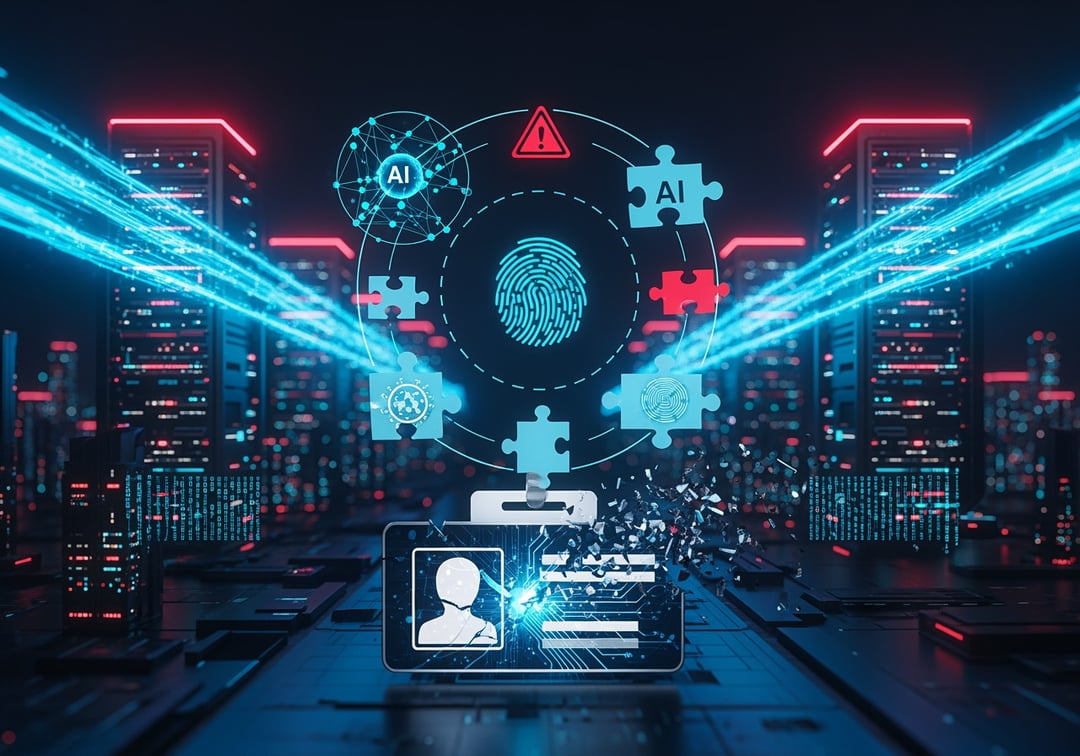
The “Era of Total Convergence” in Cybercrime
Something has shifted. And it’s not subtle.
Security researchers are calling 2026 the “era of total convergence” in cybercrime—a moment where artificial intelligence, identity theft, ransomware, and vulnerability exploitation aren’t separate problems anymore. They’re fused together.
According to the 2026 Global Threat Intelligence Report by Flashpoint, cybercriminal operations are now powered by agentic AI frameworks that can handle reconnaissance, generate phishing campaigns, test stolen credentials, and rotate infrastructure—all without human control.
Let that sink in.
We’re not just dealing with smarter attacks. We’re facing autonomous systems executing end-to-end cyberattacks at machine speed. It’s a high-velocity threat engine. And it lowers the barrier to entry for attackers while accelerating everything.
Four main factors are changing the types of threats we face:
- Autonomous AI systems executing full attack chains
- Identities becoming the primary exploit vector
- Vulnerabilities exploited within hours of disclosure
- Ransomware shifting to insider-enabled, identity-focused attacks
It’s convergence. Everything feeding everything else.
AI-Powered Cyber Attacks Are Scaling at Machine Speed
The numbers don’t whisper. They shout.
Flashpoint identified a 1,500% rise in AI-related illicit discussions between November and December 2025. That’s a jump from roughly 360,000 discussions to more than six million in a single month.
That kind of surge doesn’t happen casually.
What’s happening behind the scenes is automation. AI systems now:
- Generate phishing emails at scale
- Conduct reconnaissance across exposed assets
- Test massive credential dumps automatically
- Rotate malicious infrastructure to avoid detection
And because these tools don’t sleep, attacks don’t slow down. They iterate. Improve. Adapt.
The result? Cybercrime that moves at machine speed while most organizations still operate at human speed.
That mismatch matters.
Identity as the New Attack Surface: “Logging In” Instead of Breaking In
Here’s the uncomfortable truth: attackers don’t need to break down the door anymore.
They just log in.
In 2025 alone, researchers observed 11.1 million devices infected with infostealers, resulting in approximately 3.3 billion stolen credentials and cloud tokens.
Three point three billion.
And those credentials aren’t limited to corporate servers. The attack surface now includes:
- Employee browsers
- Personal devices
- SaaS platforms
- Third-party access points
- Cloud tokens and session cookies
Infostealers changed the game. Identity is no longer just a security layer—it’s the primary battlefield.
Instead of exploiting technical weaknesses alone, attackers are exploiting trust. Authorized access. Valid sessions.
If an attacker logs in with legitimate credentials, traditional perimeter defenses become almost irrelevant.
The Shrinking Window Between Vulnerability Disclosure and Exploitation
There used to be breathing room.
A vulnerability would be disclosed. Security teams would evaluate. Patch. Deploy.
That window is vanishing.
Researchers observed high-impact vulnerabilities being mass-exploited within hours of disclosure. Not days. Hours.
When AI automates scanning and exploitation workflows, the time between “public knowledge” and “active compromise” collapses.
And here’s what makes it worse: patch cycles in many organizations are still measured in weeks.
That gap—between disclosure and remediation—is where attackers thrive.
Ransomware’s Evolution: Insider-Enabled and Identity-Driven Attacks
Ransomware isn’t disappearing. It’s evolving.
Incidents rose by 53% in 2025, with Ransomware-as-a-Service (RaaS) groups responsible for more than 87% of attacks.
But encryption payloads alone aren’t the centerpiece anymore.
Modern ransomware operations are:
- Recruiting malicious insiders
- Abusing authorized access
- Using stolen login details
- Targeting identity systems
This shift makes detection harder. Because when attackers operate through valid accounts or compromised insiders, the activity can look legitimate—at least at first glance.
Ransomware is no longer just a malware problem. It’s an identity and access management problem.
How Businesses Can Stay Safe in the Age of AI-Driven Cybercrime
The threat landscape is accelerating. So defenses have to evolve too.
Flashpoint highlights several key actions organizations must prioritize:
Patch Vulnerabilities Immediately
Speed matters more than ever.
With vulnerabilities exploited within hours, delayed patching dramatically increases exposure. Rapid vulnerability management and automated patch deployment reduce the attack window.
Monitor for Stolen Credentials and Compromised Endpoints
Since identity is now central to attacks, businesses must actively monitor:
- Credential leaks
- Dark web marketplaces
- Compromised endpoints
- Suspicious login patterns
Credential exposure should trigger immediate containment measures, including password resets and token invalidation.
Strengthen Identity Security and Access Controls
Because attackers are logging in instead of breaking in, identity protection is critical. That means:
- Enforcing strong authentication controls
- Securing cloud tokens and session management
- Tightening third-party and SaaS access
Identity is no longer just an IT function. It’s frontline defense.
Combine Automated Detection with Human-Led Threat Intelligence
AI is powering attacks. But defense still benefits from human judgment.
Automated detection tools can identify anomalies at scale. Human-led threat intelligence adds context—spotting patterns, emerging tactics, and coordinated campaigns that machines might miss.
It’s not automation versus humans. It’s both.