
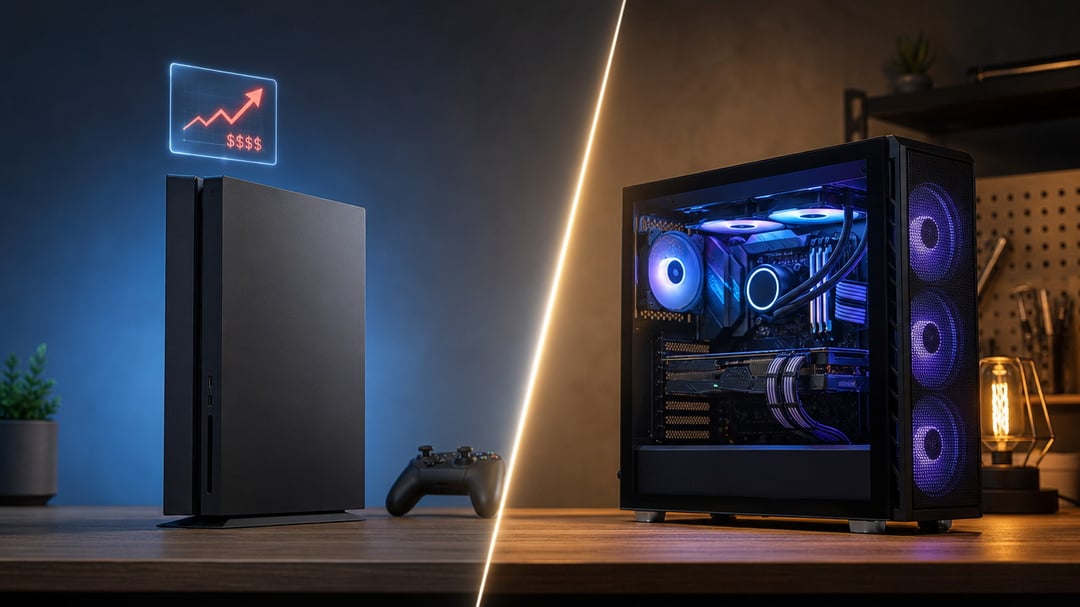
Microsoft just made the console argument a lot more complicated. On June 25, 2026, Xbox confirmed a worldwide price update effective August 1 that pushes the flagship Series X to $799.99 and lifts the Series S to $499.99 for the base 512GB model. It's the third Xbox price increase in about fifteen months and it breaks a rule console buyers used to take for granted: hardware is supposed to get cheaper as a generation ages, not more expensive.
That shift raises an obvious question for anyone shopping for a new gaming setup this summer. If a console now costs nearly $800, does a gaming PC finally make more financial sense? The honest answer is more nuanced than a simple yes or no.
The Xbox Price Hike, By the Numbers
The new Xbox pricing lands across the entire current-gen lineup. The 512GB Series S rises to $499.99 and the 1TB model climbs to $599.99. The digital-only 512GB Series X moves to $749.99 and the 1TB disc version tops out at $799.99. Microsoft is also discontinuing the 2TB Galaxy Black Special Edition entirely.
Microsoft has been unusually direct about the cause this time. According to the official Xbox Wire announcement, console storage and memory costs have climbed by more than two and a half times over the past several months and the company warns costs could double again before fall 2027. Consoles are typically sold at or near cost rather than for profit so a spike in the price of their most expensive component (memory) hits the sticker price almost dollar for dollar.
Xbox isn't the only platform absorbing this pain. Sony raised the PS5 to $649. Nintendo is lifting the Switch 2 by $50 to $499.99 in September. Valve pushed Steam Deck pricing up by as much as $300 on some configurations. Every current gaming platform is fighting the same battle.
The Memory Shortage Driving Every Price Tag in Gaming
None of this is really about consoles or GPUs specifically. It's about memory. AI data centers now consume a staggering share of global chip output and analysts at IDC estimate that share could reach 70% of memory production in 2026, up from roughly a quarter just a few years ago. When the world's most profitable companies are willing to pay premium prices for DRAM and NAND flash, consumer electronics simply lose the bidding war.
That same dynamic is squeezing PC builders too. Fixed-price GPU memory contracts expired at the end of 2025 and both AMD and Nvidia raised card prices in the months that followed. A gaming PC and a gaming console draw from the exact same shrinking pool of memory chips so neither one gets to sidestep the shortage.
What a Gaming PC Actually Costs Right Now
This is where the "just build a PC instead" advice runs into trouble. Mid-range graphics cards in the $300 to $800 range are projected to see another 10 to 25% price increase this year. RAM has been just as brutal, as tracked by Tom's Hardware: a 32GB DDR4 kit that cost $60 to $90 in October 2025 was going for $150 to $180 by January 2026.
Add it all up and analysts expect overall PC prices to climb somewhere between 4% and 20% in 2026 depending on the vendor and configuration. One builder's story sums it up well: a rig that cost $2,700 three years ago now runs roughly $5,500 to replicate. That's not a rounding error. It's a real shift in what PC gaming costs to get into.
So Which One Actually Wins?
The upfront numbers still favor the console in most cases. Even at $799.99, the Xbox Series X undercuts most gaming PCs capable of similar performance once you factor in current GPU and RAM pricing. Where the calculation gets interesting is total cost of ownership. A PC lets you upgrade one component at a time instead of replacing an entire box. It also opens the door to steeper game sales and skips any recurring subscription cost if you don't want one.
The console still wins on simplicity and upfront price. The PC still wins on flexibility and long-term value, assuming you're willing to spend more today to get it.
Frequently Asked Questions
Is the Xbox price increase permanent?
Microsoft hasn't announced a rollback and has warned memory costs could double again by late 2027 so relief in the near term looks unlikely.
Are gaming PCs cheaper than consoles right now?
Not for a comparable performance tier. GPU and RAM shortages have pushed PC build costs up alongside console prices so PCs remain the pricier upfront option in most cases.
When will component prices come down?
Analysts including Gartner and IDC point to 2027 or 2028 before new memory fabrication capacity meaningfully eases the shortage.