
On August 24, 1996, Gabe Newell and Mike Harrington signed the paperwork that created Valve, LLC. Both had just left Microsoft. Newell spent thirteen years there working on early versions of Windows and walked away with more than a million dollars of his own money. Harrington proposed putting that capital into games. The two had known each other since a birthday party in 1987. They opened an office in Kirkland, Washington, roughly five miles from Microsoft’s campus in Redmond.
Their personal savings fell short of what the new company needed. Sierra On-Line, a publisher based in the same state, stepped in with about a million dollars. In return Sierra claimed 30 percent of the revenue and every piece of intellectual property. Even after that deal the founders remained four million dollars short. Harrington sold his Microsoft shares to cover his portion. Newell refused to sell his and instead borrowed against them.
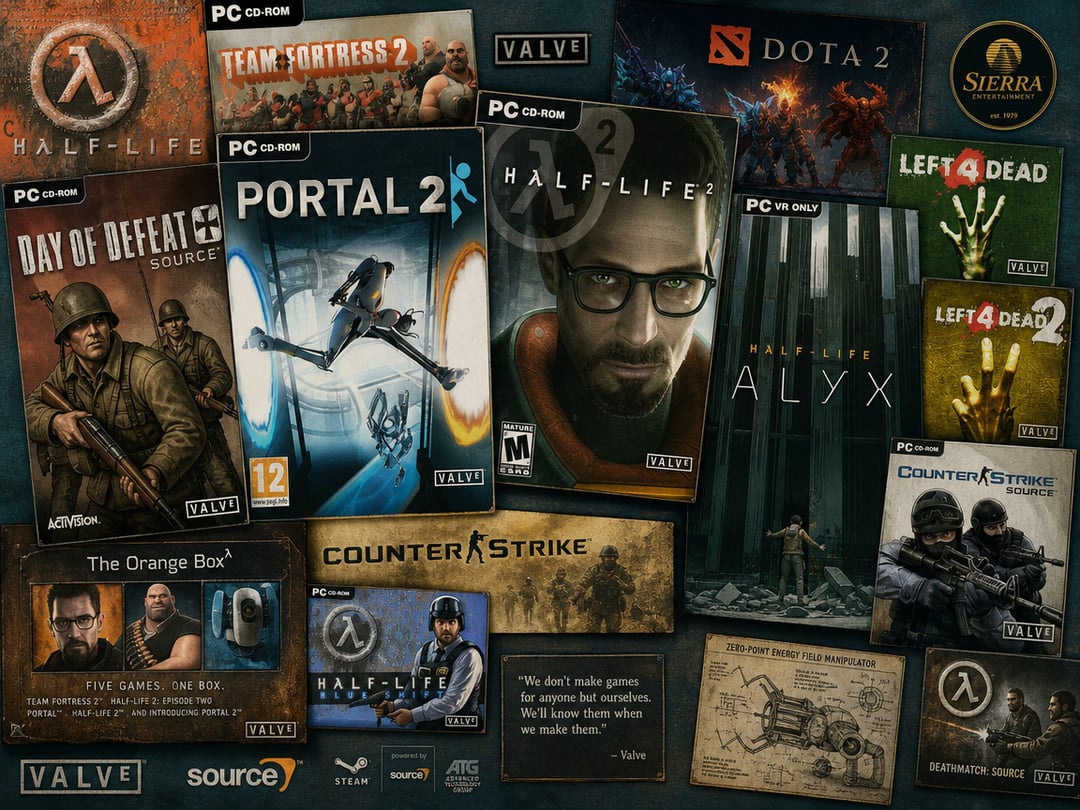
The risk began to pay off roughly two years later. Half-Life launched in November 1998 and moved 2.5 million copies in its first twelve months. Much of that success rested on the way the game told its story. Events unfolded around the player while movement continued instead of stopping for traditional cutscenes.
Five years after Half-Life, Valve released Steam. The platform started with a narrow purpose: delivering updates. Patches for titles such as Counter-Strike frequently broke the games for days at a time, so Valve built a system to push fixes more reliably. Over time Steam expanded into a full storefront that also sold games from other developers. Today the bulk of Valve’s revenue comes from Steam. The company takes a 30 percent cut of most titles sold through the service. Alinea Analytics estimates Steam grossed $11.1 billion in the first six months of this year.
Revenue at that scale enabled Valve to design its own hardware. The Steam Deck handheld arrived in 2022. This June the company introduced the Steam Machine, a compact living-room PC. The 512 GB model starts at $1,049. Valve settled on that price after a shortage of memory chips forced it to abandon its original pricing plan.