
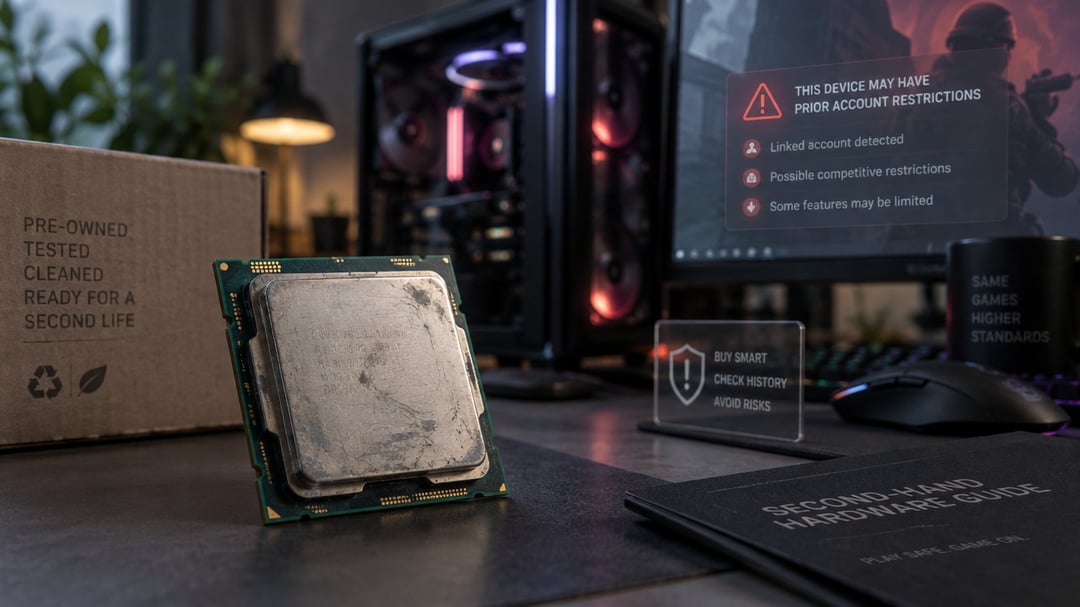
Hardware prices are higher than they've ever been, and gamers feel it even more. So hunting for secondhand parts makes sense. It also comes with the usual catch of used gear, which is no warranty. There's one more risk that's easy to miss: you could drop in a used upgrade, log into your favorite online multiplayer game, and find yourself banned on the spot.
How a Used Part Can Carry Someone Else's Ban
Anti-cheat systems for online games can flag individual PC parts, not just accounts. Picture a Valorant player who gets frustrated, runs a cheat program from a shady source, and gets his Riot account banned. Later he needs cash and sells his Nvidia graphics card on eBay to another Valorant player. She installs it, logs in with her own clean account, and gets banned right away.
That kind of thing has happened to a handful of players across different competitive multiplayer games. It's real, but it looks pretty rare.
A Recent Case: A Used Ryzen 7 5800X3D
The most recent example is a Reddit post from a German Valorant player. They bought a used Ryzen 7 5800X3D CPU, and it worked fine. The moment they logged into the game, they were banned.
Riot's support team told the player nothing would be done. It didn't stop at the processor, either. The player's other components, including the motherboard and storage, were also blacklisted in Riot's Vanguard anti-cheat system.
Why Anti-Cheat Can Tag Hardware
Modern anti-cheat software doesn't stop at your account or your IP address. It tags hardware too, down to individual components. Doing that takes fairly deep hooks into a PC's operating system and even its BIOS.
Reporting from Heise.de says Vanguard only runs when Secure Boot and a Trusted Platform Module are enabled. Requirements like these are part of why games such as Valorant still aren't available on Linux or SteamOS. Anti-cheat hardware checks, along with the occasional false positive after used hardware changes hands, have been reported for years.
Which Components Can Be Identified
Which checks each anti-cheat system actually runs isn't generally known. Still, with kernel-level tools in play, the software could technically identify:
- CPU
- Graphics card
- Motherboard
- SSD or hard drive
- Network adapter
- A specific operating system license
- Any combination of the above
Less invasive data points can also be used to "fingerprint" individual users beyond their accounts.
Little Guidance and Little Recourse
Riot, Valve, and Epic Games run Vanguard, Valve Anti-Cheat, and Easy Anti-Cheat, respectively. All three were asked three things: which hardware could be flagged, how buyers can avoid blacklisted parts on the secondhand market, and what an innocent buyer can do after a ban. None of them responded before publication.
The few cases from the past several years point the same way. Customer support is generally unwilling to lift bans that were applied through hardware ID.
How Likely Is This, Really?
Very unlikely. To run into it, you'd have to:
- buy a part secondhand from a cheater,
- who plays the same game, or at least a game from a company using the same anti-cheat system,
- and who has already been flagged by that system for cheating.
That's a tiny overlap. You're far more likely to end up with a part that doesn't work, or to fall for a more conventional scam.
Why It's Worth Knowing About Now
Sticker shock on gaming hardware, plus general economic anxiety, has the used market thriving more than usual. So the number of false positives has probably gone up, even if the share of used sales affected hasn't. And there's no real way to know whether a part has been flagged before you buy it, unless the seller chooses to say so.
So if a buddy admits to using an aimbot, think twice before picking up their secondhand parts when they upgrade.